
Team Collaboration Benefits That Actually Move the Needle
A collaboration problem rarely begins with unwilling people. It begins with fragmented context, unclear ownership, and tools that make shared work harder than individual work. Yet the case for fixing that friction is substantial: 73% of employees report better performance when they collaborate, while 60% say collaboration increases innovation, according to a workplace collaboration summary that connects these findings with Deloitte's 2018 research on digital collaboration (teamwork statistics and research summary). The important question isn't whether collaboration sounds beneficial. It's which kind of collaboration improves which kind of work.
What Team Collaboration Actually Delivers
A product team is spread across time zones. One person is refining the brief in a document, another is answering questions in Slack, and a third is waiting for a decision that nobody clearly owns. By Friday, everyone has been busy, but the team still can't say which version is final or why a key choice was made.
That familiar failure doesn't mean collaboration itself is ineffective. It means the team has confused activity with coordination. Collaboration produces value when people combine relevant knowledge, make decisions visible, and maintain a shared path toward an outcome. Without those conditions, more messages just create more places for work to disappear.
The strongest evidence supports collaboration as an operating choice, not a cultural slogan. A Stanford experiment found that people working collaboratively focused on tasks 64% longer than people working alone, while also reporting greater engagement, lower fatigue, and higher success rates (Niagara Institute summary of teamwork research). That finding matters because persistence is often the hidden constraint in difficult knowledge work. A group that stays engaged can notice problems an individual might abandon or postpone.
Practical rule: Collaboration earns its place when the work benefits from shared attention, not merely when a team has access to a chat channel.
The broader workplace evidence points in the same direction. The cited research links collaboration with stronger execution and more innovation, while tightly connected teams have been reported to complete projects 25% faster with 18% fewer defects than comparable siloed groups (teamwork effectiveness research). Those outcomes don't justify putting every task into a meeting. They justify designing collaboration around work that requires judgment, iteration, or combined expertise.
That distinction also explains why remote teams need deliberate practices for comunicazione team remoti. The aim isn't constant availability. It's reliable access to the context a person needs, at the moment they need it.
Five Research-Backed Benefits Worth Measuring
Team collaboration benefits matter only when they produce an observable change in how work is decided, developed, completed, or checked. A useful measurement plan connects each benefit to a mechanism, then tracks whether the signal improves without creating more coordination cost than value.
1. Better collective reasoning
Groups can combine different knowledge, assumptions, and areas of expertise. That combination improves judgment when contributors explain their reasoning and test one another's interpretations. One person may identify an overlooked constraint, another may examine its consequences, and a third may connect the issue to relevant past experience.
The strongest measure is not the number of people in the discussion. Track decision turnaround, revisions after approval, and the proportion of decisions reopened. Faster decisions are not automatically better. Repeated reopening, however, can indicate that the group missed a relevant perspective or approved a weak assumption.
2. More varied ideas
A diverse group expands the search space, but it does not guarantee better ideas. Contributors need room to offer different interpretations before the team narrows its options. A discussion involving a designer, customer-facing employee, engineer, and analyst may reveal separate problems in the same product experience.
Track qualified ideas generated, ideas tested, and concepts that survive evaluation. Raw suggestion counts reward volume, including ideas no one can use. A better signal is the number of distinct concepts that reach a real experiment or a planned improvement.
3. Greater persistence
Difficult work often stalls after the first plausible answer. A partner can challenge an assumption, propose another route, or help identify the next test when an initial attempt fails. This benefit is most relevant to troubleshooting, analysis, and learning tasks, where progress depends on repeated attempts and corrective feedback.
Measure completion rates for difficult tasks, stalled-work duration, and blocked items resolved without escalation. The target is intelligent continuation, not additional time spent together. For routine work with clear instructions, individual focus may produce a better result than adding another collaborator.
4. Faster completion
Parallel ownership can reduce delivery time when responsibilities divide cleanly. One person can prepare research while another develops the draft and a third checks dependencies. That advantage weakens when every small action requires a handoff, clarification, or approval.
Track cycle time, waiting time between handoffs, and the age of blocked tasks. Compare the full workflow, not just the number of contributors assigned. If additional people increase queues and approval delays, the team has added coordination cost instead of speed. Guidance on how to improve team productivity can help teams examine whether the constraint lies in workflow design rather than individual effort.
5. Stronger quality control
A second reviewer can detect omissions and errors that the original contributor no longer sees clearly. This applies to documents, code, operational checks, and decisions based on incomplete information. Review produces more value when the reviewer has a defined question, enough context, and sufficient independence to challenge the work.
Track defect rate, escaped errors, and the percentage of reviews that result in a meaningful correction. A review that approves everything may reflect excellent work, or it may show that reviewers are skimming. The metric should distinguish genuine confirmation from passive approval.
| Benefit | Supporting research | Metric to track |
|---|---|---|
| Collective reasoning | Workplace collaboration research links coordinated teamwork with stronger execution and innovation (research summary) | Decision turnaround and reopened decisions |
| Idea diversity | Collaboration gives contributors with different knowledge a way to examine the same problem from several angles | Qualified ideas tested |
| Persistence | Paired troubleshooting can keep stalled tasks moving and resolve blocked items without escalation (teamwork effectiveness research) | Difficult-task completion and stalled-work duration |
| Speed | Parallel ownership can reduce waiting when responsibilities are genuinely separable | Cycle time and handoff delay |
| Quality | Independent review creates another opportunity to identify omissions and defects | Defect rate and escaped errors |
These measures also expose where collaboration oversells itself. Shared work should expand reasoning, maintain progress, or reduce avoidable errors. For tasks requiring uninterrupted concentration, adding meetings or handoffs can lower performance, so individual focus remains the more efficient operating choice.
How Different Audiences Experience These Benefits
The same collaboration mechanism can look entirely different depending on the people involved. Shared context helps a family coordinate a weekend, while students use explanation to expose gaps in understanding. A small business needs rapid cross-role decisions, and digital nomads need work that survives the clock.
Families
A shared calendar, grocery list, and meal plan can prevent two people from buying the same ingredients or discovering too late that nobody planned dinner. The measurable signal is not a workplace productivity score. It's fewer duplicated purchases, fewer last-minute messages, and less time spent reconstructing the plan.
Students
Two students preparing for a statistics exam might trade problem sets. One solves a question, while the other explains why the method works and identifies where the first student made a wrong assumption. That exchange combines retrieval, explanation, and immediate correction. A useful measure is the number of problems each student can solve independently after the session.
Small businesses
A four-person bakery adding delivery services needs the baker, order coordinator, driver, and customer contact to share the same operational picture. A short daily check can reveal that a menu item is unavailable before the customer receives a promise, while a named owner prevents every employee from assuming someone else handled the route.
Digital nomads
A developer in Lisbon and a colleague in Bangkok can preserve momentum with a clearly documented issue, a visible decision log, and a handoff that states what changed and what remains. They don't need to overlap for every task. They need the next person to find the latest source of truth without restarting the investigation.
Collaboration works across lifestyles when people share the right context, not when they imitate the same schedule.
A clear collaborative decision-making process helps each audience decide which choices need discussion and which can stay with one owner. That distinction protects both coordination and personal time.
When Collaboration Helps and When It Does Not
A recent synthesis of remote-work evidence reports that fully remote work can be 10% to 20% less productive for collaborative work and onboarding, while focused individual tasks can be 10% to 15% more productive (remote work trends synthesis). These figures point to a task-fit problem. The work mode that supports shared problem-solving can interrupt work that depends on sustained concentration.
A design brainstorm usually gains from collaboration because the problem is ambiguous and alternative ideas have value. Several people can explore different directions before the team commits. This approach works when the cost of reviewing options is lower than the cost of choosing a weak direction early.
Financial audits require a different arrangement. Multiple reviewers can strengthen checks at defined control points, yet too many editors working in the same calculations can create version confusion and blur accountability. One person can own the working file while independent reviewers examine it at agreed stages.
Software refactoring often rewards uninterrupted focus. A developer needs time to understand dependencies and preserve the system's logic. A shared pull-request process can catch errors after the refactor, while continuous commentary during the work can fragment the reasoning required for accuracy.
A 2025 field experiment on generative AI adds another consideration. Human collaboration improved output quality compared with individuals working alone, while technology augmented rather than replaced teamwork. The practical question is which parts people should solve together, and which parts technology or individual focus should handle.
| Task type | Best approach | Why | Typical examples |
|---|---|---|---|
| Ambiguous and exploratory | Collaboration first | Multiple perspectives widen the search | Design concepts, product discovery |
| Structured and reviewable | One owner with independent checks | Clear ownership limits version confusion | Financial audits, compliance reviews |
| Deep and sequential | Solo focus with scheduled review | Uninterrupted concentration protects coherence | Refactoring, analysis, long-form writing |
| Iterative and interdependent | Small collaborative group | Frequent feedback prevents late rework | Launch planning, incident response |
The distinction is useful because collaboration has coordination costs. Each added reviewer, comment, or handoff can consume attention without improving the result. Teams should compare the value of another perspective with the time and ambiguity it introduces.
Decision rule: Collaborate when a task needs multiple perspectives, repeated iteration, or pooled accountability. Choose focused individual work when concentration, clear ownership, or rapid execution matter more.
Teamwork creates value under the right conditions. Treating it as the default can reduce the quality it is meant to improve.
Building a Collaboration Setup People Trust
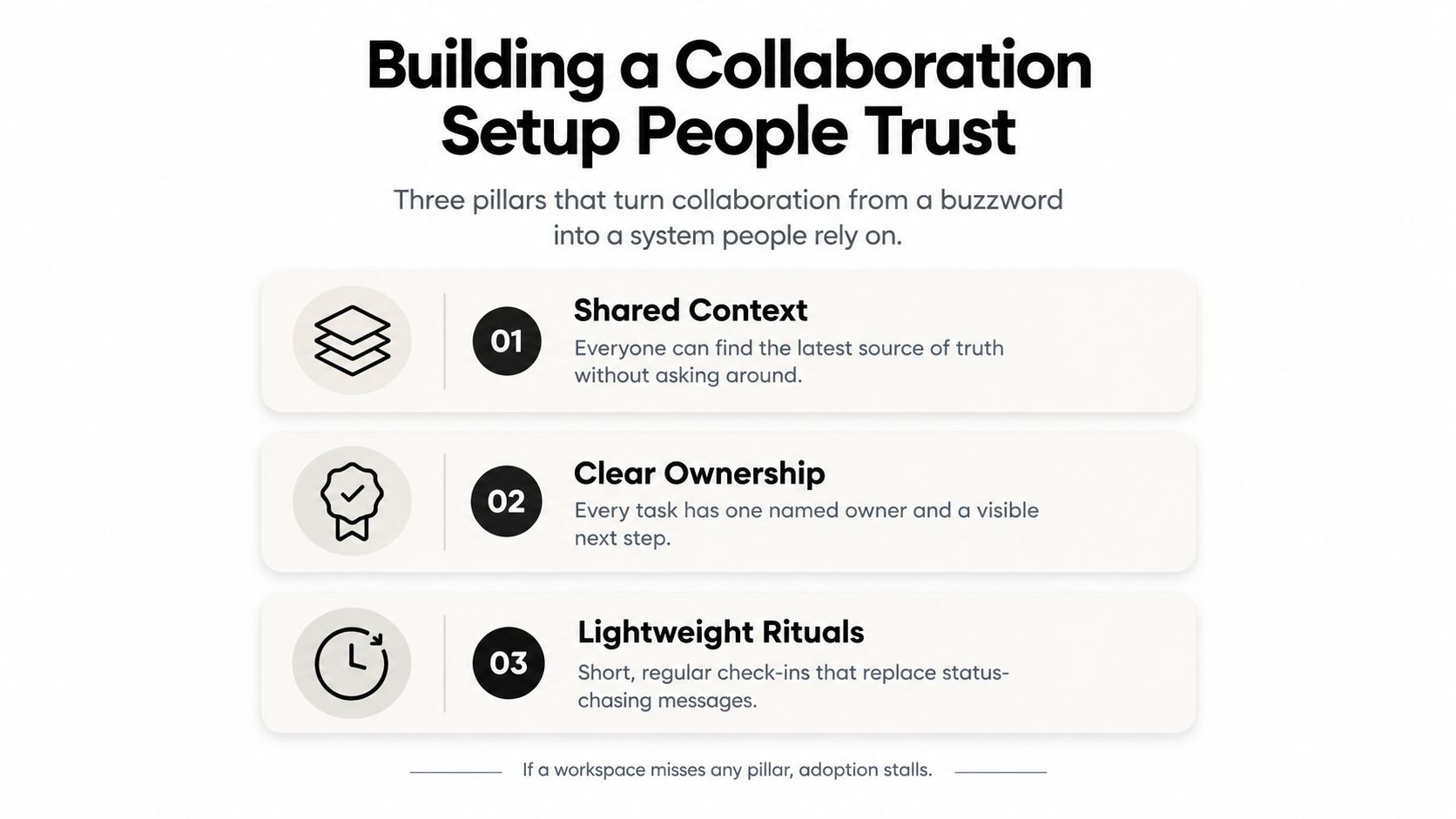
People adopt shared workspaces when the system answers three questions without creating another meeting. Where is the current information? Who owns the next move? What can each person access?
Shared context
A collaboration space needs one recognizable source of truth. Teams should use predictable names, archive obsolete versions, and place decisions near the work they affect. If contributors must ask where the latest brief lives, the workspace is storing files but not providing context.
Clear ownership
Every deliverable needs one named owner, even when several people contribute. Ownership doesn't mean doing every task. It means someone is responsible for defining the next step, resolving ambiguity, and confirming completion. This prevents shared responsibility from becoming invisible responsibility.
Lightweight rituals
A short recurring check-in can surface blockers without turning every update into a live meeting. A shared agenda, concise decision log, and clear escalation path often provide more value than a stream of status messages. Teams can adapt these practices when choosing remote collaboration tools.
Security determines whether the setup remains trustworthy as participants change. Role-based controls, audit trails, and encryption in transit help teams share information with clients, vendors, contractors, or family members without giving everyone unrestricted access. Access should match the work, and it should be easy to remove when the work ends.
External support can also help maintain orderly workflows when internal contributors are stretched. For example, teams evaluating Lathire virtual assistants should apply the same standards for ownership, permissions, and documented handoffs as they would to internal roles.
The goal is unremarkable reliability. When people can find information, understand responsibility, and trust access controls, they stop spending attention on the collaboration infrastructure itself.
Where AccountShare Fits Into the Collaboration Picture
Shared resources are one of the clearest forms of collaboration. A family can coordinate access to a service, a student group can share a relevant tool, and a small business can give contributors access to software without asking every person to purchase or manage a separate subscription.
AccountShare fits this use case through a centralized hub for shared accounts. Its model supports group purchasing, shared access, member invitations, payment tracking, password sharing options, and customizable permissions. Those functions turn a pooled subscription from an informal arrangement into an access system with visible participants and defined controls.
The operational benefit is more important than the purchasing mechanism itself. New members can receive access through an established group setup rather than receiving a personal password in an untracked message. When someone leaves, administrators can manage that member's access instead of hunting through old conversations to determine which credentials were shared.
Security remains the boundary condition. AccountShare's described controls include encrypted credential handling and granular administration, which can help groups avoid circulating personal passwords or losing visibility into access. That doesn't remove the need for sensible group policies. Administrators still need to decide who should have access, which permissions are necessary, and when access should be revoked.
The broader lesson is that collaboration depends on more than communication. People also need shared capability, meaning access to the tools, information, and resources required to complete the work. A pooled-access model can support that capability when it preserves ownership and visibility rather than treating account sharing as an informal shortcut.
For a small team, family, student group, or digital nomad, the useful test is simple: can every participant understand what they can use, what they can change, and who manages the shared resource? If the answer is yes, shared access becomes part of the collaboration design rather than a separate security risk.
Common Pitfalls That Quietly Erase the Gains
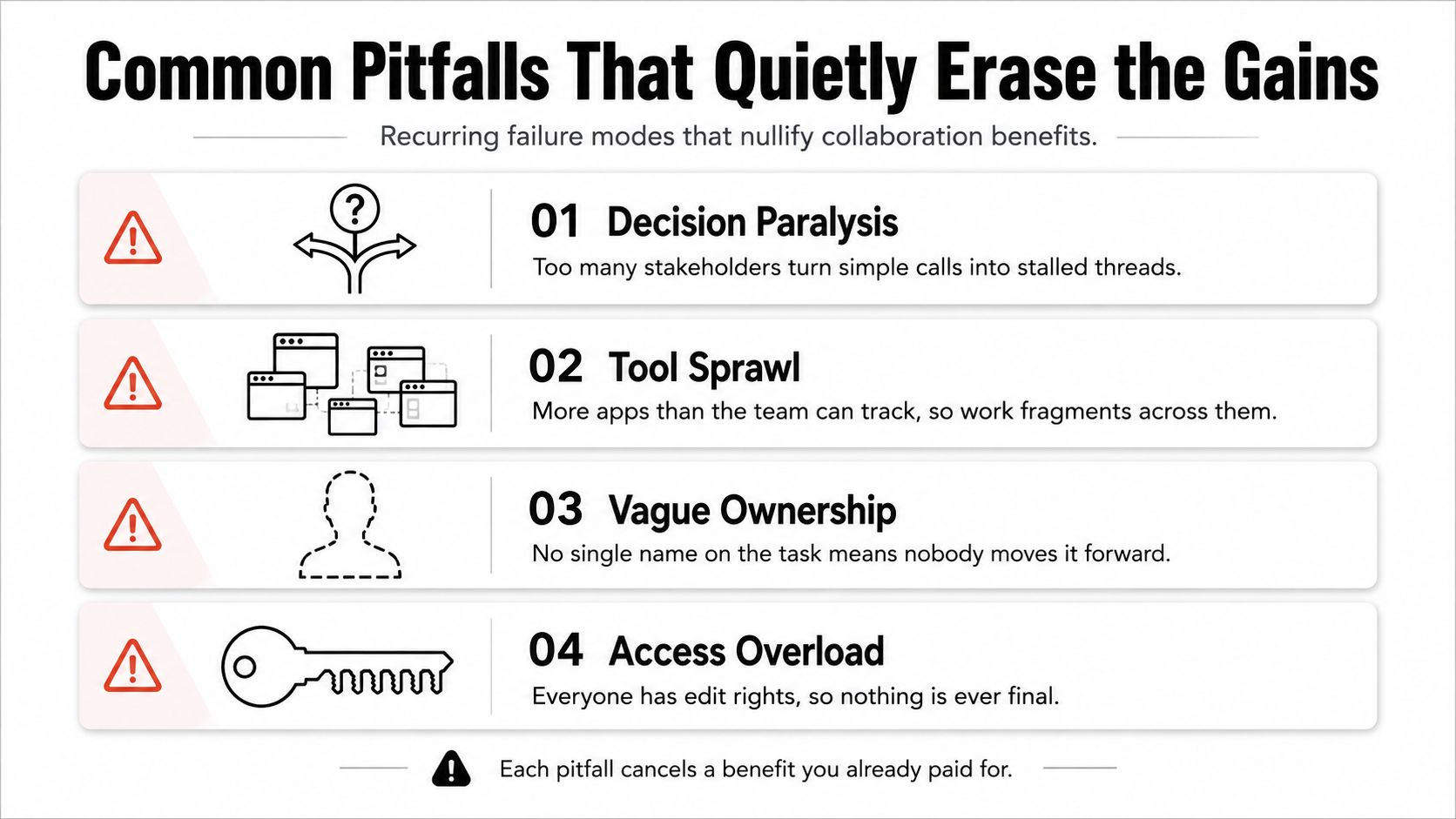
Collaboration often fails gradually. A team adds one more stakeholder, one more app, and one more shared folder until the original benefit becomes difficult to see.
Use these questions as a quick audit:
- Decision paralysis: Does a routine decision need input from people who won't implement or own it?
- Tool sprawl: When did the team last retire a tool instead of adding another one?
- Vague ownership: Can every contributor name the person responsible for moving this deliverable forward?
- Notification overload: Can people protect uninterrupted focus without appearing unavailable or unresponsive?
- Access drift: Does each person's current permission still match their role and current work?
The danger isn't that any single issue makes teamwork impossible. The danger is that each issue adds a small delay, duplicated action, or interruption. Over time, contributors begin working around the system, keeping private copies, bypassing review, or using direct messages that others can't search.
Access deserves particular attention because convenience tends to expand permissions while accountability stays fixed. A shared workspace should make the safe action easy, with clear roles, visible ownership, and a regular review of who can see or edit what.
A healthy collaboration audit doesn't ask whether people are committed enough. It asks where the system creates avoidable effort.
Putting It All Together This Week
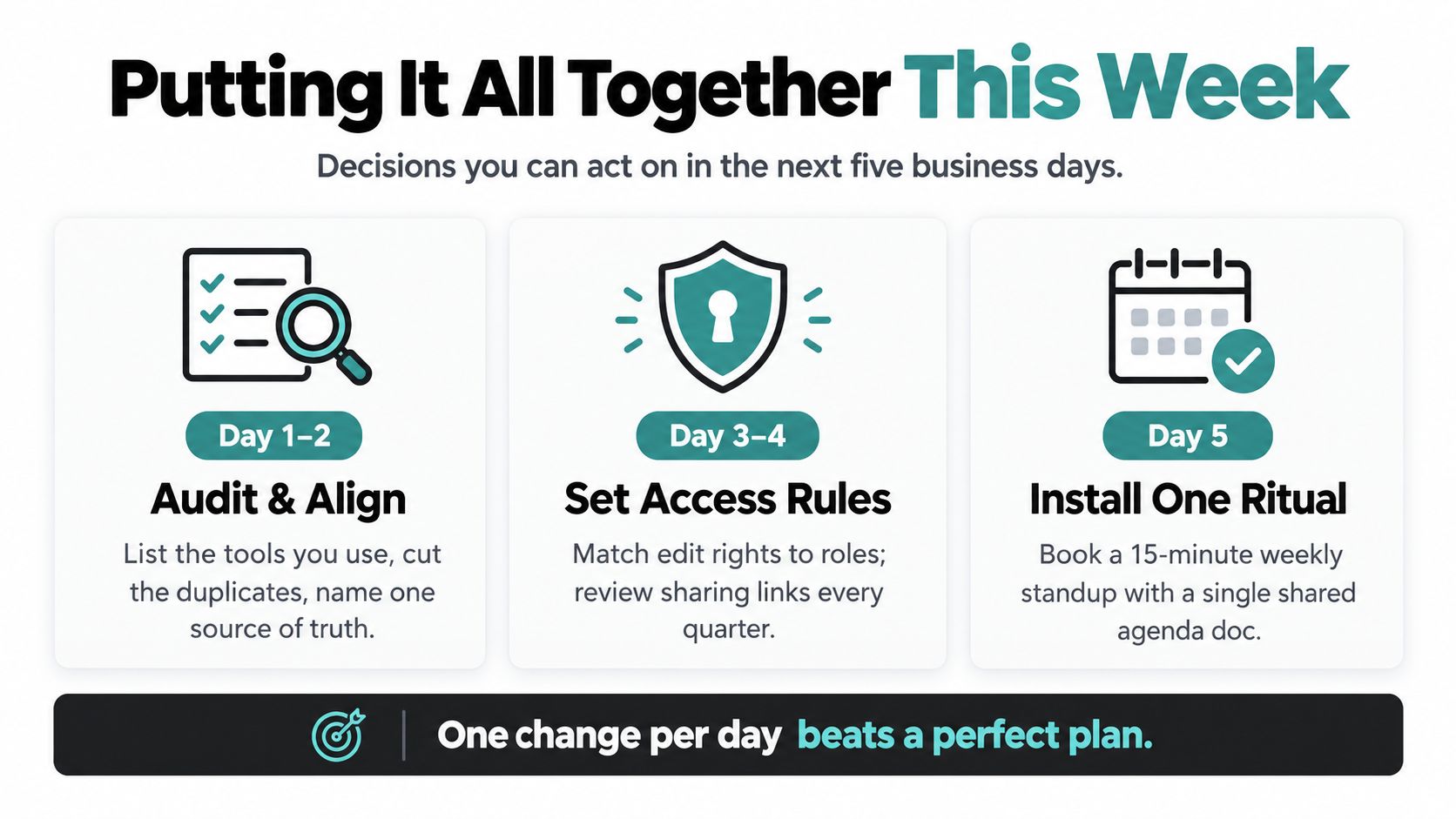
Use the next five business days as an operating review, not a culture initiative. Begin with the bottleneck that slows current work. Measure decision turnaround when choices stall, defects when review misses errors, and cycle time or blocked-task age when handoffs create waiting.
Days one and two
Create an inventory of tools for messages, files, tasks, decisions, and access. Mark duplicates, select one source of truth for each workstream, and assign an owner to every tool that stays. A smaller stack is useful only if contributors can find the current work without checking multiple locations.
Days three and four
Write the access policy in plain language. Specify who may view, comment, edit, administer, or invite others. Record how long access lasts and who revokes it after a role changes. Review shared links and dormant accounts, then store each decision where administrators can retrieve it.
Day five
Add one lightweight ritual. A short weekly standup with a shared agenda can cover progress, blockers, decisions, and owners. Keep updates asynchronous when discussion is unnecessary. Protect focus blocks for work that benefits from uninterrupted individual concentration.
The evidence supports a task-fit model. Collaboration can strengthen persistence, quality, and innovation, while focused individual work can suit tasks that require little coordination. The task-fit evidence from earlier in this article supports assigning collaboration deliberately and protecting solo execution with equal care. A productive team measures both outcomes, rather than treating more interaction as automatic progress.
AccountShare provides a centralized way to organize shared account access, manage members, track payments, and apply permissions for group purchasing. Visit AccountShare to assess whether shared access can provide resources for a team, family, or study group without adding unmanaged password sharing to the workflow.