
Is Tidal Better Than Spotify a Head-to-Head Comparison
So, is Tidal actually better than Spotify? Honestly, it's not a simple yes or no. The right answer really boils down to what you care about most when you hit play.
If you're an audiophile with a serious audio setup—we're talking high-end headphones and a DAC—then yes, Tidal's superior sound quality makes it the hands-down winner. But if your priority is discovering new music, sharing playlists with friends, and having an app that just works everywhere, Spotify still holds the crown for most people.
Tidal vs Spotify: The Quick Verdict
Picking a streaming service can feel like choosing a team. You've got Spotify, the giant in the room, known for its massive user base and an algorithm that uncannily predicts your next favorite song. Then you have Tidal, which has always put artists and high-fidelity audio at the forefront of its mission.
The choice really hinges on what you want out of your daily listening. Are you chasing the pure, uncompressed sound of a studio recording, or do you just want a seamless way to find great tunes and create the perfect workout playlist?
This guide cuts through the noise. We're going beyond the basic feature lists to give you the real-world context you need to decide which service fits your life.
Tidal vs Spotify at a Glance
Before we get into the nitty-gritty of audio codecs and exclusive content, let's start with a high-level look. This quick comparison table lays out the core DNA of each platform, showing you where they shine.
| Feature | Tidal | Spotify |
|---|---|---|
| Best For | Audiophiles & music purists | Casual listeners & music explorers |
| Max Audio Quality | HiRes FLAC (up to 24-bit, 192 kHz) | Ogg Vorbis (up to 320 kbps) |
| Music Discovery | Human-curated playlists & artist radio | World-class algorithmic recommendations |
| Unique Content | Exclusive music videos & artist content | Extensive podcasts & audiobook library |
| Social Features | Limited, artist-focused | Strong, with shared playlists & Blend |
| Artist Payouts | Higher per-stream rate | Lower per-stream rate |
Think of this table as your starting point. Now, we’ll dig deeper into each of these areas to help you figure out which service truly speaks to you.
The Battle for Best Audio Quality
If you ask anyone, "Is Tidal better than Spotify?" the conversation almost always lands on one thing: audio quality. This is Tidal's whole identity, the foundation of its reputation as the go-to service for serious music lovers and audiophiles. They built their brand on delivering high-fidelity, lossless audio that keeps all the detail from the original studio recording.
Tidal’s HiFi and HiFi Plus tiers stream music using FLAC (Free Lossless Audio Codec). Unlike the compressed audio most of us are used to, FLAC doesn't throw away data to save space. For those with the right audio setup, the difference is night and day. It’s like watching a movie in stunning 4K versus standard definition—the story is the same, but the clarity, depth, and detail are in a completely different league.
Will You Actually Hear the Difference?
Here's the real talk, though: the tech is only half the story. Whether you can actually hear the benefits of lossless audio depends entirely on your gear and where you're listening.
- Casual Listening: Let's be honest. If you're mostly streaming with standard Bluetooth earbuds during a noisy commute, the subtle details of lossless audio are going to be completely lost. In this scenario, Spotify’s highest quality setting (320 kbps Ogg Vorbis) is perfectly fine.
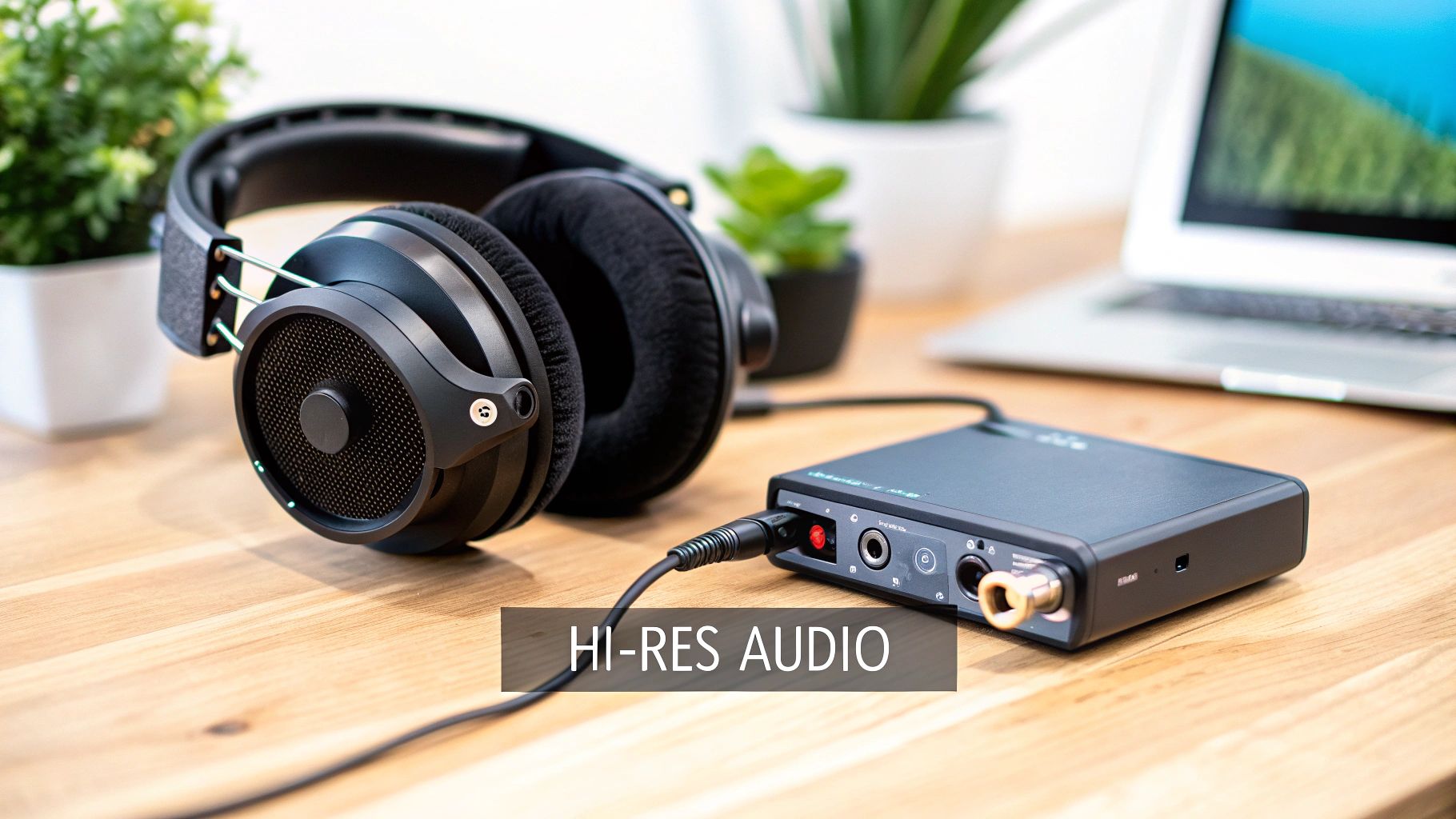
- Dedicated Listening: Now, if you've got a pair of quality wired headphones, an external DAC (Digital-to-Analog Converter), and a quiet space to really listen, that’s where Tidal shines. You’ll start to hear a richer, more detailed soundstage. Subtle instrumental layers and crisp vocals that get a bit muddy on compressed streams will suddenly come to life.
Tidal’s edge isn't just standard lossless audio. The real knockout punch is its HiFi Plus tier, which delivers HiRes FLAC files all the way up to 24-bit/192 kHz. It also includes immersive formats like Dolby Atmos and Sony 360 Reality Audio, creating a genuine surround-sound experience that Spotify can't match.
For a long time, this was an easy win for Tidal. But the gap has narrowed recently. Spotify finally started rolling out its own lossless audio to Premium subscribers in some regions, offering up to 24-bit/44.1kHz FLAC streaming. This was a monumental move, especially when you consider Spotify's user base is roughly 14 times larger than Tidal's, making a feature rollout like this incredibly complex.
The Verdict on Sound
For the average person listening on the go, Spotify's audio quality is fantastic and more than enough for daily enjoyment. But for the discerning audiophile, Tidal is still the undisputed champion.
If you've spent good money on audio gear, Tidal's lossless and hi-res options will let you wring every last drop of performance out of your hardware. This is particularly true if you're curious about spatial audio, which is a core feature of Tidal's premium experience but completely absent on Spotify. It's also worth remembering that other high-end services prioritize this, too, as you'll see in guides like the one on the Qobuz family plan. Ultimately, understanding how to enhance audio quality from the production side gives you a much greater appreciation for what these high-fidelity services are preserving in the first place.
Finding Your Next Favorite Song
Sure, audio quality is a huge deal, but what really makes or breaks a music streaming service is how well it helps you find new songs you actually love. This is where the conversation shifts from technical specs to something far more personal. The real question is, how do you like to find new music? Do you trust a powerful algorithm that seems to read your mind, or do you prefer recommendations from real, in-the-know music experts?
This is the core difference between Spotify and Tidal's discovery philosophies. Spotify has built its reputation on a data-driven powerhouse of an algorithm, using its massive user base to fuel some of the best recommendation engines out there. It's the secret sauce behind iconic playlists like Discover Weekly and Release Radar.

Spotify's Algorithmic Dominance
Spotify's algorithm is, without a doubt, its crown jewel. It learns from the listening habits of hundreds of millions of people worldwide. Holding a global market share somewhere between 31.7% and 37%, the platform has an almost unbelievable amount of data to work with, which is why its suggestions can feel spookily accurate. You can dive deeper into these music streaming industry trends on explodingtopics.com.
The system analyzes what you play, what you skip, and what you save. It then finds other users with similar tastes and uses their listening history to predict what you’ll want to hear next. This makes Spotify incredibly good at finding artists and tracks that fit right into your established comfort zone. If you're deep into a niche subgenre, Spotify will keep the new-to-you hits coming.
Tidal's Human-Centric Curation
Tidal takes a different route, putting its faith in human curation. Yes, it has its own algorithm-generated "My Mix" playlists, but its discovery engine truly shines through its editorial content. The platform is filled with playlists and features curated by music journalists, industry insiders, and even the artists themselves.
This approach often leads to more left-field, serendipitous finds. You might stumble upon a playlist from your favorite producer that reveals their biggest influences or read an editorial deep-dive into an emerging scene that pushes your musical boundaries. It’s a more intentional, magazine-like experience.
Tidal's discovery feels like getting recommendations from a friend with impeccable taste who works at a record store. Spotify's feels like a brilliant AI assistant that has perfectly mapped your musical DNA. Neither is inherently better; they just serve different discovery needs.
So, when deciding if Tidal is better than Spotify for you, it really comes down to how you prefer to explore.
- Choose Spotify for predictable excellence: If you want a dependable, endless stream of new music that you're almost guaranteed to enjoy, Spotify’s algorithm is unbeatable. It’s perfect for listeners who know what they like and just want more of that good stuff.
- Choose Tidal for unexpected gems: If you love the thrill of stumbling upon something completely different and appreciate the context that human experts provide, Tidal’s curated approach offers a richer experience that can broaden your horizons in surprising ways.
A Look at the Music and Podcast Libraries
At first glance, Tidal and Spotify seem to be on equal footing. Both platforms boast a staggering 100 million+ tracks, but that number is where the similarities end. The real difference isn't in the quantity but in the philosophy behind their catalogs, and that's what will make one a perfect fit and the other a constant frustration.
Tidal has built its entire brand around a deep respect for music culture. It sets itself apart with a huge library of high-definition music videos—something Spotify has mostly moved away from. If you're the kind of fan who loves to watch the visuals that go with an album, Tidal delivers a much more complete experience. This artist-first approach also shows up in their exclusives, with a history of landing early album releases and behind-the-scenes content straight from the creators.
The "Everything Audio" Approach
Spotify, on the other hand, has made a hard pivot to become the go-to app for all things audio. Music is still the main event, of course, but the company has poured billions into dominating the podcast and audiobook space. This strategy has turned Spotify into a true one-stop shop.
If you jump from a morning news podcast to a focus playlist at work, then unwind with an audiobook at night, Spotify’s all-in-one library is just plain convenient. There’s no need to juggle different apps. Tidal does have some podcasts, but they feel like an add-on, not a central part of the experience.
For the music purist, Tidal's dedication to video content and artist-centric exclusives makes it a more compelling package. For the listener who wants everything audio in one place, Spotify's massive investment in podcasts and audiobooks makes it the undeniable champion of convenience.
Where the Money and Curation Go
There’s another key difference happening behind the scenes: how artists are paid. Tidal has consistently been recognized for offering one of the highest per-stream payout rates in the business. If you care deeply about financially supporting the musicians you listen to, this could easily be a deciding factor. As you weigh the massive libraries, it's also interesting to see how artists navigate this world; many guides explain how to promote music online to stand out in a crowded field.
So, when it comes to the library, who wins? It really comes down to your listening habits. Are you after a service that celebrates the art of music with high-quality videos and special releases? Or do you just want a single, reliable app for every song, podcast, and book you could ever need?
Breaking Down the Price and Plans
Beyond the flashy features and massive music catalogs, it all boils down to one simple question: What will this actually cost me, and is it worth it? For a lot of people, the final verdict in the Tidal vs. Spotify debate comes down to the price tag. Both services have a similar tiered structure, but what you get for your money is where they really start to show their true colors.
At first glance, they look almost identical. Both Tidal and Spotify offer their standard individual plans for $10.99 per month, which gets you the essentials: no ads, unlimited skips, and offline listening. But right here, at the most basic level, is a massive difference. For that $10.99, Tidal gives you HiFi quality—that’s CD-quality, 16-bit/44.1 kHz FLAC audio. Spotify, on the other hand, maxes out at 320 kbps.
Monthly Subscription Plan Comparison
Let's break down the pricing and features side-by-side to see what you're really paying for with each service.
| Plan Type | Tidal Price & Features | Spotify Price & Features |
|---|---|---|
| Individual |
$10.99/month Includes HiFi, Master Quality Audio (MQA), Dolby Atmos, and Sony 360 Reality Audio. Ad-free listening, offline downloads. |
$10.99/month Includes standard 320 kbps audio quality. Ad-free listening, offline downloads, and 15 hours/month of audiobook access. |
| Student |
$5.99/month All the features of the Individual plan for verified students. |
$5.99/month All the features of the Individual plan, plus access to a Hulu (With Ads) subscription. |
| Family |
$16.99/month Up to 6 accounts. Each member gets the full HiFi Plus feature set. |
$16.99/month Up to 6 accounts. Each member gets a standard Premium account, plus Spotify Kids app and parental controls. Primary account holder gets audiobook access. |
As you can see, the value proposition changes depending on your priorities. For students, Spotify's Hulu bundle is a compelling perk. For families, the choice is between pure audio quality and family-friendly features.
A Closer Look at Family and Student Plans
If you need more than just one account, the Family and Student plans are where you'll find the most bang for your buck.
-
Student Plans: Both services offer a steep discount for verified students, coming in at $5.99 per month. While Tidal gives students the full high-res audio experience, Spotify throws in a Hulu (With Ads) subscription, which is a pretty sweet deal for entertainment lovers. It’s a toss-up, depending on what you value more.
-
Family Plans: Here’s where the priorities really diverge. Tidal’s Family plan is $16.99 per month for up to six people, and every single person gets the full HiFi Plus experience. Spotify’s Family plan costs the same at $16.99 per month for six accounts but adds practical tools like parental controls and the separate Spotify Kids app.
The decision for families really comes down to audio quality versus practical features. Tidal gives every family member a top-tier listening experience for a great price. Spotify leans into its identity as an "all-in-one" audio platform by providing family-management tools and bundling audiobooks for the main account holder.
Smart Ways to Save on Subscriptions
Let's be real, even these monthly fees can add up. That's why a lot of savvy listeners have found creative ways to cut costs. One of the most popular methods is using a group-purchasing platform like AccountShare. These services let you legally and securely split the cost of a Family plan with others, dramatically lowering your individual price without giving up any premium features.
If you're curious about how this works, checking out a guide on how much Spotify Premium Family costs can show you just how much you can save. This kind of approach makes high-end audio services much more accessible, letting you enjoy high-fidelity music or ad-free podcasts for just a few dollars a month. It completely changes the conversation from "which service is cheaper?" to "how can I get the best value for my budget?"
So, Which Streaming Service Should You Choose?
Alright, let's get down to it. Is Tidal better than Spotify? The honest answer is... it depends entirely on you. There's no single winner here. The best service is the one that fits how you listen to music.
To make this easier, I've broken it down into a few common listener types. See which one sounds most like you.
For the Audiophile
If you've spent good money on high-quality headphones, a DAC, or a serious home stereo system, the choice is pretty simple: Tidal is your service. It's built from the ground up for high-fidelity sound.
When you're really listening—not just putting on background noise—the difference in clarity and detail with Tidal's lossless and Hi-Res streams is undeniable. You'll actually get to hear what your expensive gear is capable of.
For the Music Explorer
Are you constantly on the hunt for your next favorite band? Do you live for discovering new tracks? If so, Spotify’s algorithm is still the king of the hill.
Its Discover Weekly and Release Radar playlists are legendary for a reason; they just work. They have an almost spooky ability to figure out what you'll love. While Tidal has some great human-curated playlists, Spotify’s massive data engine serves up a near-perfect, personalized stream of new music with zero effort.
For the All-in-One Listener
If you want one app to handle absolutely everything—your music, your podcasts, and now even your audiobooks—Spotify is the practical choice. They've poured a ton of resources into becoming a one-stop audio shop.
For sheer convenience, nothing beats having all your listening in a single, integrated library. If you value a streamlined experience over anything else, Spotify delivers.
This decision tree gives you a quick visual on how to pick a plan based on what matters most to you.
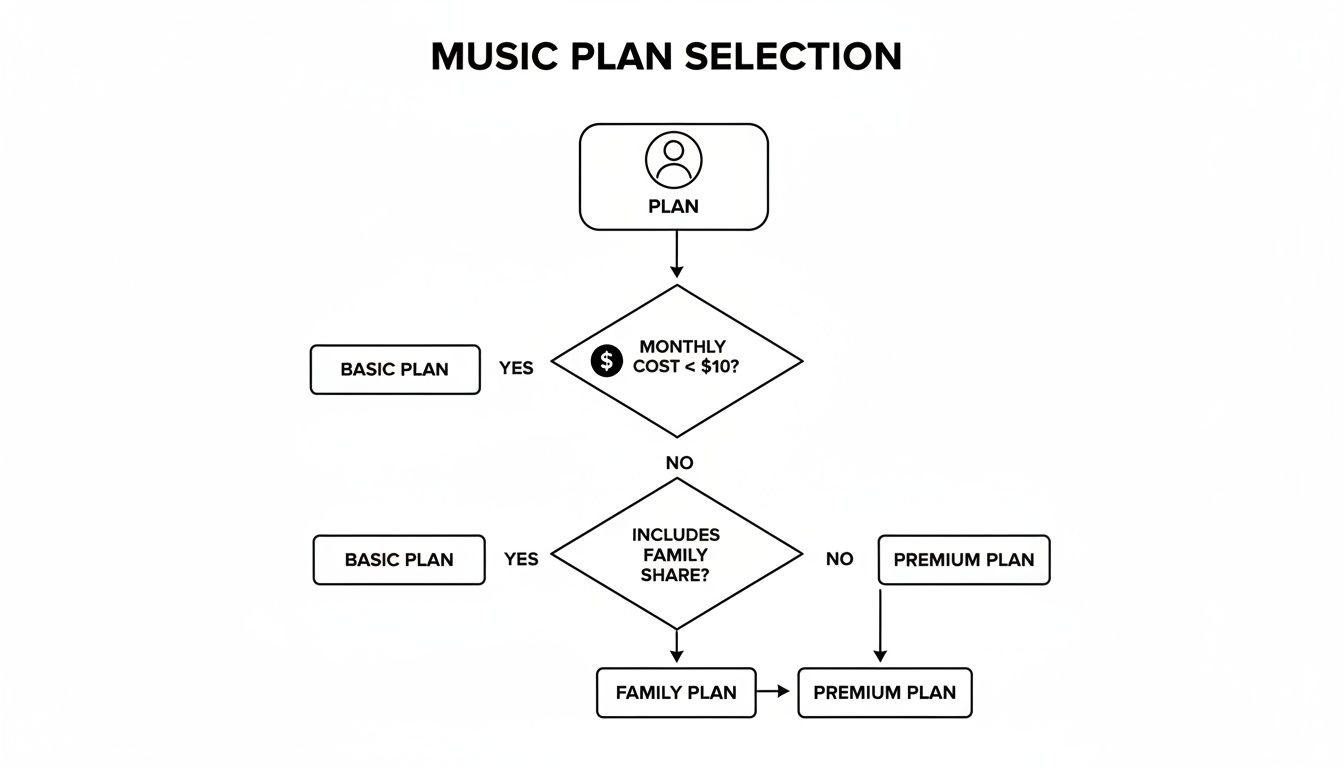
As you can see, prioritizing top-tier audio quality usually points you toward Tidal, while a focus on discovery algorithms and a wider content library makes Spotify the logical pick.
For the Budget-Conscious User
When price is the bottom line, both services have very similar pricing tiers. What can tip the scales, though, is how easy it is to share a plan. Spotify's sheer dominance in the market—holding nearly 37% of the US market share with an estimated 53.8 million subscribers—gives it an edge.
This widespread adoption means it’s often easier to find family or friends to split a plan with. You might also find services that help group up for a family plan, making it much more affordable. If you're looking to save and want to explore other options, it's worth checking out our guide on the best alternative to Spotify.
Got Questions? We've Got Answers
After digging into the details of audio quality, music discovery, and pricing, you might still be weighing a few practical points. Let's tackle some of the most common questions that pop up when people are trying to choose between Tidal and Spotify.
Can I Move My Playlists from Spotify to Tidal (or Vice Versa)?
Yes, and it's surprisingly painless. You don't have to rebuild your carefully curated playlists from scratch.
Services like Soundiiz or TuneMyMusic are lifesavers here. You just connect both your Spotify and Tidal accounts, and these tools can copy over everything—your playlists, saved albums, and liked songs. It makes switching a whole lot easier.
Will Tidal's HiFi Streaming Destroy My Mobile Data Plan?
In a word, yes. It's a data hog, but that's the price of high-quality audio. The files are much larger than the compressed ones you're used to on Spotify.
To put it in perspective, a single song in Master Quality can burn through over 100MB of data. Unless you have an unlimited plan, it's a good idea to download your music over Wi-Fi for offline listening before you head out.
Which Service is Better for Artists?
Tidal has made artist compensation a cornerstone of its brand. It consistently pays out more per stream than almost any other service.
While the exact numbers fluctuate, reports generally show Tidal's per-stream payout rate is two to three times higher than Spotify's. If you want more of your subscription fee to go directly to the musicians you love, Tidal has a clear edge.
This isn't just a talking point; it's a fundamental part of Tidal's mission. They've positioned themselves as the artist-centric alternative in a world dominated by services focused on massive scale.
Which App is Easier to Use?
This one really boils down to taste, but each app has a distinct feel. Spotify's interface is built for speed and ease of use. It's incredibly intuitive, honed over a decade to help you find and play what you want with minimal fuss.
Tidal, on the other hand, feels more like a high-end digital magazine. It puts a big emphasis on beautiful, high-resolution album art and video content. Some people adore this sleek, premium aesthetic, while others might find Spotify’s straightforward, function-first design a bit quicker for day-to-day navigation.
Ready to get premium features without the premium price? Join a shared plan on AccountShare and start saving today. Find your subscription deal on AccountShare