
What Is Multi-Tenant Architecture and How Does It Work?
Multi-tenant architecture is a clever way to build software where one single version of an application serves many different customers, or "tenants." The best analogy is an apartment building. Everyone lives in the same structure and shares common resources like the foundation, water, and power, but each tenant has their own private, secure apartment.
Even though they're all under one roof, your neighbor can't see what's inside your unit. In the software world, this means each tenant's data is logically walled off and completely invisible to others.
Understanding Multi-Tenant Architecture
Let’s say you’re building a new software service. You fundamentally have two choices. You could build a separate, standalone house for every customer you sign up—that’s the single-tenant model. Or, you could build one big, efficient apartment building to house everyone—that’s the multi-tenant approach.
A private house offers complete isolation, but it's incredibly expensive to build and maintain a new one for every single person who moves in.
The apartment building model, on the other hand, is much smarter. The cost of the land, foundation, plumbing, and electrical systems is spread across all residents, making it far more affordable for everyone. This is the simple idea behind multi-tenant architecture. A single, shared infrastructure supports all users, which dramatically lowers operational costs and makes maintenance a breeze.
This is the model that powers most of the Software as a Service (SaaS) platforms we all use every day, from email clients to project management tools.
The Backbone of Modern SaaS
Multi-tenant architecture is the engine of modern cloud computing. It’s what allows platforms like AccountShare to serve thousands of users from a shared pool of resources, keeping the service both powerful and affordable. The concept really took off with the rise of SaaS in the early 2000s, but its roots trace all the way back to 1960s mainframe computing when multiple people had to share incredibly expensive hardware.
This shared approach delivers a few huge advantages that have come to define the SaaS experience:
- Cost Efficiency: When everyone shares resources—like databases, application servers, and the people who maintain them—the provider's costs plummet. These savings are usually passed right on to customers in the form of lower subscription fees.
- Painless Maintenance: Instead of patching and updating thousands of separate software installations, developers only have to update the one central application. This means bug fixes and new features get rolled out to every single user at the same time, without any hassle.
- Effortless Scalability: Bringing on a new customer is often as easy as creating a new account. There's no need to set up new servers or deploy a fresh copy of the software, which allows a service to grow its user base almost instantly.
At its core, multi-tenancy is all about achieving economies of scale in software. By serving many from one, you create a system that is more affordable to run, easier to manage, and faster to improve for everyone.
To truly get it, you have to understand the bigger picture of how to design software architecture to deliver real business value. Ultimately, multi-tenancy is the framework that enables the powerful and efficient delivery of shared services. To dig deeper into that, check out our guide on what are shared services.
Multi-Tenant vs Single-Tenant Architecture at a Glance
To make the distinction crystal clear, it helps to see the two models side-by-side. Each has its place, but for most modern SaaS applications, the benefits of a multi-tenant approach are hard to ignore.
| Feature | Multi-Tenant Architecture | Single-Tenant Architecture |
|---|---|---|
| Cost | Lower cost due to shared resources and infrastructure. | Higher cost per customer; dedicated resources required. |
| Resources | Pooled resources are shared among all tenants. | Dedicated, isolated resources for each tenant. |
| Maintenance | Single application to update and maintain for all tenants. | Each tenant's instance must be updated individually. |
| Scalability | Easy to onboard new tenants; scales efficiently. | Slower to scale; requires provisioning new infrastructure. |
| Customization | Generally offers configuration options within the platform. | High degree of customization possible for each instance. |
| Security | Requires strong logical data isolation between tenants. | High level of physical isolation by default. |
While single-tenancy offers maximum control and isolation—ideal for organizations with extreme security or regulatory needs—multi-tenancy provides the scale, efficiency, and affordability that has fueled the entire SaaS industry.
Understanding the Core Tenancy Models
Not all multi-tenant systems are created equal. The specific path an architect takes has a massive impact on everything from cost and security to how the application scales down the road. These design choices are known as tenancy models, and they're all about how tenant data is stored and, more importantly, kept separate.
Getting a handle on the three main models is fundamental to understanding what multi-tenancy is all about. Each one strikes a different balance between sharing resources to save money and walling off data to keep it secure. The right choice really comes down to what the application needs to do.
Think of it like an apartment building. A single structure (the application) can house many different tenants, and each one has a key to their own private space.
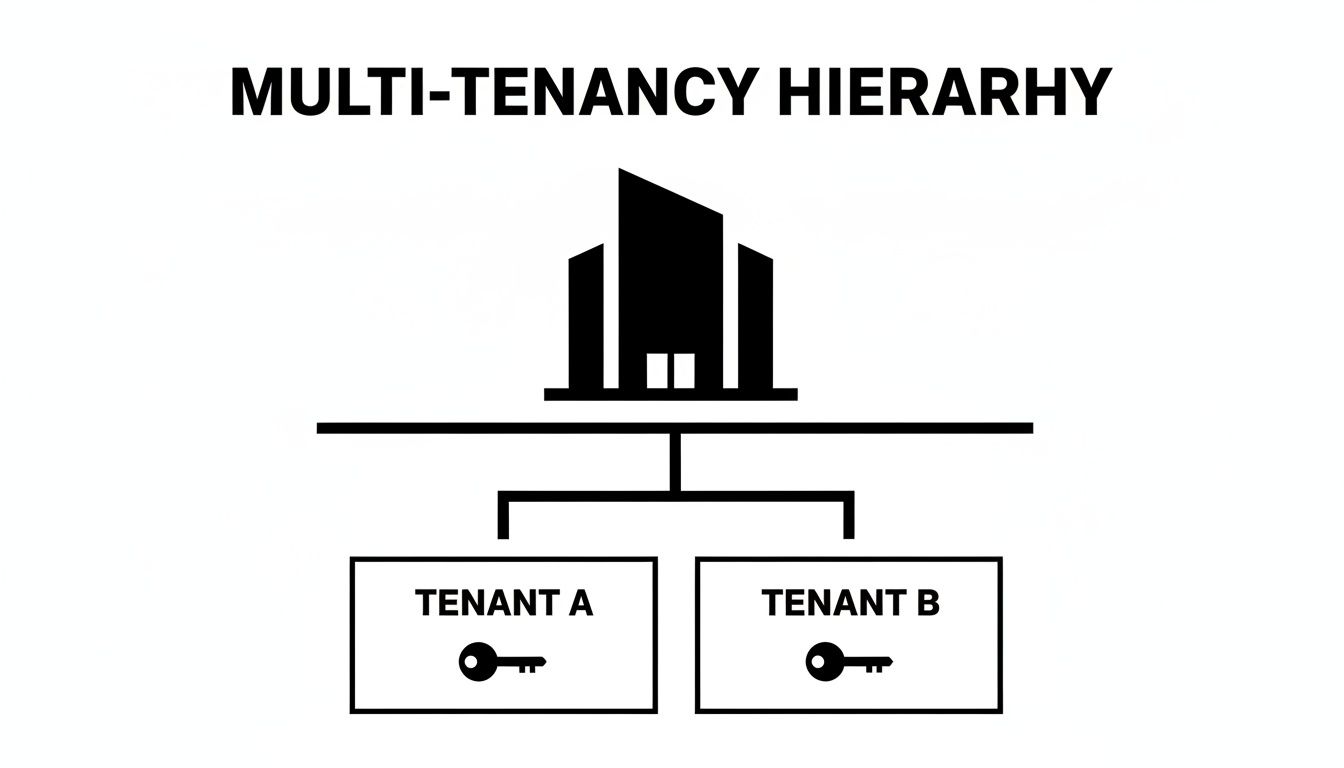
This simple visual nails the core idea: one shared system providing secure, private experiences for everyone who uses it.
Model 1: The Shared Database and Shared Schema
This is by far the most common and budget-friendly way to build a multi-tenant application. It’s a bit like a public library. All the books are on the same shelves, organized by the same system. If you want to know what a specific person checked out, you just look up their library card number.
In technical terms, every tenant’s data lives in the same database and uses the exact same table structure, or schema. To keep things straight, a TenantID column is added to the tables. This little tag is what separates one tenant's data from another's.
- Best For: Apps that need to support a huge number of tenants with relatively simple data needs, like a project management tool or a social media platform.
- Pros: It’s the most efficient use of resources, which keeps operational costs way down and makes management simpler.
- Cons: You have to be incredibly careful with your application code. One small bug could accidentally show one tenant's data to another.
This model packs the most tenants onto the least amount of hardware, but it puts all the pressure on the software itself to enforce strict data privacy.
Model 2: The Shared Database with Separate Schemas
Moving up the ladder in terms of isolation, we get to a popular middle-ground approach. Picture a large bank vault filled with hundreds of private, locked safe deposit boxes. The vault itself is shared, but what’s inside each box is completely separate and private.
Here, all tenants use the same database server, but each one gets their own dedicated set of tables (a schema) inside of it. This creates a strong logical wall between tenants right at the database level. To make this work, you need solid access control methods to ensure users can only see and touch their own schema.
This model is a fantastic compromise between cost and security, which is why you see it so often in B2B SaaS products.
Model 3: The Separate Databases Model
This is the Fort Knox of multi-tenancy, offering the highest level of isolation. Think of it as a planned neighborhood where every family gets their own house. They might share the roads and sidewalks, but each home is a totally private, separate structure.
In this setup, each tenant gets their very own, completely dedicated database. This provides the maximum data isolation possible because there’s a hard, physical boundary between them. It also makes it much easier to customize the database for one specific tenant or restore someone’s data from a backup without disrupting anyone else.
- Best For: High-stakes applications in fields like finance, healthcare, or enterprise software where clients have intense security, compliance, or data residency rules.
- Pros: Unbeatable data isolation and security. Customizing things for a single tenant is also much more straightforward.
- Cons: This model is the most expensive and a headache to manage. Imagine trying to update, back up, and maintain thousands of individual databases—it gets complicated fast.
As we dive into these models, it’s worth remembering that they often live within broader cloud strategies, like hybrid cloud vs multi cloud environments. Ultimately, the tenancy model you pick is a foundational decision that will define how your application operates for years to come.
The Big Wins of a Multi-Tenant Approach
There's a reason multi-tenant architecture has become the go-to model for cloud software—it delivers real, tangible benefits. It's a classic win-win situation for both the software provider and their customers. By intelligently sharing resources, companies can build more efficient, scalable, and affordable products.
Those advantages get passed right down to you, the user. Think lower subscription fees and getting new features faster. The impact of multi-tenancy is behind almost every modern SaaS app you use today.
Unlocking Significant Cost Savings
The most obvious and powerful benefit of a multi-tenant setup is the huge drop in costs. Let’s go back to our apartment building analogy. It's vastly cheaper to build and run one large building than it is to construct a separate house for every single resident. That same principle of economies of scale is the financial engine of multi-tenancy.
Providers get to manage one application, one set of servers, and one database for all their customers. This consolidation translates into massive savings across the board:
- Infrastructure Costs: You simply need fewer servers, databases, and network components, which directly lowers the hardware and cloud hosting bills.
- Operational Overhead: A smaller team can manage the entire system, cutting down on expenses for staff, monitoring, and support.
- Energy Consumption: Running a centralized, efficient data center uses less power per customer, which also trims operational costs.
This financial efficiency is exactly what allows companies to offer sophisticated software at such accessible prices. The entire SaaS subscription model really hinges on this approach.
Gaining Effortless Scalability
Another game-changer is the ability to grow your user base without hitting a wall. In a single-tenant world, bringing on a new customer is a major project. It means setting up new servers, deploying the application, and configuring a database from scratch. That process is slow, expensive, and a real headache to automate.
Multi-tenant architecture completely flips the script. Since all the infrastructure is already running and shared, adding a new tenant is often as simple as creating a new account entry in the database. This seamless scalability means a provider can jump from ten customers to ten thousand without having to re-engineer their entire operation.
For any business looking to grow fast, this is a massive advantage.
The rise of the Software as a Service industry is a direct result of multi-tenant architecture's power. By 2024, an estimated 85% of business applications are SaaS-based, a market that continues to surge. This model lets providers serve a diverse client base from a single codebase, which can slash maintenance costs by as much as 70%. You can explore more data on the multi-tenant market's expansion on precedenceresearch.com.
Streamlining Maintenance and Upgrades
Finally, keeping the software up-to-date becomes incredibly straightforward. Instead of patching, updating, and squashing bugs across hundreds or thousands of separate installations, developers only have one central application to worry about.
When a new feature is built or a security patch is needed, the team deploys the update once, and every single tenant gets it instantly. This ensures consistency and reliability for everyone. All users are always on the latest, most secure version of the software, which gets rid of the version-fragmentation nightmare that plagued older software models. It just makes the whole system more robust and easier to manage.
Navigating the Risks and Security Considerations
While the benefits of a multi-tenant setup are compelling, sharing resources naturally introduces some unique challenges. It's not a free lunch. A well-designed system anticipates these hurdles from day one, building in robust protections to ensure everything runs smoothly, securely, and fairly for every customer.
The absolute number one concern is always data security. When you have different customers' data sitting on the same infrastructure, you have to be absolutely certain that Tenant A can never, under any circumstances, see Tenant B's information. This is where the idea of logical data isolation becomes paramount.
Preventing Data Breaches and Ensuring Isolation
In a shared system, there are no physical walls separating tenants. The software itself must create impenetrable virtual ones. A single, seemingly minor bug in the application code could theoretically expose data, which makes rigorous, paranoid security practices completely non-negotiable.
Achieving this kind of isolation requires multiple layers of defense. It starts with strict access controls baked into the application, ensuring a user's request can only ever pull data tagged with their specific TenantID. To build a truly bulletproof system, you need a comprehensive strategy. For a deeper look at this, our guide on how to implement Zero Trust security is a great resource.
A "defense in depth" strategy is essential in multi-tenant systems. This involves layering multiple security controls—such as row-level security, encryption for data in transit and at rest, and continuous security audits—to ensure that if one control fails, others are still in place to protect tenant data.
Some key security measures include:
- Rigorous Code Reviews: Every single line of code that handles data must be scrutinized for potential flaws that could compromise tenant separation.
- Automated Security Scans: We're talking continuous vulnerability scanning and penetration testing to proactively find and patch weaknesses before they can ever be exploited.
- Strict Authentication and Authorization: Robust identity management is the gatekeeper. It verifies that only authenticated users get in and that they are only authorized to see their own data—and nothing else.
Tackling the Noisy Neighbor Problem
Another classic challenge in the multi-tenant world is the "noisy neighbor" effect. This is what happens when one tenant starts hogging a disproportionate amount of shared resources—like CPU, memory, or database connections—and slows things down for everyone else.
Think of it like living in an apartment building. If your neighbor decides to throw a massive party every night, their noise makes it impossible for you to sleep. In the same way, a tenant running a huge, resource-intensive report can make the application sluggish for every other user if the system isn't built to handle it.
Thankfully, modern platforms have a mix of monitoring and control mechanisms to deal with this.
Strategies for Fair Resource Allocation
To guarantee a stable and responsive experience for every user, architects put several key strategies in place to keep noisy neighbors from ruining the party.
These strategies often include:
- Resource Throttling: The system can set quotas on how much of a resource any single tenant can use in a certain timeframe. If a tenant hits that limit, their requests might be slowed down or queued to protect the system's overall health.
- Performance Monitoring: Advanced tools keep a close eye on resource usage for each tenant in real-time. This lets operators spot anyone causing a performance drain and step in before it affects others.
- Intelligent Load Balancing: The smartest systems can automatically shift workloads around to prevent bottlenecks. For instance, some platforms use fair-queuing systems that prioritize requests from "quieter" tenants, so they don't get stuck in line behind a resource hog.
By proactively managing data isolation and resource allocation, you get all the cost and efficiency wins of multi-tenancy without ever having to compromise on security or performance.
How the Pros Build on Multi-Tenant Architecture
The theory behind multi-tenancy is one thing, but seeing it in the wild is where it really clicks. You don't have to look far to see it in action—some of the biggest names in tech built their entire empires on this model. Their success isn't an accident; it's a direct result of the cost-efficiency, speed, and reliability that a well-executed multi-tenant system provides.
By looking at how these giants operate, we can see the real-world impact of concepts like shared infrastructure and logical data isolation. Multi-tenancy is the quiet, powerful engine running underneath the SaaS platforms millions of us use every single day.
Salesforce: The Original SaaS Disruptor
Salesforce is probably the poster child for betting the farm on a multi-tenant model and winning big. Back in 1999, the idea of delivering complex business software over the internet from a shared platform was pretty radical. They proved that thousands of companies could run their operations securely and effectively on a single, shared software instance.
This move was genius because it let them bring on new customers in a flash, without the crippling cost of setting up dedicated hardware for each one. This made powerful CRM tools affordable for small and medium-sized businesses for the first time, completely changing the software game.
Salesforce proved that a shared database and application layer could be just as secure and reliable as isolated systems, as long as the logical fences between tenants were built correctly. They basically wrote the playbook for the entire SaaS industry.
The model is so successful that the data centers powering these services have become a massive industry themselves. North America currently leads the multi-tenant data center market with a 37-38% share in 2024, largely because of the hyperscale providers who live and breathe multi-tenancy. This powerful infrastructure is what allows companies to offer cost-effective shared services to businesses and families around the world. For a deeper dive, you can find additional details on the multi-tenant data centers market.
Google Workspace: A Masterclass in Global Scale
Every time you draft an email in Gmail or collaborate on a Google Doc, you're using one of the most massive multi-tenant systems ever built. Google Workspace serves millions of organizations, from one-person startups to Fortune 500 giants, all from the same underlying infrastructure.
This approach delivers some incredible benefits:
- Effortless Collaboration: With everyone on the same platform, real-time collaboration just works. It’s simple and incredibly effective.
- Instant Updates for Everyone: When Google pushes out a security patch or a new feature, every single user gets it at the same time. No one gets left behind.
- Unbelievable Scalability: Google can absorb huge spikes in usage without breaking a sweat, scaling its resources up or down so smoothly that individual tenants never even notice.
The fact that Google can serve such a massive, diverse user base from a single, unified system is a powerful demonstration of what multi-tenant architecture can do.
Shopify: Fueling an Army of Entrepreneurs
Shopify has made it possible for millions of people to launch their own online stores, a feat that would be impossible without its multi-tenant foundation. Instead of wrestling with code and servers, a merchant just signs up and starts building their shop on Shopify's shared platform.
Shopify handles all the messy stuff—the servers, the security updates, the payment gateways—for every single one of its tenants. This frees up merchants to focus on what actually matters: their products and their customers. Because it's multi-tenant, the platform can handle the light traffic of a brand-new boutique just as easily as it handles the crushing volume of a Black Friday sale for a global brand, all on the same system.
Let's break down how these and other platforms approach multi-tenancy. This table shows how popular SaaS companies use different models to effectively serve their huge user bases.
Real-World Multi-Tenant Platforms and Their Models
| Platform | Primary Tenancy Model | Key Benefit Achieved |
|---|---|---|
| Salesforce | Shared Database, Shared Schema | Maximum cost-efficiency and rapid onboarding for millions of business customers. |
| Shopify | Shared Database, Shared Schema | Extreme scalability to handle fluctuating e-commerce traffic for all merchants. |
| Slack | Shared Database, Separate Schemas | Balances cost with strong data isolation between different company workspaces. |
| AWS | Isolated Tenants (EC2/VPC) | Offers customers complete control and security in their own virtual private cloud. |
As you can see, the choice of a tenancy model isn't random. It's a strategic decision tied directly to the service being offered, whether it's maximizing cost savings for a CRM or guaranteeing total isolation for cloud computing.
How Multi-Tenancy Makes AccountShare Possible
Everything we've discussed so far—the cost savings, the easy scaling, and the built-in security—all comes together in a service like AccountShare. Think of multi-tenant architecture as the engine that powers the entire group purchasing model. It’s the secret sauce that makes premium subscriptions affordable for everyone.
The whole concept is built on sharing resources. Instead of every group needing its own expensive, dedicated version of the software, everyone shares one powerful, central platform. This slashes the costs of servers, maintenance, and everything in between. Those savings get passed directly on to you.
Making Group Buying a Reality
AccountShare’s entire reason for being rests on the efficiency that a multi-tenant setup provides. Because it can serve thousands of users from a single application, the cost per person drops dramatically. This is what turns a pricey individual subscription into a budget-friendly group plan.
Just imagine if they tried to do this with a single-tenant model. The expense and headache of setting up and managing a separate software instance for every single group would be staggering. The service would be too expensive to even exist. Multi-tenancy is what creates the necessary economy of scale, letting countless groups share the platform without a hitch.
Security and Privacy in a Shared Space
So, how does AccountShare keep your group's information private if you're all sharing the same system? The answer is a well-implemented concept called logical data isolation. Even though your group is running on the same hardware as others, there are strict digital walls built between you.
These aren't just polite suggestions; they're hard-coded rules baked into the application's DNA, making it impossible for data to leak from one tenant to another.
- Strict Access Controls: The system is built so a user from "Group A" can only ever see data tagged with "Group A's" ID. Period.
- Encrypted and Isolated Data: Your group’s account details, shared credentials, and activity are kept completely separate and secure, totally invisible to any other group on the platform.
This design gives you the best of both worlds: you get the cost savings of sharing without giving up an ounce of the privacy and security you'd expect from your own dedicated service.
Multi-tenancy isn't just a technical detail for AccountShare; it's the entire business model. It allows them to pool resources and open up access to premium tools for everyone, making the service affordable, fast, and reliable.
Ensuring a Fast and Reliable Experience
Finally, this architecture is what guarantees you have a smooth experience every time you log in. The platform is designed from the ground up to handle the load of all its users at once. Smart resource management systems are in place to make sure one group's heavy usage doesn't slow things down for anyone else—solving the classic "noisy neighbor" problem before it even starts.
This means that whether you're logging in at peak time or in the middle of the night, the performance stays quick and responsive. And since all maintenance and updates happen in one place, new features and security patches get rolled out to everybody simultaneously, keeping the platform modern and secure. The technical foundation directly translates into the value you get as a customer.
Frequently Asked Questions
Even after covering the models and benefits, a few common questions always seem to come up when you get down to the practical side of multi-tenant architecture. Let's tackle them head-on with some quick, clear answers.
How Is Multi-Tenancy Different from Virtualization?
This is a great question because it cuts right to the core difference between sharing an application and sharing hardware. They feel similar on the surface, but they operate at completely different layers of the tech stack.
Here's a simple way to think about it:
Virtualization is like leasing a private office suite in a large commercial building. You get your own dedicated space—a virtual machine—with its own front door, walls, and utilities, but it all runs on the same shared physical hardware (the building itself). Each business is completely separate.
Multi-tenancy, on the other hand, is like having a private apartment in a massive residential tower. Everyone lives in the same building (the application) and uses the same core infrastructure like plumbing and electricity (the database and code), but their individual living space is completely private and secure.
So, virtualization shares hardware to run many separate apps, while multi-tenancy shares one app among many separate users.
When Is Single-Tenant Architecture a Better Choice?
While multi-tenancy powers most modern SaaS platforms, it’s not a one-size-fits-all solution. There are specific, high-stakes situations where a single-tenant architecture—giving each customer their own dedicated software and infrastructure—is the only way to go.
A single-tenant model makes sense for:
- Extreme Security Requirements: Think government agencies, defense contractors, or financial institutions where the physical and logical isolation of a dedicated instance is non-negotiable.
- Heavy Regulatory Burdens: Industries with strict compliance mandates, like HIPAA in healthcare, often find it much simpler to prove compliance in a completely isolated environment.
- Deep, Custom Code Changes: If a customer needs to fundamentally alter the core software for their own unique needs, a single-tenant instance is necessary to avoid disrupting other users.
If you need absolute control and ironclad isolation, single-tenancy is your answer. Just be prepared for the much higher cost and operational overhead that comes with it.
How Does Multi-Tenancy Affect Application Performance?
This is a classic concern. In a poorly designed system, the "noisy neighbor" problem is a very real threat—one tenant monopolizing resources and slowing the application down for everyone else.
But a well-engineered multi-tenant platform doesn't just cross its fingers and hope for the best. It's built from the ground up to prevent this. These systems actively manage and balance resources to ensure a consistently fast experience for every single user, regardless of what their neighbors are up to.
Modern platforms accomplish this with a mix of smart load balancing, carefully defined resource limits, and constant real-time monitoring. It’s all about creating a system that's both fair and stable, keeping things snappy for everyone.
Ready to see how a secure, multi-tenant platform can save you money? AccountShare is built on this powerful architecture to make premium subscriptions accessible and affordable. Start sharing and saving today!