
What Is a Share Subscription Agreement Explained Simply
A share subscription agreement is a legally binding contract in which an investor agrees to buy newly issued shares directly from a company for an agreed price. The company receives the investment and, subject to the agreement's conditions and the required corporate steps, issues the shares to the investor.
If you've been asked to review one before investing in a company, it's easy to mistake it for a general promise to provide money. The document does more: it sets the terms of the investment and connects payment to the company's formal process for issuing and recording ownership. And despite the word “subscription,” it has nothing to do with signing up for streaming, software, or shared online services.
The Plain-English Definition
The essential distinction is who issues the shares and receives the money. In a share subscription, the company issues new shares directly to the investor and receives the proceeds. In a secondary share sale, an existing shareholder sells shares they already own, so the money goes to that shareholder instead. Thomson Reuters' explanation of subscription agreements describes the agreement as a contract for an investor to purchase a defined amount of company shares or other securities, commonly in a private placement.
That difference affects the company's ownership records. When a company issues new shares, the number of shares in issue changes, and existing shareholders' proportional ownership may be diluted. A secondary sale changes who holds existing shares, but doesn't by itself add newly issued shares to the company's capitalization.
The term can also trip up people familiar with consumer subscriptions. In a consumer service, a subscription usually buys access to a product or service. A share subscription agreement is about equity: the investor acquires shares and the associated rights, while the company takes on obligations connected with issuing and recording them. It's not an agreement to share a digital account, and it doesn't mean the investor is buying a company's services.
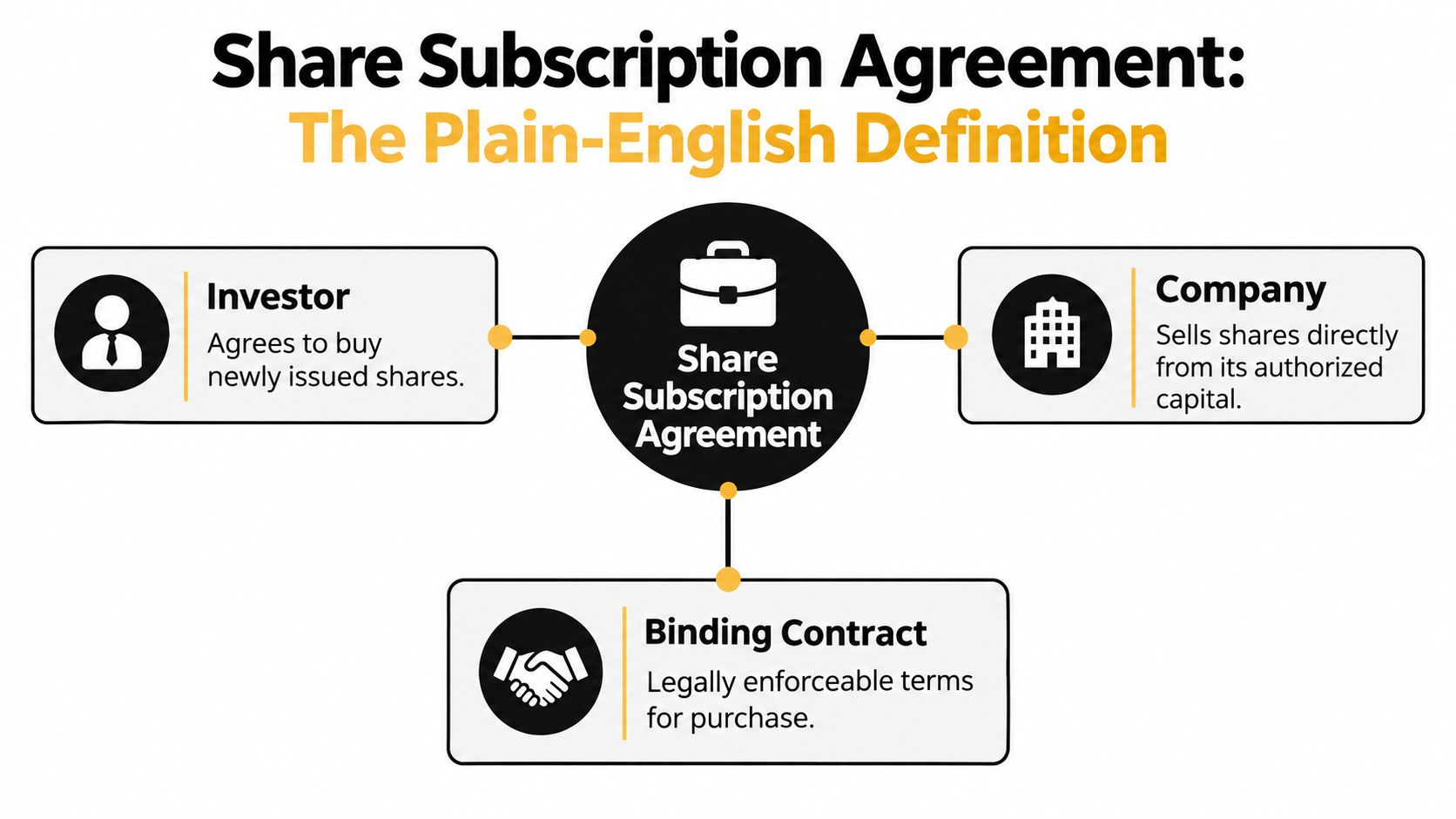
A useful mental model is to treat the document as three things in one: a record of what the investor is buying, instructions for how payment and completion should happen, and an enforceable commitment to issue the agreed shares if the conditions are met. It gives both sides a clearer record than informal correspondence or a preliminary discussion.
It's separate from the rules that govern shareholders' ongoing relationship after the investment. For questions about how those arrangements can address personal circumstances, shareholder agreements for divorce protection offer a related perspective.
Where the Agreement Fits in Company Law
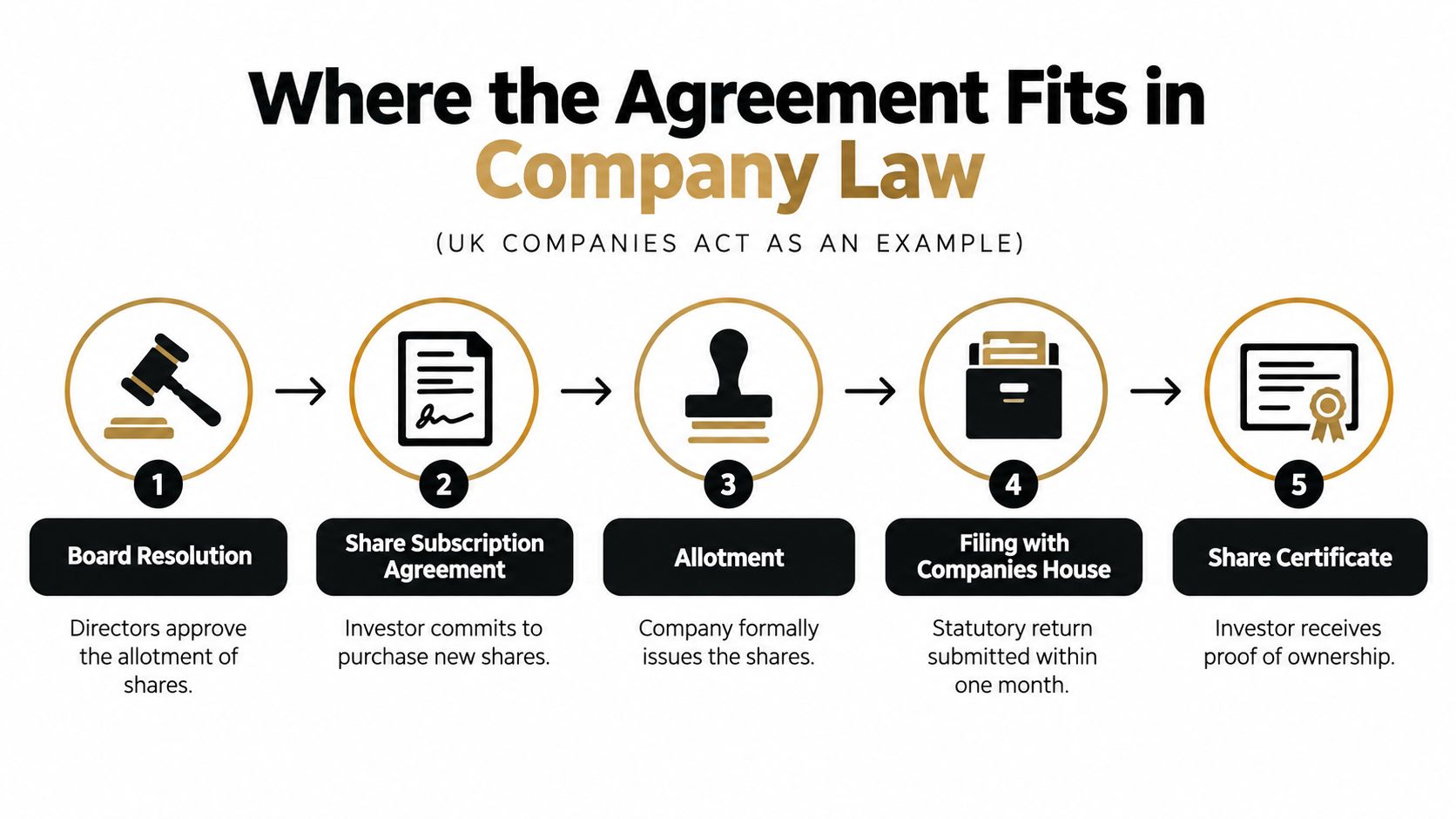
A signed agreement is important, but it's only one part of a share issue. Company law can also require the right corporate authority, payment in accordance with the offer, a formal allotment, and updates to company records. Those steps help establish that the company was entitled to issue the shares and that the investor's ownership can be properly recorded.
The UK provides a concrete example of how these controls developed. Under the Companies Act 1908 provisions on allotment, a company offering share capital to the public had to reach the stated minimum subscription before allotting shares. If no minimum was stated, the full amount offered had to be subscribed. The legislation also required application money to be paid and received, and an allotment return to be filed within one month with details such as the shares allotted and the identities of the allottees.
Earlier UK law also included a specific payment safeguard: the Companies Act 1948 provided that the application money payable for each share couldn't be less than 5% of its nominal amount. Modern UK law retains the principle that a public company can't allot shares offered for subscription unless the issue is fully subscribed or the offer expressly allows allotment under stated conditions.
The agreement is one part of the process
In practice, the company needs to check that its directors have authority to allot shares, and whether existing shareholders have pre-emption rights that apply. The agreement can set out what each side has promised to do, but it doesn't replace approvals or other steps required under the company's articles and applicable law.
After the allotment, the company's records need to reflect the new ownership. The agreement, payment evidence, approvals, allotment documents, and updated register form a connected record of the transaction. The historical requirements around subscription thresholds and filing show the broader purpose: a capital raise should be documented as a process, not left as a handshake or a payment without a clear record.
Requirements vary by jurisdiction, company type, and offering method. The UK example helps explain the mechanics, but it shouldn't be treated as a universal checklist for every company.
Core Clauses You Should Expect
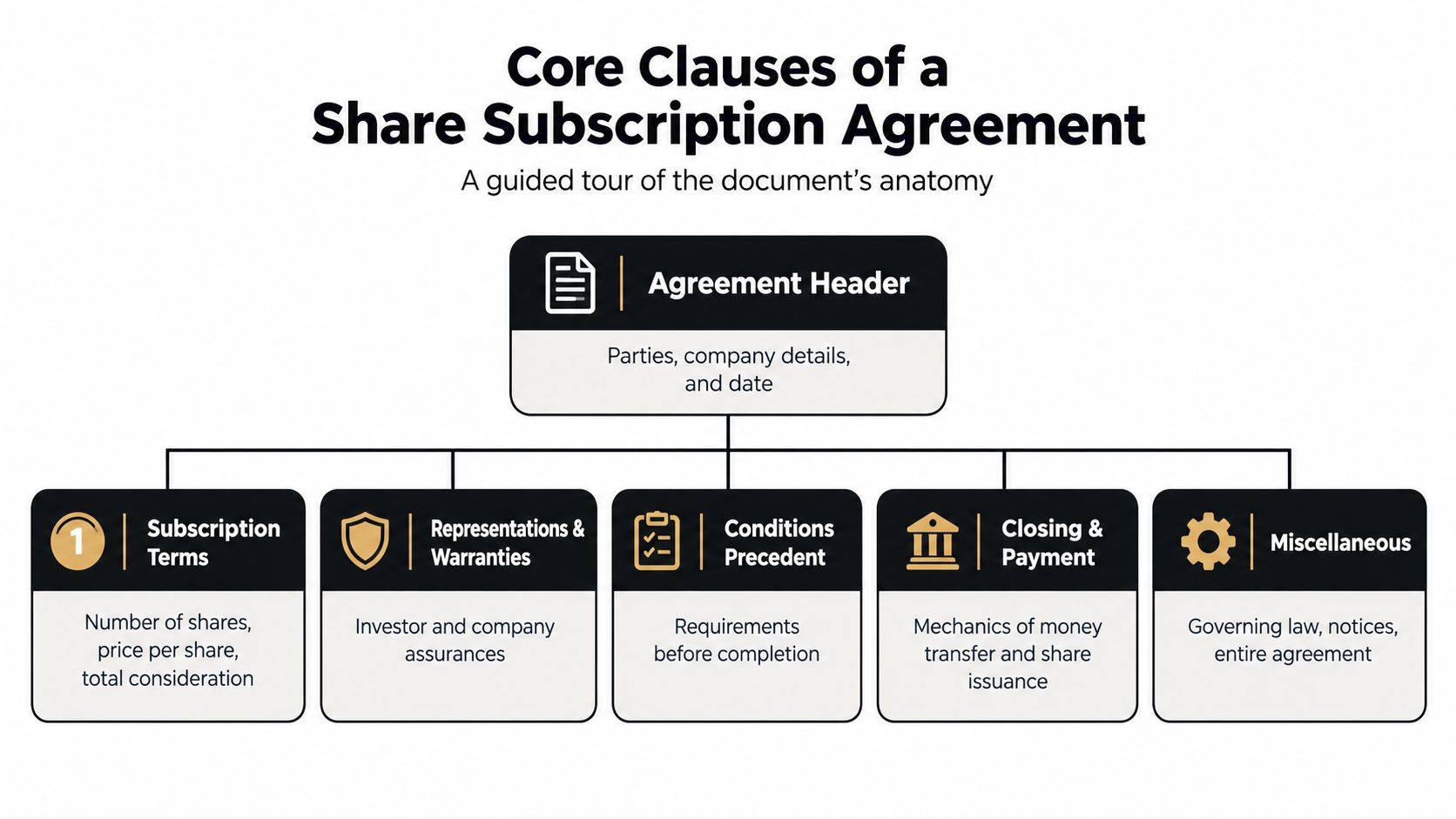
Read the agreement as a set of answers to practical questions. Who's investing? What shares are being issued? What must happen before the company issues them? What does each side promise if the deal completes?
Identify the investment clearly
The agreement names the company and investor and specifies the number and class of shares being subscribed for. It should also set out the subscription price, payment method, and when payment is due. These details prevent a basic but consequential misunderstanding: both sides should be able to identify exactly what the investor has agreed to buy and what the company expects to receive.
The share class matters because different classes can carry different rights. Check the provisions on voting, dividends, priority if the company is wound up, conversion, and protection against dilution. A share's label alone doesn't explain those rights; the agreement and the company's constitutional documents need to be read together.
If the price is stated per share, check that the total amount due matches the share count and price. If payment depends on a particular event, the agreement should say what triggers it and what evidence confirms payment.
Check what must happen before completion
Conditions precedent are requirements that must be satisfied before the transaction completes. They may include corporate approvals, waivers of applicable pre-emption rights, receipt of cleared funds, or delivery of agreed documents. The point is to prevent the parties from treating the transaction as complete while a required step remains outstanding.
In the UK, directors generally can't allot shares or grant rights to subscribe for shares unless they're authorized by the company's articles or a shareholder resolution. As the Companies Act provisions on directors' authority to allot shares make clear, signing the agreement alone may not give the investor legal title. The formal allotment and entry in the company's register still matter.
Practical rule: Treat the conditions and completion steps as carefully as the signature page. They determine what must be true before the company issues the shares.
Understand the assurances and remedies
Investor representations are statements the investor makes, such as confirming authority to enter the agreement. Company warranties are assurances from the company about matters specified in the document. The agreement may also set out confidentiality obligations, information rights, and what happens if a condition isn't met or a party fails to perform.
For related accounting context, an explanation of share premium accounts can help clarify how the issue price relates to the company's share capital records. The agreement itself should still state the commercial terms precisely, rather than leaving the reader to infer them from accounting treatment.
Dilution and Ownership Math
The share count in the agreement has a direct effect on ownership. A simple starting formula is:
Investor ownership percentage = subscribed shares ÷ post-money issued shares
“Post-money” means after the newly subscribed shares have been added to the company's issued shares. The calculation is straightforward, but the denominator needs attention: it should reflect the post-issue share count, not just the shares that existed before the investment.
For example, an investor subscribing for 1 million shares in a company with 9 million existing shares would hold 10% of the post-closing issued shares, before accounting for options, warrants, convertibles, or other promised equity. LexisNexis' explanation of equity allotments gives this example and highlights why the fully diluted picture may differ.
| Shares Subscribed | Pre-Money Shares | Post-Money Shares | Investor Ownership |
|---|---|---|---|
| 1 million | 9 million | 10 million | 10% before options, warrants, convertibles, or other promised equity |
This table shows the basic issued-share calculation. It doesn't account for securities or rights that could lead to shares being issued later. Options and warrants can give their holders a right to acquire shares, while convertible securities can turn into shares under their terms. Those potential shares may affect the investor's economic position even if they aren't currently included in the issued-share total.
Read beyond the headline percentage
A cap table should therefore be reviewed on both an issued-share and a fully diluted basis. The agreement can help by including a capitalization schedule and setting out how the parties will treat existing or promised equity. It can also address what happens if the final number of shares differs from what the investor expected.
The share class adds another layer. Voting rights, dividend priority, liquidation preference, conversion rights, and anti-dilution protections can all change the practical value of a percentage stake. A smaller holding with particular rights may not be economically equivalent to a larger holding in a different class.
Ownership terms can also become important when shareholders disagree about control, information, or the company's direction. For background on the kinds of issues that can arise, this discussion of private company shareholder conflicts provides related context.
How It Differs From Related Documents
Fundraising documents can look similar because they all describe an investment, but they serve different purposes. The clearest distinction is whether the company is issuing shares now, an existing shareholder is transferring shares, or the parties are documenting a possible future investment.

New shares or existing shares
A share subscription agreement covers an investor's purchase of newly issued shares from the company. The company receives the proceeds, and the new issue affects its capitalization.
A share purchase agreement usually covers a transfer of existing shares from one shareholder to another. The seller receives the sale proceeds, and the company's total issued share count doesn't increase merely because of that transfer. The agreement still needs to identify the shares and deal with the conditions for transferring them, but the transaction isn't the same kind of primary capital raise.
Binding terms or a preliminary outline
A term sheet is generally a preliminary summary of proposed investment terms. It helps the parties negotiate the main commercial points before they prepare definitive documents. Its effect depends on its wording and applicable law, so readers shouldn't assume every term sheet is wholly non-binding or that it completes an investment on its own.
A subscription agreement, by contrast, records the operative terms for the share purchase and the steps required for completion. The investor and company need to understand which document governs if the terms differ.
Shares now or an instrument that may convert later
A SAFE or convertible note is structured to convert into shares later under its terms, rather than necessarily issuing the shares at the outset. A convertible note may also have debt features; a SAFE is a different type of instrument. The details depend on the document and governing law, so neither should be treated as interchangeable with a direct share subscription.
A shareholder agreement is another separate document. It can set rules for how shareholders deal with one another after they hold shares, while the subscription agreement focuses on the investment and issuance. Readers comparing those roles may find the Everglow Prosperity shareholder agreement guide useful for understanding the separate governance layer.
Common Misconceptions Worth Clearing Up
Signing doesn't necessarily mean the investor already owns the shares. A subscription agreement sets out commitments, but the company may still need the proper authority, satisfaction of conditions, payment, formal allotment, and registration. The investor should confirm what the agreement says counts as completion and what documents or records will evidence ownership.
A related mistake is treating completion conditions as routine boilerplate. If the company hasn't obtained a required approval or can't validly allot the shares, the investor may face a different situation from the one they expected. Conditions are there to identify what must happen before the transaction proceeds, so each should be understandable and achievable.
“Subscription” doesn't mean consumer access. A consumer subscription grants access to a service under its terms. A share subscription is a corporate financing transaction: it concerns shares, ownership rights, the company's records, and potential dilution. The shared word can obscure the fact that the legal and financial consequences are entirely different.
Don't assume one template fits every deal
A template may provide a starting structure, but the right terms depend on the share class, the company's jurisdiction and constitutional documents, the investor, and the negotiated economics. An agreement for ordinary shares may not address the same rights as one for preferred shares. A company issuing shares also needs to check how the agreement interacts with existing shareholder rights and promised equity.
Nor should a signed document be treated as a substitute for checking the company's records. The share count, investor's identity, class of shares, price, and conditions should align across the agreement and the company's closing documents. If they don't, clarify the difference before funds are transferred or the allotment is recorded.
A Practical Closing Checklist
Before signing, the company and investor should be able to answer the same practical questions. Use this checklist to spot gaps in the document and the process.
- Confirm authority: The company should identify the approval needed for the allotment and obtain it through the proper corporate process.
- Check existing rights: Find out whether pre-emption rights apply and, if needed, secure a valid waiver or disapplication.
- Reconcile the capitalization: Confirm the share class, share count, issue price, and the effect on both issued and fully diluted ownership.
- Read every condition: Identify what must happen before completion, who is responsible, and how each requirement will be evidenced.
- Match payment to issuance: Confirm the payment method and timing, and specify what the company must do once payment and other conditions are satisfied.
- Verify the ownership record: Agree how the company will register the allotment and provide evidence of the investor's ownership.
- Check the rights attached: Make sure the issued shares rank as represented and that the agreement's warranties, remedies, and termination terms are clear.
Legal review is especially important when the company's authority is uncertain, existing shareholders may have participation rights, the agreement uses unfamiliar share classes, or the parties are relying on documents from more than one jurisdiction. A template can't confirm that the company has completed the required approvals or that the investor's expected ownership matches the capitalization records.
AccountShare helps people access premium digital services through group purchasing, with shared-account management and customizable permissions. If you came here because the word “subscription” sounded familiar, visit AccountShare to explore a different kind of subscription: affordable access to streaming, AI tools, and software.