
What Are Shared Services A Guide to Cutting Costs and Boosting Efficiency
Ever wonder how big companies manage to be so efficient? A lot of the time, the secret sauce is something called shared services. It’s a surprisingly simple idea: pool resources to cut costs and boost performance.
Think of it like sharing a family streaming plan or splitting a vacation rental with friends. Everyone gets the full experience, but no one has to foot the entire bill.
What Are Shared Services, Really?
At its core, the shared services model is all about smart collaboration. Instead of every single department in a company running its own separate IT, HR, or finance team, these common functions get bundled into one central hub. This single unit then serves the entire organization.
This central hub acts almost like a separate business within the main company. Its only job is to deliver its specific services—like payroll or tech support—as efficiently and professionally as possible. This setup gets rid of duplicated jobs, creates consistent processes for everyone, and usually results in better service because you have a team of dedicated experts on the job. The whole concept is part of a bigger shift you can explore in our guide to collaborative consumption, where having access to something is more valuable than owning it outright.
And this isn't just for corporate giants. The logic applies everywhere. A group of designers might split the high cost of an Adobe Creative Cloud subscription, or a household might bundle their streaming accounts to save money. The end goal is always the same: get more done with less.
From an Idea to a Multi-Billion Dollar Strategy
This isn't just a passing trend; it's a massive movement in the business world. The global market for shared services was already worth around USD 171.75 billion in 2024 and is expected to explode to an incredible USD 593.11 billion by 2033. That kind of growth shows just how many companies are successfully using this playbook to slash their operating costs.
The real power of shared services is moving from a mindset of "this is my department's resource" to "this is our organization's capability." It’s a fundamental shift from siloed operations to integrated, enterprise-wide solutions.
This one-to-many delivery model is similar to how other business solutions work, like white label solutions, where one company creates a product or service that many others can rebrand and sell. It's all about creating value at scale.
To really see the difference, it helps to put the old way and the new way side-by-side.
Shared Services at a Glance
This table breaks down the key differences between a modern shared services setup and a traditional, siloed business structure.
| Characteristic | Shared Services Model | Traditional Model |
|---|---|---|
| Structure | Centralized unit serving multiple departments | Each department has its own internal support functions |
| Cost | Lower costs due to economies of scale | Higher costs from duplicated roles and resources |
| Efficiency | Standardized, optimized, and automated processes | Inconsistent processes and potential for inefficiencies |
| Expertise | Deep, specialized knowledge within the service unit | Generalist skills spread thinly across departments |
| Focus | Delivers services as its core business objective | Support functions are secondary to the department's primary goal |
As you can see, the shared model is built for efficiency, while the traditional approach often leads to waste and inconsistency.
The Two Core Models of Shared Services
When we talk about shared services, it’s not a one-size-fits-all deal. The concept really breaks down into two main flavors, each serving completely different needs. Getting a handle on these models helps show how the strategy works for massive corporations and small, nimble groups alike.
1. The Centralized Hub: The Corporate Powerhouse
The first and most traditional approach is what I call the Centralized Hub. Picture a huge company with offices all over the globe. Instead of every single office having its own little HR and finance teams, the company builds one specialized department to handle those tasks for everyone.
This central unit becomes the go-to expert, creating standard, repeatable processes that slash costs and boost consistency across the entire organization. It’s all about achieving economies of scale. By consolidating these functions, businesses cut out redundant roles and simplify workflows, which is why this model has been the playground for large enterprises for decades.
This map shows the fundamental shift from that traditional, top-down structure to a more modern, collaborative approach.
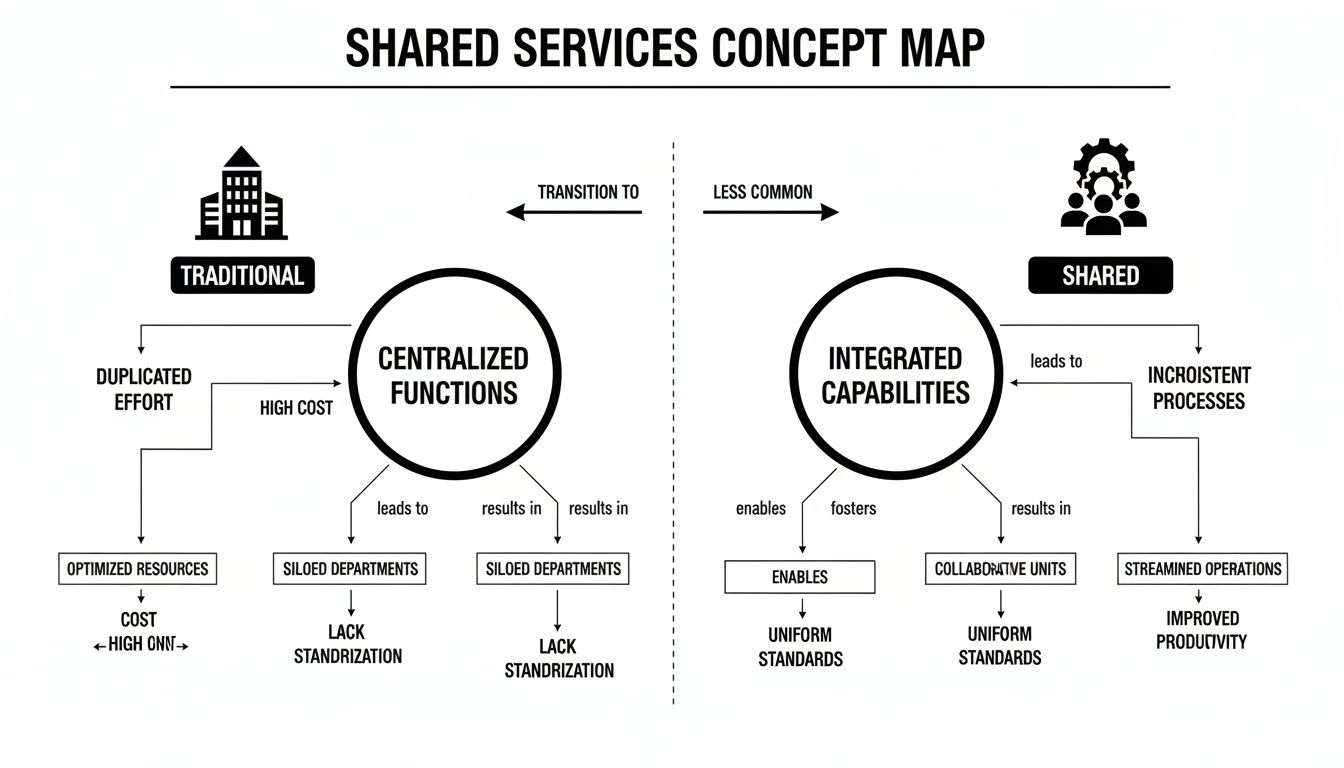
You can see how the thinking moves from a rigid, building-focused system to a more networked, people-first one.
2. The Collaborative Subscription: Power to the People
The second model is the Collaborative Subscription, a modern spin that puts power back into the hands of individuals and small teams. This is where a group of people pools their cash to get their hands on premium digital tools that would be way too pricey for any one person to buy alone. It’s a perfect example of what resource pooling is and how it unlocks incredible capabilities.
You see this model in action all the time:
- Freelancers going in on an expensive license for design software.
- Startups splitting the bill for a high-end AI or project management tool.
- Families bundling their streaming services to cut down on monthly entertainment costs.
This approach is all about democratizing access to powerful tech. While big companies still dominate the market, smaller businesses are catching on fast, using shared access to punch above their weight. This very trend is fueling a market expected to explode from USD 58.98 billion in 2024 to a mind-boggling USD 473 billion by 2035.
The Collaborative Subscription model isn't just about saving a few bucks. It's about getting access to a higher class of tools and capabilities that would otherwise be completely out of reach, leveling the playing field for smaller players.
At the end of the day, both models run on the same core idea—sharing to get more value—they just apply it in vastly different worlds.
Unlocking the Real Benefits of Sharing Resources
So, what's the big deal with shared services? Why are so many people and companies jumping on board? While the initial draw is almost always about saving money, the real perks go much deeper. It’s a powerful mix of cutting costs, boosting quality, and getting your hands on tools that would normally be way out of your budget.
The most obvious win is significant cost reduction. It’s a simple concept that works everywhere, from a massive corporation centralizing its IT support to a few friends splitting a subscription for design software. By pooling your money, everyone pays just a piece of the total price, suddenly making expensive services totally affordable.
Better Quality and Deeper Expertise
But it’s not just about the savings. Shared services often lead to a major leap in quality. Think about it: imagine a big company where each department has its own "IT person" who dabbles in tech support while juggling a dozen other tasks. They’re generalists, doing their best to keep things running.
Now, picture a single, dedicated IT department for the whole company. You've got a team of specialists who live and breathe this stuff. They can fix problems in a fraction of the time, roll out better security, and keep up with the latest tech because it’s their entire job. That concentration of skill raises the bar for everyone.
The real magic isn't just doing the same work for less money; it's about doing the work better, faster, and more consistently by putting all your experts in one place.
This idea is fundamental to running a tight ship. It’s a key driver behind bigger business goals, which is why it's so connected to the power of digital transformation and automated workflows for business efficiency.
Access to Otherwise Unaffordable Tools
Here’s where it gets really exciting, especially for individuals and small teams. A $500 per month subscription for a high-end AI platform or a sophisticated analytics tool? That's a deal-breaker for most freelancers, students, or small businesses.
But what happens when five people split that cost? Suddenly, it’s not a dream—it’s a smart investment.
This opens up a whole new world. It levels the playing field, giving smaller players the ability to use the exact same powerful tools as their giant, well-funded competitors. This trend is a huge reason the shared services market is exploding, particularly in North America, which currently dominates the space. The market there is on track to rocket from USD 62.69 billion in 2025 to an incredible USD 268.54 billion by 2032, all because businesses are using shared resources to get leaner and meaner. You can dig into these shared services market trends if you want to see the numbers for yourself.
Seeing Shared Services in the Real World

Theory is great, but the concept of shared services really clicks when you see it in action. And the truth is, this model is everywhere. It’s the engine running behind the scenes at massive global companies, and it’s probably how you’re watching your favorite show this weekend.
The core idea is always the same: pooling resources to get more done with less.
Let’s look at a classic corporate example. Picture a huge company with offices scattered across a dozen countries. Instead of every single location having its own separate finance department—each with its own staff, processes, and software—they create a single, centralized finance hub.
This one hub handles payroll, accounting, and reporting for the entire organization. What you get is a highly efficient, standardized operation. Redundant tasks disappear, and every employee gets paid correctly and on time, no matter where they are in the world. This is the shared services model in its most traditional, powerful form.
Modern Digital Examples of Sharing
While corporate hubs are a great illustration, the most familiar examples today come from our digital lives. The principles are identical, just applied on a more personal scale.
Consider the challenges that freelancers, small businesses, and even families face every day.
-
The Freelance Developer Squad: Imagine a small team of freelance coders needs a high-end suite of development tools that costs a steep $3,000 per year. That's a huge hit for one person. But by pooling their money, five developers can get full access for just $600 each, giving them the professional-grade resources they need to land bigger projects.
-
The Startup's AI Advantage: A new startup wants to use a powerful AI model in its product, but the monthly subscription is way outside its tiny budget. By sharing the account with two other non-competing startups, they cut the cost by two-thirds. Suddenly, they're working with the same powerful tech as their much larger competitors.
At its heart, sharing digital subscriptions is about democratizing access. It breaks down financial barriers, allowing individuals and small teams to use the same elite tools that were once reserved for the giants of their industry.
These modern scenarios show how the idea of sharing has evolved. It’s not just a corporate cost-cutting strategy anymore; it's a powerful tool for personal and professional growth.
To see how this plays out across different areas, the table below illustrates how the shared services model is applied in various contexts, from corporate functions to personal subscriptions.
Shared Services Use Cases Comparison
| Use Case | Primary Goal | Key Benefit | Example Platform/Tool |
|---|---|---|---|
| Corporate Finance | Standardize Processes | Cost Reduction & Efficiency | SAP, Oracle |
| Startup SaaS | Access Premium Tools | Competitive Advantage | OpenAI, Ahrefs |
| Family Entertainment | Reduce Monthly Bills | Affordability & Convenience | Netflix, Spotify |
| Freelancer Toolkit | Share Licensing Costs | Access to Pro-Grade Software | Adobe Creative Cloud |
As you can see, whether it's a CFO optimizing a global budget or a few friends splitting a streaming plan, the fundamental goal remains consistent: gain access to valuable resources more affordably and efficiently.
How to Perfect Your Subscription Sharing Strategy

Knowing that shared services can save you money is one thing. Actually putting that knowledge into practice with your digital subscriptions? That’s where the real magic happens. But as anyone who’s tried to wrangle a shared account knows, it can quickly turn into a chaotic mess of tracking payments, juggling password changes, and sorting out who gets to log in.
It’s a classic story. A group of friends or colleagues gets excited about splitting a premium tool to cut costs. Before long, the headaches pile up. Someone forgets to send their payment, another person can’t log in because someone else is already using the account, and an unexpected password change locks everyone out. This kind of disorganized sharing often ends up being more trouble than it’s worth.
This is where a dedicated sharing platform completely changes the game. It takes the stress out of the equation and replaces it with security, convenience, and reliability, solving all the common problems that come with trying to do it all yourself.
The Headaches of Manual Sharing
Trying to manage shared subscriptions on your own almost always leads to the same frustrating problems. These issues not only create extra work for the account owner but can also put a strain on friendships and working relationships.
Sound familiar?
- Payment Chasing: You feel like a bill collector, constantly having to remind people to send you their share of the payment. It's awkward and annoying.
- Insecure Password Handling: Sharing passwords through texts or emails is a huge security risk. One wrong move and your account details are exposed.
- Access Conflicts: Ever been kicked out of a streaming service mid-show because too many people are watching? Plans with limited device slots create constant login battles.
- Lack of Clear Rules: With no formal agreement in place, it’s only a matter of time before arguments break out over who gets to use the account and when.
These common frustrations are exactly why a more structured approach is a lifesaver. A purpose-built platform automates the tedious stuff, so everyone can just enjoy the benefits. Getting familiar with the different kinds of shared subscriptions can also help you figure out which model is the right fit.
The Smart Solution: A Dedicated Platform
A dedicated sharing platform acts as your automated and secure middleman, handling all the logistics so you don’t have to. Think of it as the difference between using a crumpled paper map and a GPS—sure, both might eventually get you to your destination, but one makes the journey a whole lot smoother.
The real value of a sharing platform isn’t just splitting the bill. It’s about getting rid of the friction, insecurity, and manual work that make sharing so difficult in the first place.
Take a platform like AccountShare, for example. It automates payment collection, manages access securely without ever revealing the main password, and sets clear rules for everyone from the start. This creates a fair and seamless experience for the entire group, turning a potentially chaotic mess into a simple, effective cost-saving strategy.
Common Questions About Shared Services, Answered
Jumping into shared services—whether you're a massive company or just splitting a streaming account with friends—always raises a few questions. It's only natural to wonder about the rules, the risks, and the fairest way to handle everything. But these concerns shouldn't stop you. Getting straight answers is all it takes to share with confidence.
Let's dig into the big questions people ask most often.
Is It Actually Legal to Share Subscriptions?
This is the million-dollar question, and the answer is... it depends. There’s no single law governing this; it all comes down to the Terms of Service (ToS) for each specific platform. When you sign up, you agree to their rules, and that's where the truth lies.
Many of the big names in streaming and entertainment build their plans around the idea of a single household.
- Household-Based Plans: Think of services like Netflix and Spotify. Their family plans are explicitly designed for people under one roof. Sharing your login with a friend across the country technically goes against their terms.
- Business and Team Plans: On the software side, companies often sell team-based subscriptions. These are meant for coworkers and organizational members, with clear rules about user limits and what each person can do.
- Permissive Policies: Then there are services with more relaxed rules. Some companies are starting to recognize that the modern "household" isn't always so clear-cut and don't enforce the rules as strictly.
The bottom line is simple: always check the fine print. If you break the ToS, the service could suspend or even shut down your account. Knowing the rules before you share is the only way to stay in the clear.
How Do You Keep Everything Secure?
Just handing out your password is a terrible idea. Think about it—that password, sent over a text message, could easily fall into the wrong hands. If you’re like most people and reuse passwords, a breach on one service could suddenly put your other, more sensitive accounts at risk.
A structured, secure approach is non-negotiable.
The real goal here is to grant access without ever giving away control. In a truly secure setup, no one but you—the account owner—should ever know the actual password.
This is where a dedicated sharing platform comes in. It works like a secure vault for your credentials. You can invite people to your group, and they get access to the service without ever laying eyes on your password. This method keeps your login information isolated and secure, ensuring you always remain in complete control.
What's the Best Way to Handle the Money?
Nobody likes chasing people for their share of the bill. It's awkward, annoying, and can easily turn a friendly arrangement into a source of friction. You shouldn't have to play debt collector, sending reminders and trying to remember who’s paid and who hasn't.
Automating the payments is the only sane solution. A system that handles the collections and payouts for you makes everything fair, reliable, and stress-free.
- Automated Billing: The platform automatically charges each person for their portion on a set schedule. No more "I'll get you next week."
- Centralized Payouts: The full amount is collected and sent to the account owner in one lump sum, so the bill always gets paid on time.
- Clear Tracking: Everyone can see the payment history, which brings transparency to the whole process and prevents any arguments down the line.
This takes all the personal awkwardness out of the equation. It turns a messy financial headache into a simple, automated transaction. Everyone can just focus on enjoying the service, not on who owes what.
Ready to stop chasing payments and sharing passwords insecurely? AccountShare automates the entire process, making it easy and safe to share your favorite digital subscriptions. Start sharing smarter today at AccountShare.