

Privacy Compliance Explained: A Practical Guide for 2026
You split a streaming subscription with family, roommates, or friends to lower the cost. Then the billing screen displays someone else's full name and email address. A password-reset message reveals the original account holder's address, while another participant can see viewing history that was never meant for them. Nothing about the arrangement feels like a formal data breach, yet personal information is moving between people without clear boundaries.
That's where privacy compliance becomes practical. It isn't only a legal department's responsibility or a document stored in a company folder. It's the daily discipline of deciding what personal data an organization collects, why it collects it, who can access it, how long it stays available, and how the organization can prove those decisions are being followed.
The need for operational proof is becoming harder to ignore. DLA Piper's survey reports that cumulative GDPR fines reached about €7.1 billion by 10 January 2026, including roughly €1.2 billion issued during 2025 (DLA Piper's GDPR fines and data breach survey). Privacy compliance now has two lenses: the legal requirements that establish the floor, and the evidence that shows your systems meet that floor every day.
What Privacy Compliance Actually Means
Privacy compliance means handling personal data in a way that matches the organization's legal obligations, public promises, and internal controls. Personal data can include obvious identifiers such as names and email addresses, but it can also include account credentials, viewing behavior, device information, support conversations, location details, or records that become identifiable when combined.
A useful working definition is:
Privacy compliance means collecting, using, sharing, retaining, and deleting personal data for documented reasons, with appropriate user choices and verifiable controls.
That definition has several moving parts. An organization needs a lawful reason for processing. It needs to explain that processing in language people can understand. It must support applicable rights, such as access, correction, deletion, or objection. It also needs records showing what happened, who approved the processing, and whether the system enforced the stated rules.
Privacy compliance is not the same as security
Cybersecurity focuses on protecting information and systems from unauthorized access, alteration, loss, or disruption. Encryption, multifactor authentication, endpoint protection, and vulnerability management belong primarily to that discipline.
Privacy compliance asks a different question: should the organization collect or use the information in the first place, and is it using the information as promised? A company can encrypt every database and still violate privacy requirements by collecting unnecessary data, retaining it indefinitely, sharing it with an undisclosed vendor, or ignoring a deletion request.
Data governance sits nearby. It helps organizations define ownership, quality, classification, lineage, and lifecycle rules. Privacy compliance uses those governance capabilities to answer legal and ethical questions about personal information. The three areas overlap, but none replaces the others.
The evidence standard
A privacy notice states what the organization intends to do. Operational evidence shows what it does. That evidence might include a data inventory, consent records, access logs, deletion tickets, vendor reviews, retention-job results, and incident timelines.
For a shared account, the evidence should show which participant received access, which categories of information they could view, when permissions changed, and whether the platform honored a withdrawal or deletion request. If a reviewer asks how the system works, a policy alone won't answer the question. Configuration records and event history will.
The Core Laws and Principles That Shape Privacy Compliance
Privacy laws differ in scope and terminology, but their operational backbone is familiar. GDPR and the UK Data Protection Act emphasize lawful processing, transparency, individual rights, security, and accountability. The CCPA and CPRA give California residents rights concerning personal information and opt-out choices. Brazil's LGPD and Canada's PIPEDA apply their own structures to similar questions about purpose, consent, access, safeguards, and responsibility.
Rather than memorizing every jurisdiction separately, organize the requirements into four working buckets.
Lawful processing and meaningful choice
Organizations need a lawful basis or other permitted justification for processing personal data. Consent, where required, must be understandable, specific, and capable of withdrawal. A preselected box or a bundled permission request makes it difficult to prove that a person made a genuine choice.
Start with a processing register that records the purpose, data category, legal basis, system, and owner. For practical California implementation details, the 10-point CCPA compliance guide can help teams turn broad obligations into an assigned checklist.
Minimization and purpose limitation
GDPR Article 5(1)(c) requires personal data to be adequate, relevant, and limited to what's necessary for the stated purpose. The 2025 Privacy Enhancing Technologies Symposium paper on data minimization connects this principle with collection, retention, destruction, and observability practices.
A small program should remove fields it can't justify, document the purpose of every remaining field, and set a deletion or review rule. Collecting less information reduces the records that may later require access, deletion, breach analysis, or regulator disclosure.
Individual rights and incident duties
People may have rights to access, correct, delete, restrict, port, or opt out of certain uses. Shared platforms must also decide how to verify a requester without exposing another participant's information.
Breach duties vary by jurisdiction and incident facts, so a response plan should identify the applicable decision points before an incident occurs. Teams that need a focused explanation of notification workflows can consult this guide to data breach notification requirements.
| Obligation Bucket | GDPR (EU/UK) | CCPA/CPRA (California) | LGPD (Brazil) | PIPEDA (Canada) |
|---|---|---|---|---|
| Lawful basis and choice | Requires a lawful basis and transparent processing information | Emphasizes notice, consumer rights, and opt-out mechanisms | Recognizes legal bases and transparency duties | Requires meaningful consent and fair information handling |
| Minimization and purpose | Data must be relevant and limited to the purpose | Disclosures and use limits must match applicable obligations | Purpose and necessity guide processing | Collection must be limited to identified purposes |
| Individual rights | Access, correction, deletion, restriction, and portability may apply | Rights include knowing, deleting, and opting out of sale or sharing | Access, correction, deletion, and portability may apply | Access and correction rights are central, with accountability obligations |
| Breach response | Requires documented assessment and applicable notifications | Requires incident handling under applicable California rules | Requires incident governance and regulator-facing processes | Requires safeguards and reporting of breaches posing a real risk of significant harm |
Cross-border transfers add another layer. The Schrems II line of decisions made organizations examine whether transfer mechanisms and destination-country protections provide adequate safeguards. Shared-account services should map where credentials, user profiles, support records, and logs travel, then connect each transfer to a documented mechanism and review.
Why Shared Account Platforms Face a Different Risk Profile
Two roommates join a shared streaming plan. The original subscriber creates the account, adds both roommates, and stores the recovery email in the service settings. Later, one roommate requests a password reset. The platform displays the original owner's full email address instead of masking it. A third participant exports the group's watchlist, and that file lands in a shared cloud folder that search engines can index.
Each event looks small. Together, they create a privacy incident involving identity disclosure, behavioral data, excessive visibility, weak export controls, and uncertain downstream exposure.
Shared-account environments multiply ordinary privacy risks because the account is no longer a clean proxy for one person. A credential may represent several humans with different relationships to the data, different consent choices, and different rights.
Three pressure points
Accountability becomes ambiguous. If several people operate behind one credential, an access log that records only the account ID can't reliably show which person viewed, exported, changed, or deleted information. The platform needs participant-level identity, session context, and permission history.
Transparency must describe visibility. A participant should know whether they can view billing details, recovery contacts, watchlists, prompts, files, or administrative settings. A generic notice about “account information” doesn't explain what another seat can see.
Response time gets compressed. If one participant's password is compromised, the platform may need to review every active session, token, export, recovery method, and connected integration associated with the group. Teams can use the account takeover prevention guide to think through controls around authentication and recovery.
Operational rule: Treat every shared seat as a distinct actor, even when the underlying service presents one account.
Deletion creates a related conflict. One user may request removal of their profile while another user's active session still depends on shared account data. The platform needs a documented way to separate the requester's information, preserve legally required records, revoke the correct access, and avoid deleting another person's data by accident.
The strongest design separates account ownership, participant identity, permissions, and activity history. A shared password may be convenient, but it shouldn't be the only way the system knows who did what.
The Five Building Blocks of a Privacy Compliance Program
A shared-account platform can receive a deletion request in the morning and face a security incident that afternoon. The response depends on evidence already in place: which participant used the account, what permission they held, which purpose covered the processing, and what the system did next. These five building blocks connect legal requirements to records an engineering, support, or privacy team can inspect.
Map the data before writing the rule
Start with the user schema for the account-sharing feature. Label names, email addresses, credentials, recovery details, usage history, payment references, support messages, and device identifiers. For every field, record its entry point, destinations, permitted viewers, business purpose, retention period, and deletion trigger. A field inventory works like a building plan. It shows where a rule must apply instead of leaving the team to guess from the interface.
NIST describes privacy controls as administrative, technical, and physical safeguards. Its SP 800-53 Revision 5 maps privacy and security controls across frameworks including the NIST Privacy Framework and ISO/IEC 27001:2022 (NIST SP 800-53 Revision 5). Use that mapping during system specification, design, development, implementation, and modification. A policy reviewed after launch cannot correct a data flow that the product never recorded.
Connect each use to a lawful basis
Record the primary user's choice separately from each secondary participant's choice when their purposes differ. Preserve the notice version, timestamp, purpose, collection method, and withdrawal event. If a participant changes a preference, define how that change reaches analytics, advertising, support, exports, and other downstream systems.
A consent record without propagation evidence is like changing a master switch while leaving several rooms powered. The team needs to show which connected systems received the update and when.
Limit access by role and participant
Set permissions for owners, members, support staff, and administrators. Hide recovery contacts by default, require deliberate approval for exports, and apply multifactor authentication to sensitive administrative actions. Review backend authorization as well as the interface. A visible toggle proves only that someone can click it. Logs and permission tests must show that the service enforced the choice for the correct participant.
Operate rights requests as tickets with evidence
Give a secondary user a clear route to request access, correction, or deletion of their own data. Verify identity without exposing another participant's information. Create a ticket containing the request, systems checked, decision, relevant communications, and completion evidence. The record should also explain any exception, such as information that must be retained for a documented reason.
Electronic approvals and consent records need the same attention to identity, integrity, and access. Teams can consult how to secure electronic signatures when setting those controls.
Prepare for incidents before they happen
Write the incident runbook before a leaked password vault or unauthorized export occurs. Name the person who triages the event, the operator who can revoke sessions, the team that contacts processors, the reviewer who assesses notification duties, and the communicator for affected users. Define escalation paths and decision thresholds in language the on-call team can follow under pressure.
The audit trail should preserve the incident timeline, decisions, evidence reviewed, containment actions, and follow-up work. For implementation guidance on maintaining a detailed audit trail, connect each event to a participant, session, permission state, and administrator action.
| Building Block | Purpose | Sample Control | Typical Owner | Maturity Signal |
|---|---|---|---|---|
| Data inventory and mapping | Show what data exists and where it moves | Field-level data-flow register | Privacy lead and engineering | Owners can answer data-location questions without manual discovery |
| Lawful basis and consent | Tie processing to a documented justification | Versioned consent and preference records | Legal, product, and marketing | Each purpose has an active basis and withdrawal path |
| Security and access controls | Limit unauthorized viewing or use | Role-based permissions and MFA | Security and platform engineering | Access reviews produce tracked remediation |
| Rights operations | Fulfill user requests consistently | Verified request workflow with system tasks | Privacy operations and support | Requests have owners, deadlines, and completion evidence |
| Breach response and governance | Coordinate decisions under pressure | Incident runbook and tabletop exercise | Security, legal, and leadership | Teams can reconstruct actions and decisions after a drill |
A Practical Privacy Compliance Checklist You Can Use This Week
Use the following checklist as a work queue, not as a statement that the program is complete. Assign each task to a named person, attach evidence to the task, and record exceptions rather than leaving them unresolved.
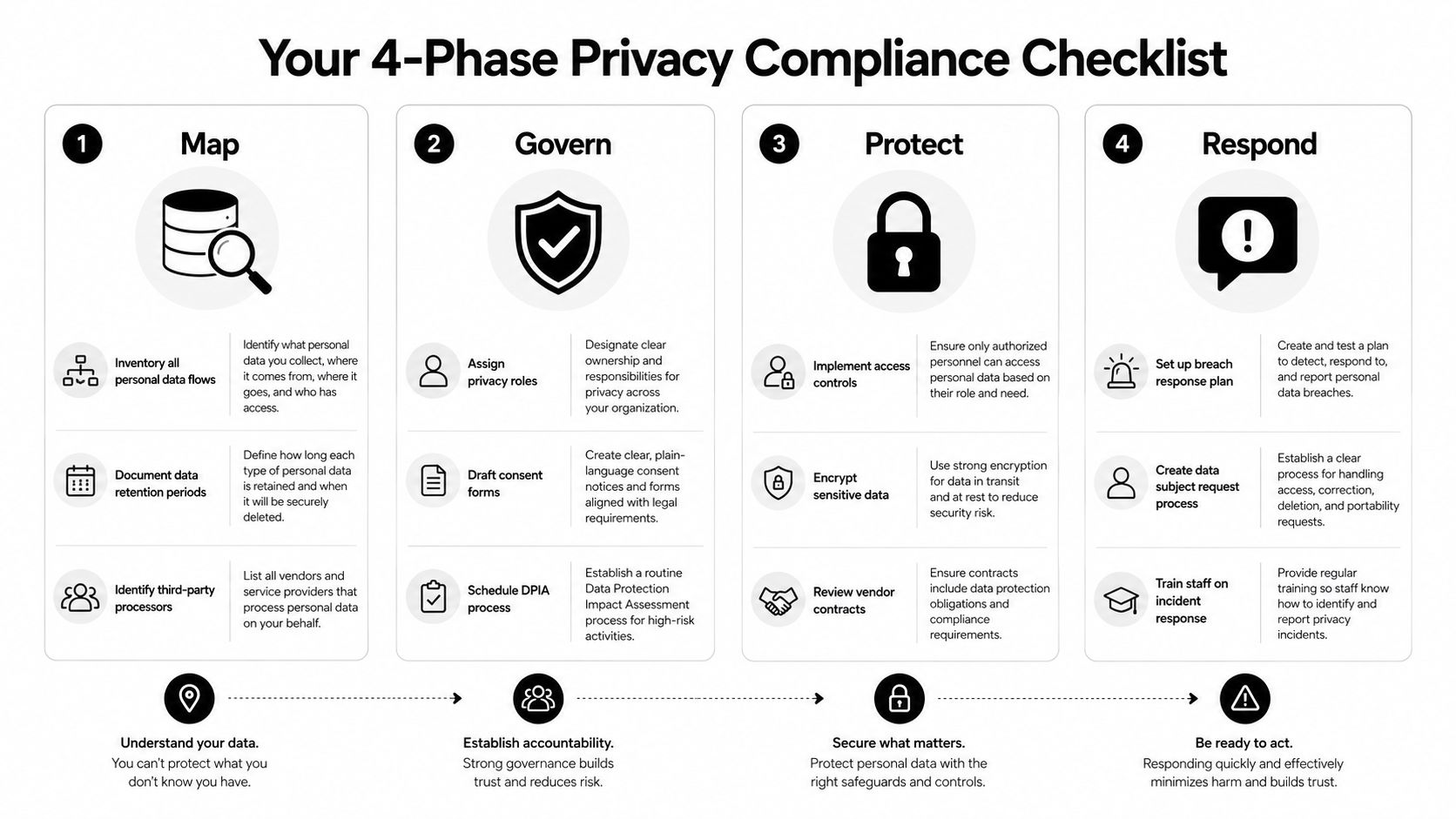
Map
- Export the schema: Pull the account-sharing module's user and event schema, then tag every field as personal data, sensitive data, operational data, or non-personal data.
- Document flows: Draw the movement of credentials, recovery contacts, usage history, support records, and exports across internal systems and processors.
- Assign purposes: Give every field a documented purpose and lawful basis. Flag fields that have no clear owner or justification.
- Set retention rules: Record how long each category should remain available, what triggers deletion, and which records require review before removal.
- Identify processors: List cloud storage, analytics, support, authentication, payment, and messaging providers that can receive personal data.
Govern
- Name accountable roles: Assign owners for privacy operations, engineering controls, security response, vendor oversight, and user requests.
- Version notices: Store the exact privacy notice and consent language shown at each release, with an approval record.
- Create consent records: Capture participant identity, purpose, choice, timestamp, notice version, and withdrawal status.
- Define DPIA triggers: Require review before launching new profiling, sensitive-data processing, large-scale monitoring, or a feature that changes participant visibility.
- Review transfers: Document the countries, vendors, transfer mechanism, and safeguards for each cross-border flow.
Protect
- Enforce least privilege: Give owners, members, support agents, and administrators only the permissions required for their tasks.
- Protect credentials: Store secrets in a managed vault, avoid exposing recovery addresses, and require MFA for high-risk actions.
- Log activity: Record participant-level access, exports, permission changes, consent changes, session revocations, and administrative configuration updates.
- Review vendors: Check processor contracts, subprocessor lists, security commitments, deletion support, and incident contacts.
- Test deletion: Run a controlled request through every relevant system and retain proof of completion.
Respond
- Write the runbook: Define triage, containment, evidence preservation, legal assessment, processor escalation, notification, and user communications.
- Create request workflows: Give users a visible route for access, correction, deletion, and applicable opt-out choices.
- Prepare templates: Draft internal escalation messages, processor notices, regulator communications, and plain-language user updates.
- Run a tabletop: Simulate a compromised shared credential and test whether the team can identify affected participants and revoke access.
- Record lessons: Close each exercise or incident with owners, deadlines, control changes, and a policy update decision.
Sample Policy Language and User Facing Notices
A shared-account user may invite a colleague, family member, or contractor without realizing what that person can see. The notice should answer that question at the point of action. Show the data categories, purpose, permission scope, and withdrawal route in plain language.
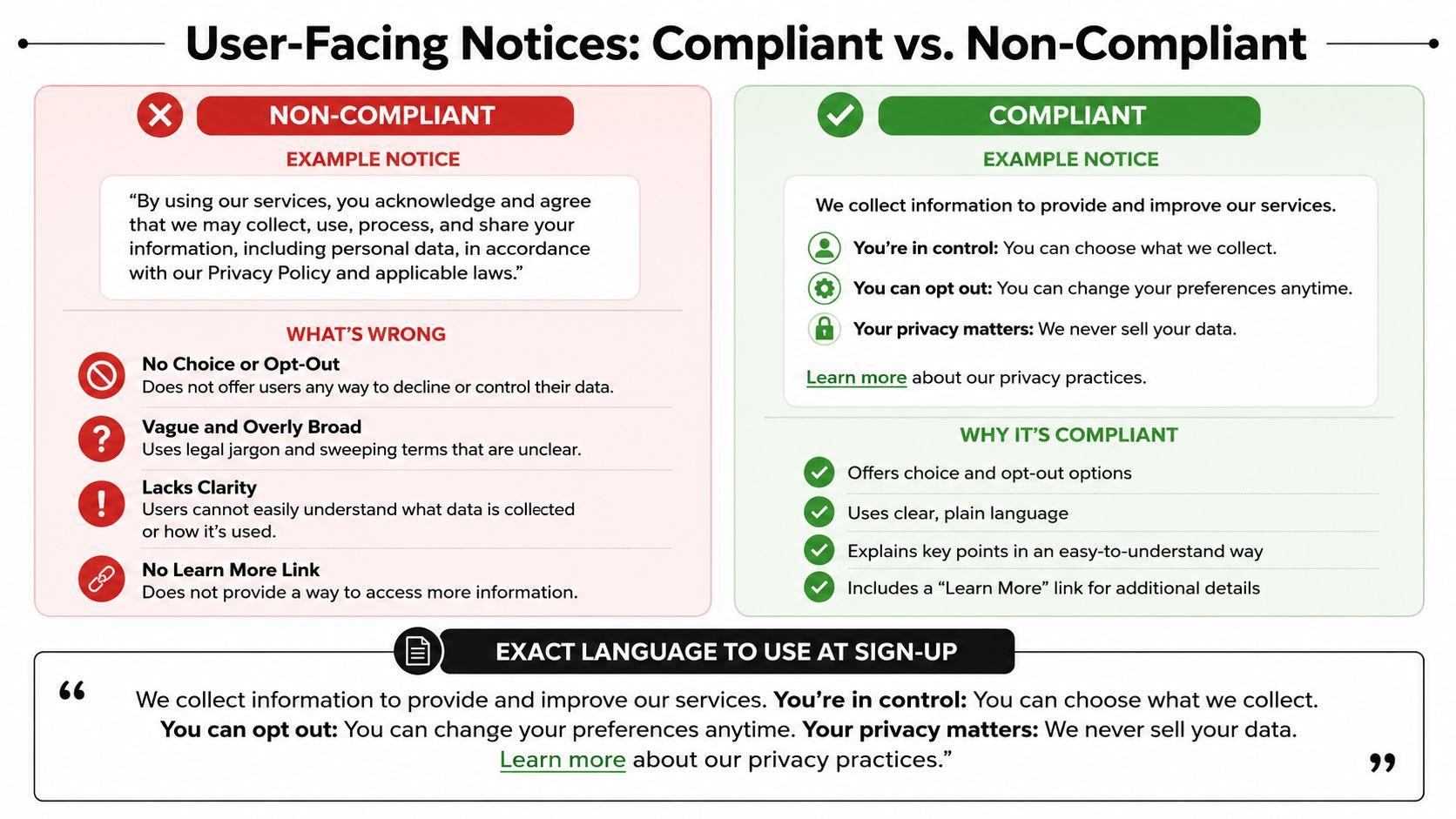
A sign-up notice could say:
We'll use your name and email address to create and secure your account, manage your subscription access, and contact you about account activity. We'll show other members only the profile information and permissions you choose to share. You can review or change these choices in Privacy Settings, or contact us at privacy@example.com. Read our Privacy Notice for details about retention, vendors, international transfers, and your rights.
Replace the example address with a monitored privacy contact and connect the reference to the published notice page. The interface should also identify required and optional fields, then explain which information other participants can view. A policy is easier to trust when its wording matches the screens, settings, and access records behind it.
Use separate language when someone adds another participant:
You're inviting another person to this shared account. They may see the services and permissions selected on the next screen. They won't receive your recovery email, billing details, or private activity unless you grant that access. You can remove their access from Account Members.
A permission prompt should identify the exact item and the resulting visibility:
Allow this member to view the shared watchlist?
They'll be able to view titles saved to the group list. This choice doesn't give them access to your private profile or account recovery details. You can withdraw access anytime in Privacy Settings.
Signals of a weak notice
- Vague categories: “We may collect information” leaves users unable to tell which data is involved.
- Bundled choices: One acceptance combines unrelated analytics, marketing, sharing, and account functions.
- Buried withdrawal: A user accepts in one click, then must search support pages to change the choice.
- Missing history: Users cannot see which notice applied when they joined or when the platform changed its practices.
- Unclear visibility: The notice does not explain what other account participants can view.
A stronger interface uses just-in-time explanations, granular permissions, an accessible policy history, and a visible privacy contact. Each choice should also create usable evidence, such as the notice version shown, the permission selected, the account or participant affected, and the time of the change. That record connects user-facing language to the operational controls that enforce it.
Common Misconceptions That Lead to Real Penalties
A privacy notice is necessary, but it's only a description of intended behavior. Regulators, customers, and enterprise partners increasingly want proof that the product follows the description.
The enforcement environment shows why this distinction matters. The CMS GDPR Enforcement Tracker recorded 2,685 fines by 1 March 2026, with around €6.11 billion in total fines and an average fine of €2.277 million across 2018 to 2026 (CMS GDPR Enforcement Tracker figures). The figures describe enforcement volume and penalties, not a guaranteed outcome for any particular organization.
| Common Misconception | What Regulators Actually Expect |
|---|---|
| “Our posted notice means we're compliant.” | A current data map, approved processing purposes, retention controls, and evidence that product behavior matches the notice |
| “A consent banner solves lawful basis.” | Purpose-specific choices, accessible withdrawal, records tied to a person or account, and downstream enforcement |
| “The vendor owns the risk.” | Reviewed processor contracts, subprocessor visibility, security commitments, deletion support, and incident cooperation |
| “We're too small for breach duties.” | An incident assessment based on the data and risk involved, with a documented decision and timely escalation where required |
A fintech may have a mature legal department and still fail if a vendor receives data for an undocumented purpose. A smaller shared-account service can create the same exposure by ignoring subprocessors that store exports or process authentication events. Company size may affect resources, but it doesn't erase the need to understand the data flow.
The Future of Privacy Forum's 2026 enforcement retrospective also highlights the operational direction of privacy enforcement, including scrutiny of opt-out flows, browser privacy signals, dark patterns, and downstream vendors honoring consumer choices. Treat compliance as a continuous evidence trail, not a one-time document project.
Your First 90 Days and Answers to Top Questions
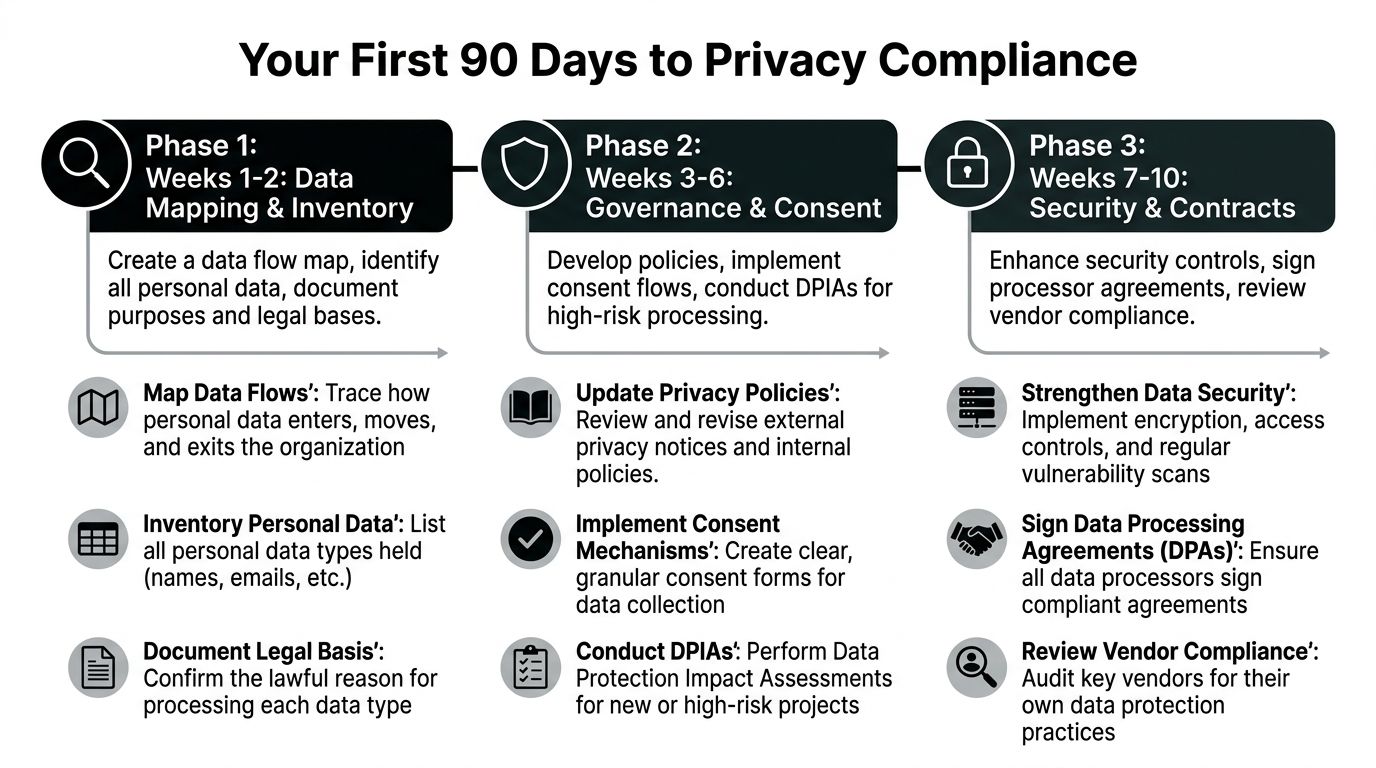
A shared account can look orderly until one participant leaves, a credential is reused, or an export reaches the wrong workspace. Your first ninety days should therefore produce evidence that explains who can access what, under which authority, and what happens when that authority changes.
- Weeks 1 to 2: Confirm the highest-risk user journeys, including invitations, account recovery, participant removal, credential sharing, and administrator access. Record the decisions and unresolved questions.
- Weeks 3 to 6: Test whether privacy notices, permission screens, and withdrawal paths match the product experience. Ask support and engineering to review the same scenarios, since each team sees different failures.
- Weeks 7 to 10: Examine edge cases, such as a former participant retaining access, a household member using another person's profile, or a vendor receiving an account export. Document the expected response and the evidence that should remain.
- Weeks 11 to 12: Hold a review with product, security, support, and legal. Rank open risks by potential user impact, set deadlines, and record who accepted each remaining risk.
Answers to common questions
Can one person consent for everyone? Only where that person has the authority required for the service and the processing involved. Otherwise, give each participant a clear choice and keep access boundaries separate.
What should happen when someone leaves? Remove their permissions, invalidate relevant sessions or shared credentials, and check connected tools. The record should show what changed and when.
How much evidence is enough? Enough to reconstruct the decision: the user or account involved, the purpose, the permission state, the system action, and the responsible owner. Evidence is the receipt for the privacy decision.
AccountShare helps groups manage shared access to streaming services, AI tools, and software with configurable permissions, password-sharing options, and security-focused account controls. Visit AccountShare to organize shared subscriptions with clearer participant boundaries and a more accountable approach to privacy.