
Group Buying Platform: A Practical Guide to Saving Together
A group buying platform aggregates demand so participants can get a lower price or shared access to a product than each could get alone. With U.S. households paying an average of $69 a month for four paid streaming services in 2025, the practical questions are whether pooling saves money and whether sharing access keeps everyone's information safe.
Your subscription list might include a streaming service for the kids, another for live entertainment, an AI tool for coursework, and software someone needed for a project that's already finished. Meanwhile, a small team might be paying for separate subscriptions even though colleagues use the same tool at different times.
Buying together sounds sensible. But a smaller payment isn't necessarily a better deal if access disappears during work, another member can see private files, or nobody knows who controls account recovery.
What a Group Buying Platform Actually Does
Think of collective purchasing as neighbors approaching a supplier together rather than knocking on the door separately. The supplier sees a combined order, and the buyers ask for terms that make joining worthwhile.
For digital subscriptions, however, the arrangement needs closer inspection. You might be buying an individual licensed seat, a place in an approved household plan, or access administered through an intermediary. Those aren't interchangeable.
Understand what you're buying
A family considering streaming access should establish whether each member gets a separate profile and whether the plan permits their arrangement. A small business considering software needs to know whether members receive their own workspace identities or merely take turns using an account.
Use these distinctions when evaluating an offer:
- Ownership: Identify who holds the subscription contract and controls billing.
- Entitlement: Establish whether you receive a seat, profile, voucher, or managed session.
- Eligibility: Check the provider's terms for household, organizational, geographic, and resale restrictions.
- Continuity: Find out what happens when the organizer leaves or the underlying subscription ends.
A platform's description of “shared access” doesn't settle those questions. Ask for the actual plan name and access conditions before paying.
Separate affordability from suitability
A discount only matters if the purchased service fits your needs. A family that wants evening entertainment has different requirements from a business handling confidential client documents.
Practical rule: Compare equivalent access, not just subscription names.
That means matching features, permitted users, availability, privacy, and cancellation terms. An arrangement that removes capabilities you need isn't equivalent to your existing subscription, even when both display the same product logo.
Treat the decision as a purchase assessment, not a clever password-sharing shortcut. The useful outcome is an affordable, permitted arrangement that you can leave without losing control of your information.
How Group Buying Works End to End
Suppose a household wants to join an eligible streaming bundle. A sensible transaction should make the journey from interest to usable access visible, rather than asking buyers to pay and hope.
From interest to activation
The organizer first collects expressions of interest. Joining a waiting list should be clearly distinguished from authorizing a payment or accepting a recurring commitment.
Next comes the activation threshold: enough eligible participants must commit for the offer to proceed. Groupon helped establish this approach after launching as Getyourgroupon in November 2008, with deals activated by a minimum buyer count; it expanded to more than 500 markets within roughly three years, according to The Edge's account of group buying's growth.
The mechanics resemble a wholesale club: participants combine demand, but the organizer still has to explain what each person receives. For a useful analogy about coordinating contributions, EasyRegistry's guide to pooling cash gifts with guests illustrates the shared-funding side, though subscription pooling also involves continuing access obligations.
From payment to support
Before checkout, the platform should clarify:
- Payment timing: Whether it collects funds immediately, authorizes them conditionally, or charges after activation.
- Failed activation: Whether buyers receive a refund, how it's processed, and whether any fees remain.
- Delivery: Whether access arrives through a provider invitation, licensed seat, or another disclosed mechanism.
- Ongoing support: Who handles unavailable access, member departures, replacement arrangements, and renewal disputes.
The group purchasing explainer provides additional context for the collective-purchase model.
Once the bundle activates, participants should receive confirmation of their entitlement and instructions for getting help. Don't assume a replacement account preserves viewing history, files, or settings.
The organizer has to manage both how many people the offer can serve and what each person can access. Collecting enough money solves neither problem by itself.
Three Flavors of Group Buying Compared
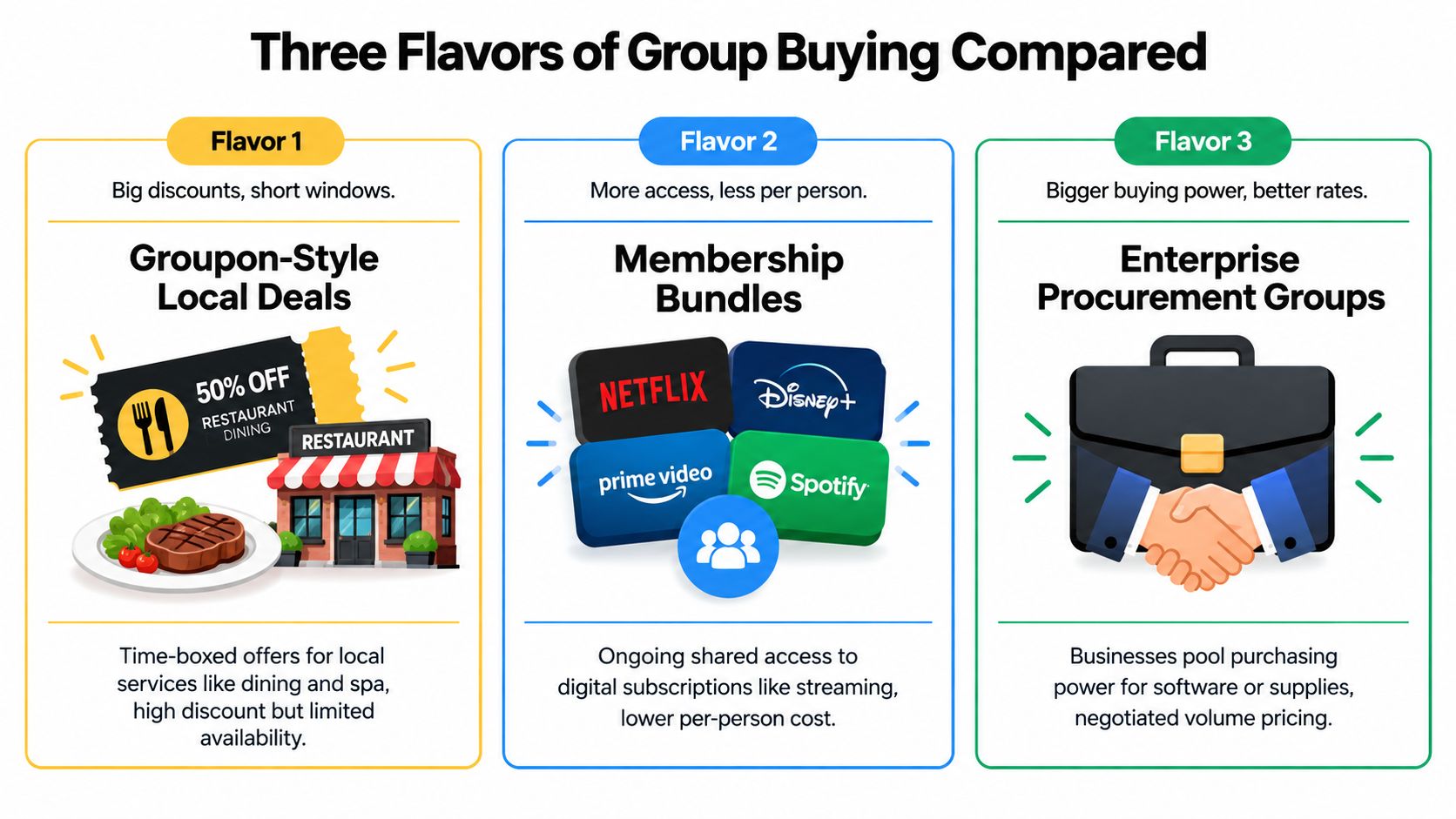
A restaurant voucher, a team order of produce, and shared software access can all involve collective demand. But buyers receive different things, and the risks don't travel neatly from one model to another.
Local deals, social commerce, and subscription pooling
Groupon-style local deals sell a defined merchant offer, such as a meal or appointment. Evaluate the redemption window and the merchant's ability to honor it, rather than assuming a discounted voucher guarantees convenient availability.
Pinduoduo-style social commerce organizes collective retail purchases. Founded in 2015 around agricultural products, Pinduoduo reached approximately $15 billion in gross merchandise value within roughly two years; coverage discussed in 2020 described $41.8 billion in merchandise across 7.5 billion orders, as detailed in Daxue Consulting's Pinduoduo analysis. Merchandise value describes goods transacted, not the company's revenue or profit.
Subscription pooling concerns continuing access rather than a completed delivery. Buyers should examine renewal responsibilities, permitted membership, and whether their access depends on someone else maintaining the account.
Three Group Buying Models at a Glance
There's no universal cohort size. The appropriate group depends on the merchant's capacity, the offer's threshold, or the subscription's documented limits.
| Model | Typical Cohort Size | Where Savings Come From | Dominant Risk |
|---|---|---|---|
| Local deals | Merchant-defined participation threshold | A promotional offer tied to aggregated demand | Redemption restrictions or insufficient service capacity |
| Social commerce | Offer-specific purchasing teams | Coordinated demand for retail goods | Product quality or fulfillment problems |
| Subscription pooling | Provider-permitted seats or members | Dividing an eligible plan's total cost | Interrupted access, privacy exposure, or incompatible sharing terms |
Enterprise procurement groups are another variation: businesses coordinate purchasing while negotiating contracts and administration separately. They shouldn't be confused with sharing a consumer login.
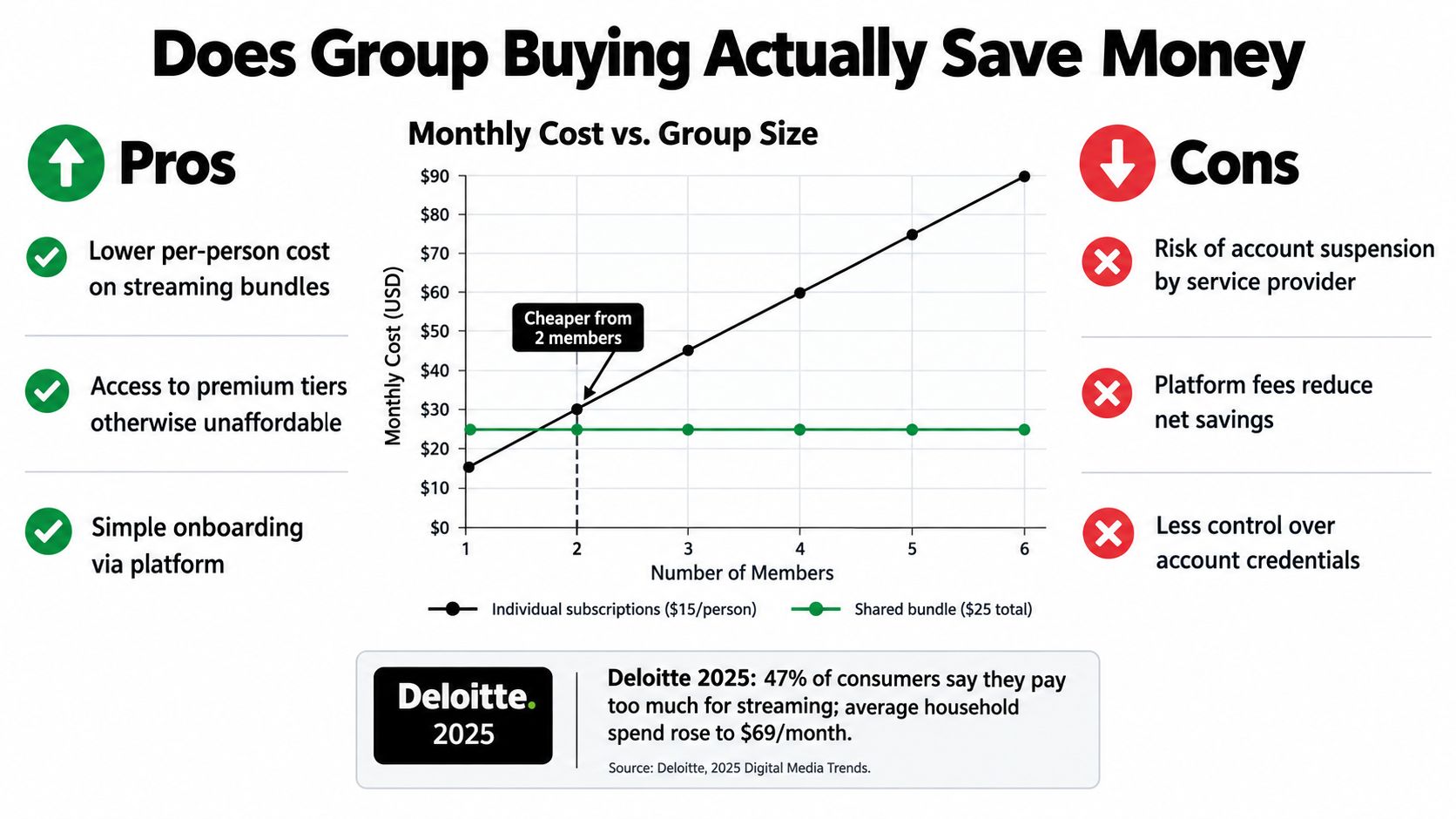
Treat the graphic as a conceptual illustration, not a verified price comparison or evidence of a particular savings rate. Actual provider quotes and fees are necessary before making a spending decision.
The useful distinction is what you receive: a redeemable offer, delivered merchandise, or a continuing entitlement. That determines which questions deserve the most attention.
Does Group Buying Actually Save Money
Pooling is a budgeting decision, not a guaranteed discount. Your comparison should be the cheapest permitted arrangement that meets your needs, not the most expensive individual subscription you can find.
Deloitte's 2025 findings put average U.S. household spending at $69 monthly for four paid streaming services, up 13% year over year; respondents considered $14 an appropriate price for an ad-free service, and a $5 increase would make 60% likely to cancel, according to Deloitte's Digital Media Trends survey. The appropriate-price response is a consumer preference, not an advertised ad-supported tariff.
Build a like-for-like calculation
Start with provider quotes, then compare the same billing period. Include taxes, payment charges, currency conversion, required upgrades, and platform fees.
Effective pooled cost per participating member = total group cost ÷ paying members
That calculation only works if you include the cost of unused seats in the total. A plan divided among hypothetical future members can look cheaper than what today's members pay.
| Cost component | Approved pooled arrangement | Best permitted alternative |
|---|---|---|
| Subscription | Full underlying plan cost | Suitable individual, household, or team plan |
| Additional charges | Platform, payment, tax, and currency costs | Applicable charges on direct purchase |
| Commitment | Renewal and member-payment obligations | Monthly or annual cancellation conditions |
| Disruption | Replacement access and migration burden | Comparable continuity requirements |
For a household considering pooled streaming, obtain the pool's all-in quote and compare it with an eligible household plan, suitable bundle, ad-supported tier, or rotating subscriptions. For annual offers, convert the upfront payment into a monthly equivalent, but retain the cancellation disadvantage in your decision.
Account for changes without inventing probabilities
Ask what you'd do if a member stopped paying or the provider changed its sharing rules. If you don't have reliable evidence for a probability, don't create a numerical “risk-adjusted saving”; test those scenarios directly.
A cheap arrangement that requires an emergency replacement subscription may cost more than a predictable direct plan.
Pooling is a poor fit when required simultaneous access isn't available, private workspaces are essential, or downtime would interrupt paid work. It also fails the budget test when you'd otherwise cancel an underused service altogether.
Security belongs in this comparison because restricted access can affect what you're buying.
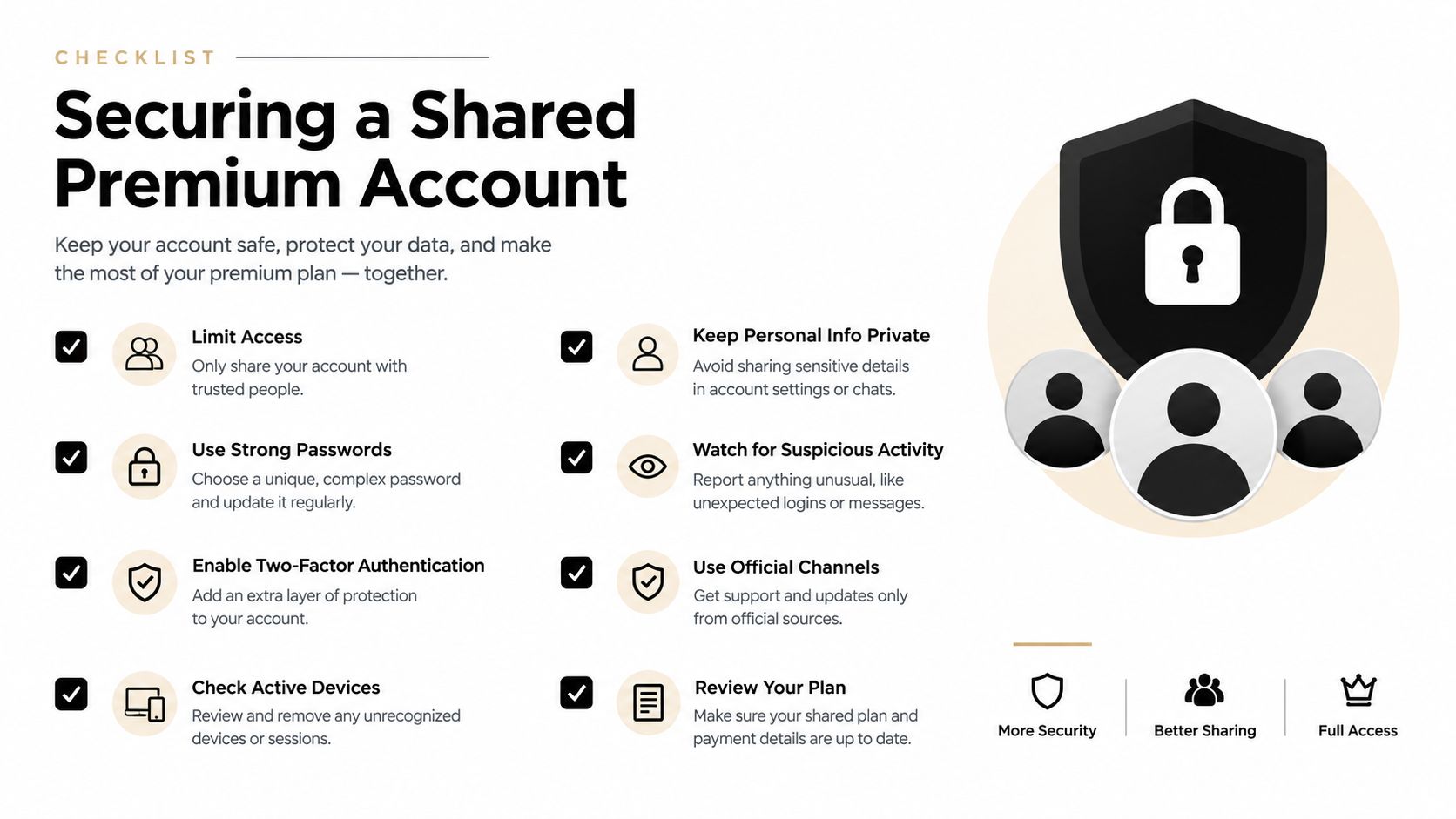
Securing a Shared Premium Account
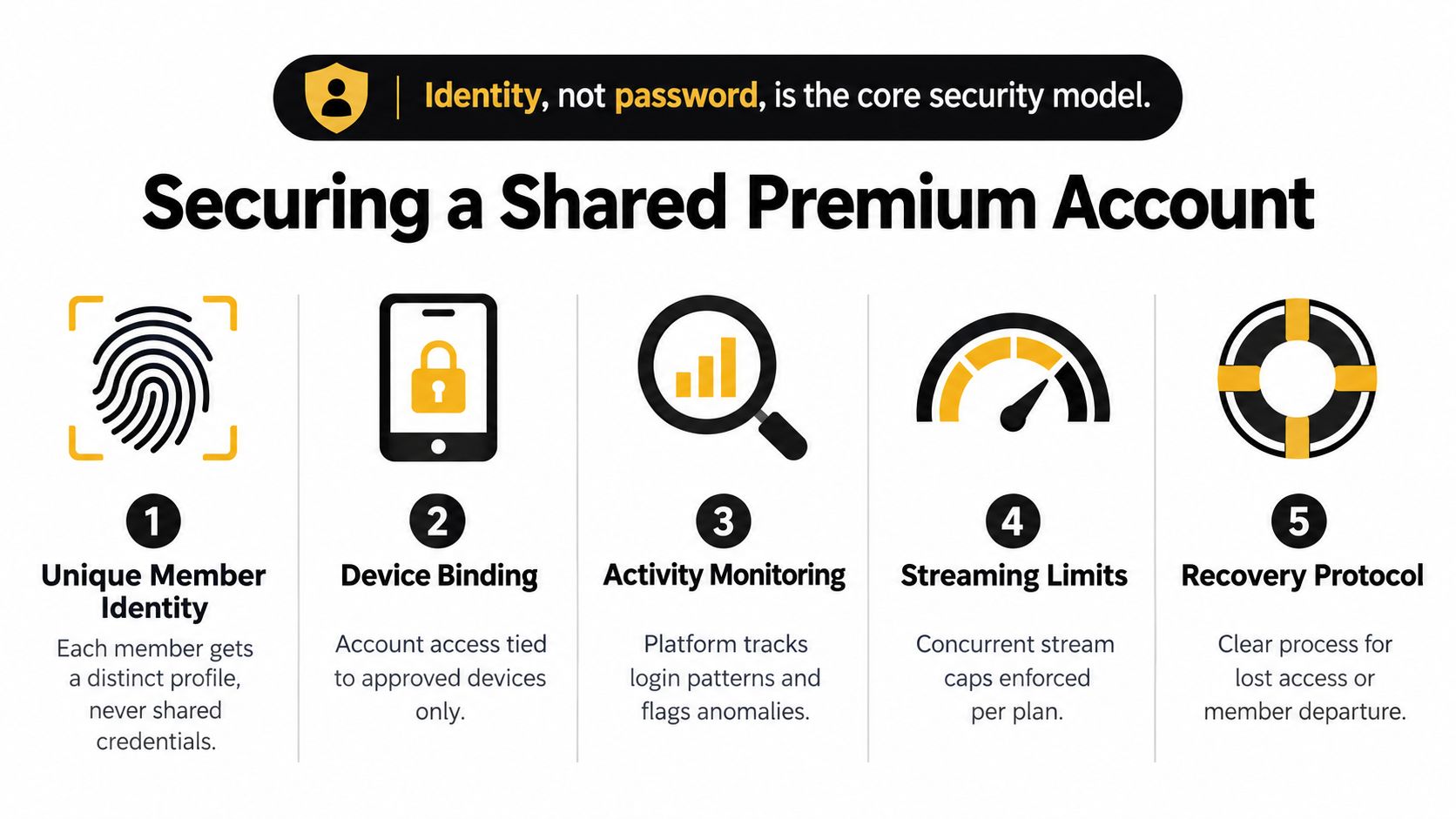
Sharing access should be an identity problem, not an exercise in circulating a password. Think of an office building: colleagues need individual badges for approved rooms, not copies of the master key.
Deloitte's 2025 Connected Consumer survey found that 47% of U.S. respondents experienced a digital-security failure in the previous year, 27% experienced multiple failures, and only 27% expressed high or very high trust in technology providers' data protection, according to Deloitte's connected-consumer findings. Those figures describe general consumer experiences, not a measured failure rate for subscription pooling.
Give each participant an accountable identity
NIST's cloud identity guidance calls for individually assigned credentials where possible and individual authentication before accessing an unavoidable shared credential. Its zero-trust principles also reject implicit trust based on network location and require secured communications.
Translate those principles into practical requirements:
- Individual authentication: Each participant signs in through a distinct identity, with MFA or phishing-resistant authentication where feasible.
- Least privilege: Ordinary members can use their entitlement without changing billing, recovery settings, or other members' permissions.
- Time-limited authorization: Access expires or is reviewed when membership changes.
- Auditable activity: Administrators can associate credential retrieval and sensitive actions with a specific participant.
A separate viewing profile isn't necessarily a separate security boundary. Verify whether another profile can access account settings, payment information, saved content, or private files.
Protect secrets and make departures manageable
If a service requires a common credential, the sharing layer should vault and rotate it rather than expose it in plaintext. Verify how access reaches the underlying service and whether members can retrieve the secret despite the interface hiding it.
Device and session records should support investigation of unusual locations, device changes, or concurrent activity. Administrators also need a workable revocation process, including terminating active sessions rather than merely removing a name from a membership list.
Keep recovery channels under a designated owner's control. If someone leaves, the organizer should be able to revoke that person without locking out everyone else.
Security test: Ask the administrator to demonstrate member removal, session termination, and recovery ownership before trusting the setup.
Use this shared-access security guide to frame questions about the arrangement. A lock icon, a reassuring slogan, or a password sent through private chat doesn't demonstrate permission isolation.
If the underlying service can't protect the data you need to keep private, the sharing layer can't be assumed to fix that limitation.
Use Cases for Families, Students, Small Businesses, and Digital Nomads
The following scenarios are decision examples, not claims about measured savings. Their usefulness depends on provider eligibility and the controls available.
Families and students
A household considering streaming or gaming access should assign billing ownership to an adult and check whether the service supports appropriate profiles and child permissions. Children shouldn't need access to payment settings to use entertainment features.
- Do: Use supported parental controls and keep purchase approvals with the responsible adult.
- Don't: Assume a profile hides payment details or prevents account-wide changes.
A student group considering AI or productivity tools should agree on a spending cap and an end-of-term exit date. Each participant should keep coursework and private material in an appropriately isolated workspace; unsuitable content shouldn't be placed in spaces used by other members.
- Do: Establish who exports work and cancels renewal when the group ends.
- Don't: Put sensitive assignments into an account whose history everyone can inspect.
Small businesses and digital nomads
A small business choosing collaborative software should prioritize named seats and role-based access over a consumer-style shared login. The billing administrator should own the organization's subscription, while a written departure agreement covers files, permissions, and outstanding payments.
- Do: Verify that the purchased tier supports required collaboration and administration.
- Don't: Treat a cheaper personal account as equivalent to an organizational workspace.
A digital nomad considering pooled access needs documented regional eligibility and a realistic understanding of time-zone overlap. Legitimate travel should be handled through approved authentication and support procedures, not concealed to evade provider restrictions.
- Do: Ask how travel-related verification and access recovery work.
- Don't: Rely on location spoofing or undisclosed workarounds.
More participants aren't automatically better. Experimental research on group-buying popularity found an inverted U-shaped relationship with purchase intention: initial popularity increased attractiveness, but excessive popularity reduced intent when buyers feared poorer service, especially among risk-averse consumers.
For these groups, a sensible interpretation is to favor a manageable cohort over indiscriminate expansion.
Launching and Monitoring a Group Buy
An organizer should be able to explain the offer, demonstrate access, and handle a departure before opening enrollment. A checkout page alone isn't an operating plan.
Before accepting participants
Use a pre-launch checklist tied to identifiable failure modes:
- Confirm eligibility: Record the provider's permitted users, regions, and sharing conditions to avoid selling incompatible access.
- Set a capacity cap: Base membership on documented seats and concurrency limits, not anticipated demand.
- Test identity controls: Verify individual authentication, MFA where supported, and restricted administrative permissions.
- Write financial rules: Define refunds, renewals, unpaid contributions, cancellation, and member exits.
- Run a test transaction: Confirm payment, delivery, support, and removal work before public enrollment.
AccountShare is an option for group purchasing of premium digital subscriptions, with shared-account management and customizable permissions. Evaluate the specific offer against approved household plans and direct team subscriptions rather than assuming every arrangement provides equivalent access.
After access begins
Monitor what happens after fulfillment, not just how many people join. Track conversion by cohort size, refund and churn rates, support response latency during peak demand, and complaints per active participant.
Each measure answers a different question. Conversion shows whether buyers accept the offer; refunds and churn expose unmet expectations; peak latency reveals whether members receive help when demand rises.
Operators should also compare predicted concurrency with the provider's documented limits and pause enrollment before capacity is exceeded. The resource allocation strategies guide offers a useful starting point for that operational discussion.
Claims about priority access or faster responses should have defined conditions and a way to verify them. Members need to know whether “priority” means support handling, service availability, or access to features.
Growth is useful only while the organizer can deliver the access already promised.
Keep participants informed when capacity, pricing, or provider terms change. Silent substitutions leave people unable to judge whether their original purchase still makes sense.
When a Group Buying Platform Is Worth Using
A group buying platform is worth considering when its all-in cost beats an equivalent permitted alternative and its access model protects what matters to you. Passing only the price test isn't enough.
Families and students may benefit from eligible plans that replace unnecessary separate purchases. Small businesses should choose pooled arrangements only when they retain required workspace and administrative controls; digital nomads should weigh flexibility against regional eligibility and dependable recovery.
Before signing up, make a short decision sheet:
- Compare: Obtain the pooled quote and the closest suitable direct-plan quote.
- Verify: Check membership eligibility, permissions, and recovery ownership.
- Plan: Write down how you'll leave, preserve your data, and replace access.
If the organizer can't answer those questions clearly, postpone the purchase. A manageable subscription budget shouldn't depend on an arrangement you don't understand.
AccountShare offers group purchasing for premium streaming services, AI tools, and software, alongside shared-account management and customizable permissions. Visit AccountShare to explore available offers, then compare the plan's total cost, eligibility, and access controls with your household's or team's requirements before joining.