

Access Control vs Authorization: Key Differences
Being logged in doesn't mean a person is authorized to do everything an account can do. That popular shortcut collapses several separate security decisions into one, which creates confusion when a shared subscription needs different permissions for owners, members, administrators, and viewers.
A better mental model is this: access control is the broader system that governs access, while authorization is the decision logic applied to each protected request. Authentication helps establish identity, but a valid login shouldn't automatically grant access to billing settings, password visibility, member management, or every application feature. The distinction becomes even more important when device health, location, session context, and changing risk can alter what someone should be allowed to do.
Why the Difference Between Access Control and Authorization Matters
The common advice says that authentication happens first and authorization follows. That sequence is useful, but incomplete. It can make authorization sound like a single check performed immediately after login, even though modern systems need to reconsider permissions throughout a session.
A user may authenticate successfully and enter a shared service. The platform still has to answer separate questions:
- Can this person view the service?
- Can they use a particular feature?
- Can they invite another member?
- Can they change billing or the password?
- Can they access the request from this device and location?
- Should the permission remain valid after the user's role, device, or session context changes?
Authenticated is not the same as continuously authorized. Authentication establishes or validates identity. Authorization determines whether that identified subject may perform a particular action on a particular resource. NIST distinguishes authorization as the privileges granted to a user, program, or process, while access control covers the process of granting or denying requests for information, services, or facilities. NIST's access-control glossary also distinguishes the decision from enforcement, meaning a system can decide that an action is allowed and then separately implement that result.
| Concept | Practical question | Example in a shared service |
|---|---|---|
| Authentication | Who is presenting this request? | Has the member successfully signed in? |
| Access control | What governance and enforcement rules apply? | Which people, resources, actions, and policy gates belong to this subscription? |
| Authorization | Is this specific action allowed right now? | May this member view a password or remove another member? |
| Enforcement | How does the system apply the result? | Does the application reveal the feature, reject the request, or require stronger verification? |
This framing helps teams avoid a dangerous design error. If account access is treated as an all-or-nothing event, a platform may give ordinary members administrative powers because they passed the login gate. A carefully designed system separates membership from privilege, and privilege from the context of the current request.
Practical rule: A successful login should open a controlled session, not grant an unlimited account-wide capability set.
For people managing shared services, the distinction also supports least privilege, auditability, and revocation. An owner can retain control of billing while a member uses the subscription, and a password can remain hidden even when the member is allowed to access the service. Teams reviewing how to protect team data can use the same layered thinking when deciding which users may view, edit, share, or administer information.
A shared-account security plan should therefore document both the governance layer and the runtime decision layer. Resources such as this guide to ensuring data security are most useful when they lead to concrete questions about permissions, enforcement points, logs, and revocation rather than stopping at the sign-in screen.
Defining Access Control and Authorization in Plain Language
Access control is the broad governance and enforcement process that manages requests to use information, computing services, or physical facilities. It defines the protected resources, the subjects who may request access, the actions they may attempt, the rules that apply, and the mechanisms that enforce the outcome.
A subject might be a person, a program, or a service account. A resource might be a document, a premium feature, a billing screen, or a stored credential. An action could be viewing, editing, inviting, deleting, or changing a setting. Access control brings these pieces together into a system that mediates access attempts rather than relying on an informal assumption that everyone inside an account is equally trusted.
Authorization is narrower. It is the specific privilege decision about whether a particular subject may perform a particular operation on a particular resource. The authorization function may return an allow or deny result, restrict the scope of the action, or require an additional verification step before proceeding.
That relationship is easiest to understand as a nested structure:
- Access-control governance defines the policy, protected resources, identities, roles, and enforcement locations.
- Authorization logic evaluates the current request against those rules.
- Enforcement applies the decision in the application, gateway, middleware, or service.
- Audit and administration record the event and provide a way to change or revoke permission.
Authorization isn't a competing alternative to access control. It's a decision point inside the larger access-control mechanism. NIST's guidance on access-control models describes access control as the broader system that mediates resource use, while authorization concerns whether a subject is permitted to access a system object. NIST's publication on access-control models is useful for translating that distinction into policy design.
What the distinction changes in practice
Suppose a shared account has an owner, an administrator, and several members. Access control can establish the account's membership rules, define which applications are connected, and identify the points where the platform must enforce restrictions. Authorization then evaluates individual actions, such as whether a member can open a premium application, invite a new person, reveal a credential, or modify subscription settings.
This separation makes revocation more precise. Removing a member from the account is one governance action, while denying that member's next request to view a password is an authorization outcome. A platform can change the authorization rule without rebuilding its entire identity or access-control mechanism.
Offboarding creates the same lesson. Disabling a user at one identity layer may not remove sessions, application-specific membership, or delegated permissions elsewhere. Administrators reviewing offboarding access removal tips should verify both the account-level relationship and the permissions enforced inside each connected service. For a broader roadmap, this access-control guide can help teams organize policies, enforcement, reviews, and revocation as one operating process.
RBAC and ABAC as Authorization Models
The authorization model determines how a system reaches its decision. Two widely used approaches are Role-Based Access Control, or RBAC, and Attribute-Based Access Control, or ABAC.
RBAC assigns permissions to roles rather than independently assigning every permission to every user. A person receives one or more roles, and the active role determines which transactions are permitted. A role hierarchy can express inherited permissions, while constraints such as separation of duty can prevent conflicting responsibilities from being combined. NIST's history of RBAC records the development of a generalized model with role hierarchies, permission relationships, role activation, and constraints, followed by later extensions and standardization. NIST's RBAC FAQ explains why role-based authorization became a scalable way to represent organizational responsibilities.
RBAC works well when groups remain stable and their permissions are easy to describe. “Owner,” “administrator,” “member,” and “viewer” are understandable roles for a shared service. The model is usually easier to explain, audit, and administer than a long list of individual exceptions.
ABAC evaluates attributes associated with the subject, resource, requested action, and environment. Those attributes might include a person's role, the sensitivity of a record, the device's trust state, the request location, a time window, or a subscription entitlement. ABAC can express conditions that RBAC alone can't capture, but every additional condition creates more policy data to collect, evaluate, test, and maintain.
The performance trade-off
A cited comparative study reports RBAC authorization latency of 0.42 to 1.34 milliseconds in static, role-hierarchical environments. The same study reports ABAC latency of 1.81 to 11.5 milliseconds as attribute variability and evaluation complexity increase, while its hybrid model measured 0.68 to 3.29 milliseconds. These are workload-specific figures, not universal benchmarks, but they illustrate why policy complexity affects the request path. OWASP's Authorization Cheat Sheet also warns that retrieving roles from a central service can add latency to each request and that excessive roles can create role-explosion and token-size problems.
A practical architecture usually starts with a stable baseline and adds context only where it changes the decision:
- Use RBAC for durable groups such as owner, family member, student, or administrator.
- Use ABAC conditions for device trust, geography, time windows, resource sensitivity, or feature entitlements.
- Use a hybrid when roles define the normal scope and attributes narrow or expand it under controlled circumstances.
For a shared-account platform, the important question isn't which acronym sounds more advanced. Ask which inputs determine the decision, how often those inputs change, and whether the authorization service can evaluate them reliably without making every request slow or fragile. Measure p50 and p95 decision latency, cache only decisions whose attributes remain stable, and fail closed for sensitive actions such as password viewing or member removal.
A deeper explanation of role-based access control should always be paired with an understanding of its limits. Roles provide structure, but they don't automatically account for a changing device, unusual location, expired entitlement, or a resource with unusually high sensitivity.
Comparing Access Control and Authorization Side by Side
The difference becomes clearer when the two concepts are placed against the same criteria. Access control establishes the system in which requests are governed. Authorization evaluates whether an individual request satisfies that system's rules.
| Criterion | Access Control | Authorization |
|---|---|---|
| Definition | The broader process for granting or denying requests to information, services, or facilities | The privilege decision about whether a subject may perform an action on a resource |
| Scope | Policies, identities, roles, resources, decision points, enforcement points, administration, and review | The current subject, action, resource, and applicable context |
| Main question | What rules exist, where do they apply, and how will the system enforce them? | Does this request pass the rules right now? |
| Typical inputs | Subjects, objects, policies, privileges, identity sources, enforcement locations, and audit requirements | Subject identity, active role, requested action, target resource, and relevant attributes |
| Frequency | Established during design, provisioning, policy changes, and governance reviews | Evaluated when a protected operation is requested, and again when sensitive context changes |
| Output | A configured governance and enforcement framework | Allow, deny, limited scope, or a requirement for additional verification |
| Decision point | Defines and organizes the mechanisms that mediate access attempts | Determines whether the specific attempt is permitted |
| Enforcement relationship | Includes the mechanisms that implement policy outcomes | Produces a decision that an enforcement point applies |
| Failure concern | Incomplete policy coverage, weak revocation, unclear ownership, or missing enforcement | Incorrectly allowing or denying a request because the policy or current context was evaluated poorly |
The table also corrects a common timing misconception. Access control isn't only a design-time document, and authorization isn't only a one-time post-login event. Access-control governance continues through provisioning, policy updates, reviews, enforcement changes, and revocation. Authorization runs at the operational edge, where the system decides what to do with a live request.
A useful test is to describe a request in full: subject, action, resource, and context. “Member accesses service” is too vague. “Member attempts to reveal the stored credential from an unfamiliar device” gives an authorization engine something meaningful to evaluate, while access-control governance determines which policy, identity data, and enforcement point handle the request.
This distinction also clarifies responsibility. Security architects define the access-control structure. Policy authors express authorization rules. Application developers place enforcement at every protected entry point. Operations teams monitor denials, unusual patterns, stale memberships, and policy changes. Treating these as separate responsibilities reduces the chance that a login check will be mistaken for complete privilege management.
Real-World Scenarios for Shared Subscriptions and Services
Shared services make the distinction tangible because several people may use one subscription without needing identical powers. The account needs a membership boundary, but each action still requires its own permission decision.
Consider a family streaming subscription. Access control establishes which people belong to the household, which seats or profiles exist, and which account-level settings are protected. Authorization decides whether a particular member may use the service from a new device, open a profile, change parental settings, invite another person, or view credentials. A successful sign-in doesn't automatically authorize administrative changes.
In a student productivity suite, access control might assign a learner to a Student role and associate that role with a course workspace and an expiry condition. Authorization then checks whether the role is still valid, whether the requested document belongs to the assigned workspace, and whether the requested operation is viewing, editing, or sharing. The same student can be allowed to read a course document and denied permission to alter workspace membership.
A small team CRM presents a more detailed case. Access control can organize users into regional groups and define which pipelines fall within each group's normal scope. Authorization can then examine the request's context, including the user's role, the sensitivity of the customer record, the device or network context, and any time-based restriction before revealing information.
These examples share the same sequence, but not the same policy:
- The service defines who belongs to the shared environment.
- The platform identifies the requested resource and action.
- Authorization evaluates the active role and relevant context.
- An enforcement point applies the result.
- Logs support review, troubleshooting, and revocation.
The model also works for non-human subjects. An integration or service account may authenticate successfully, yet authorization should limit it to the specific application feature or API operation it needs. A platform that gives every member and integration the same account-wide power has implemented identity validation without meaningful privilege separation.
The more valuable the action, the more specific the authorization request should be.
For families, that might mean separating streaming access from password visibility. For students, it might mean separating workspace membership from document editing. For small businesses, it might mean separating pipeline visibility from customer-record export. The access-control framework creates those boundaries, while authorization applies them repeatedly as users and circumstances change.
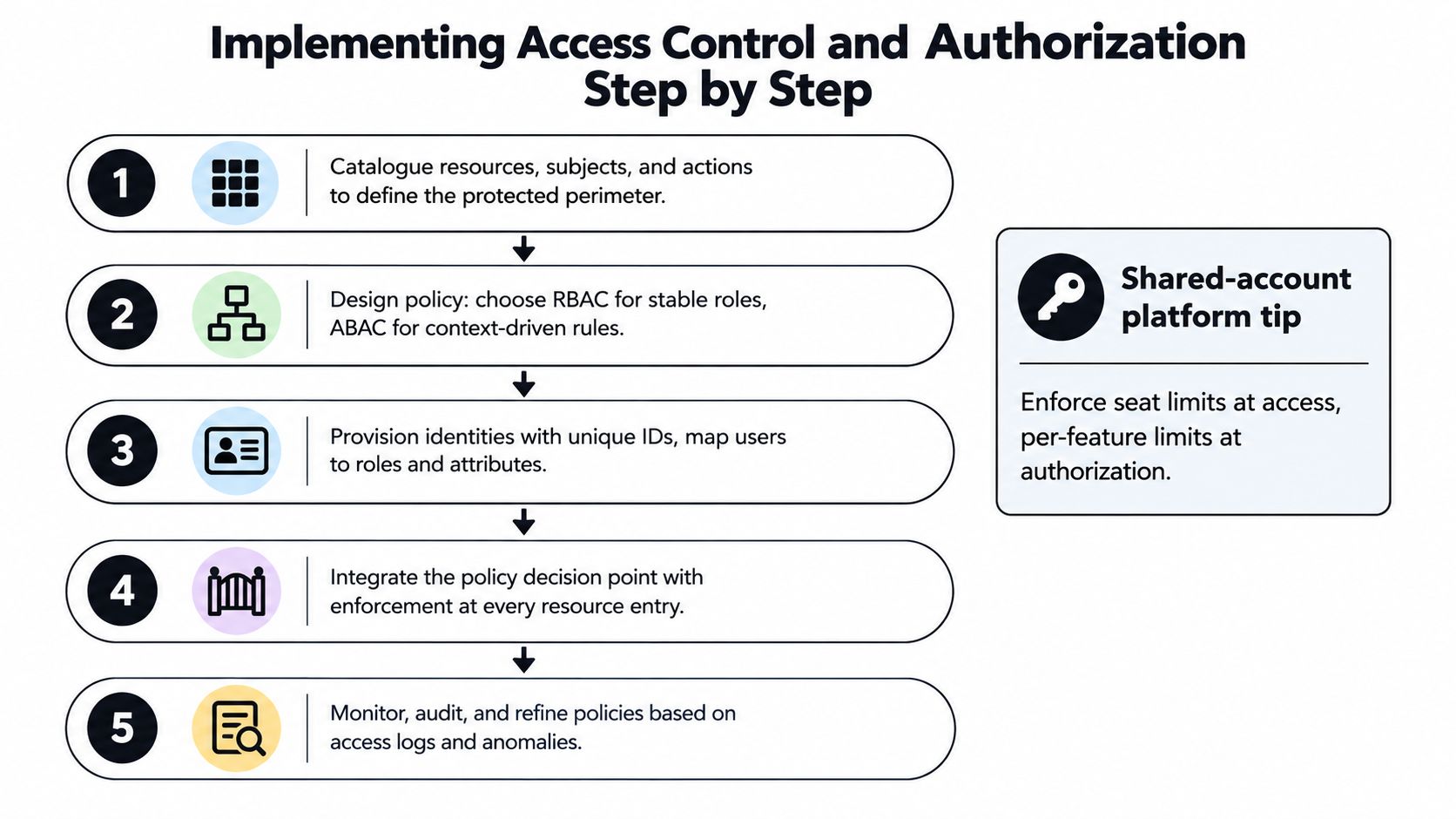
Implementing Access Control and Authorization Step by Step
A shared-account platform needs more than a list of users and passwords. It needs a model that describes protected resources, allowed actions, decision inputs, enforcement locations, and changes over time.
Start with the protected perimeter
Catalogue the resources first. Include applications, profiles, documents, credentials, billing settings, invitations, member records, administrative functions, and premium features. Then list the subjects that may request access, including owners, members, administrators, viewers, integrations, and service accounts.
For every resource, record the meaningful actions. “Access to the account” is too broad to test. “View credential,” “use application,” “invite member,” “remove member,” and “change billing” produce clearer authorization requests and expose missing policy boundaries.
Choose the policy shape
Use RBAC when stable groups explain most permission needs. Use ABAC when the decision depends on changing properties such as device health, location, resource sensitivity, time, or entitlement. A hybrid model can assign a baseline through roles and then apply attributes to narrow the permitted scope.
Keep sensitive exceptions explicit. A rule that permits ordinary use shouldn't imply permission to reveal a password or remove a member. Separate those operations so the platform can require stronger context or a different role.
Map identities to entitlements
Give each subject a unique identity and map it to roles and attributes. Avoid treating a shared credential as the identity of every person using the service. The platform should know which member initiated a request, which role is active, and which subscription or workspace contains the target resource.
Apply least privilege by starting with the smallest useful permission set. Add an entitlement only when a real task requires it, and define explicit deny behavior for operations that must remain restricted.
Connect decisions to enforcement
A policy decision point evaluates the request. A policy enforcement point applies the result. The decision point might sit behind an API gateway or in an authorization service, while enforcement might occur in application middleware, a feature boundary, or a resource handler.
Keep policy evaluation separate from interface hiding. Removing a button from a page isn't enough, because a user may call the underlying endpoint directly. Every protected resource entry must enforce the authorization result on the server side.
Policy languages such as ALFA, a language for expressing attribute-based policies, or Cedar, a policy language designed for fine-grained authorization, can make decisions more consistent and reviewable. The choice matters less than maintaining clear policy ownership, testing permit and deny paths, and recording why a sensitive request was rejected.
Re-evaluate as context changes
Continuous authorization needs current signals. Use session information, device posture, location, risk indicators, and entitlement state where they materially affect the decision. Short-lived authorization decisions can reduce exposure, but caching is appropriate only when the attributes used by the decision are stable enough for that cache period.
Measure authorization latency and inspect denial events. A slow policy path can tempt developers to bypass checks, while unexplained denials can encourage unsafe manual exceptions. Sensitive actions should fail closed when the authorization service can't establish that the request is permitted.
Implementation isn't complete when the first policy works. Test role changes, expired memberships, device changes, revoked invitations, unusual locations, service-account calls, and attempts to bypass the user interface. Review the resulting logs with the people who own the service and the people responsible for incident response.
Why Continuous Evaluation Replaces Static Access Decisions
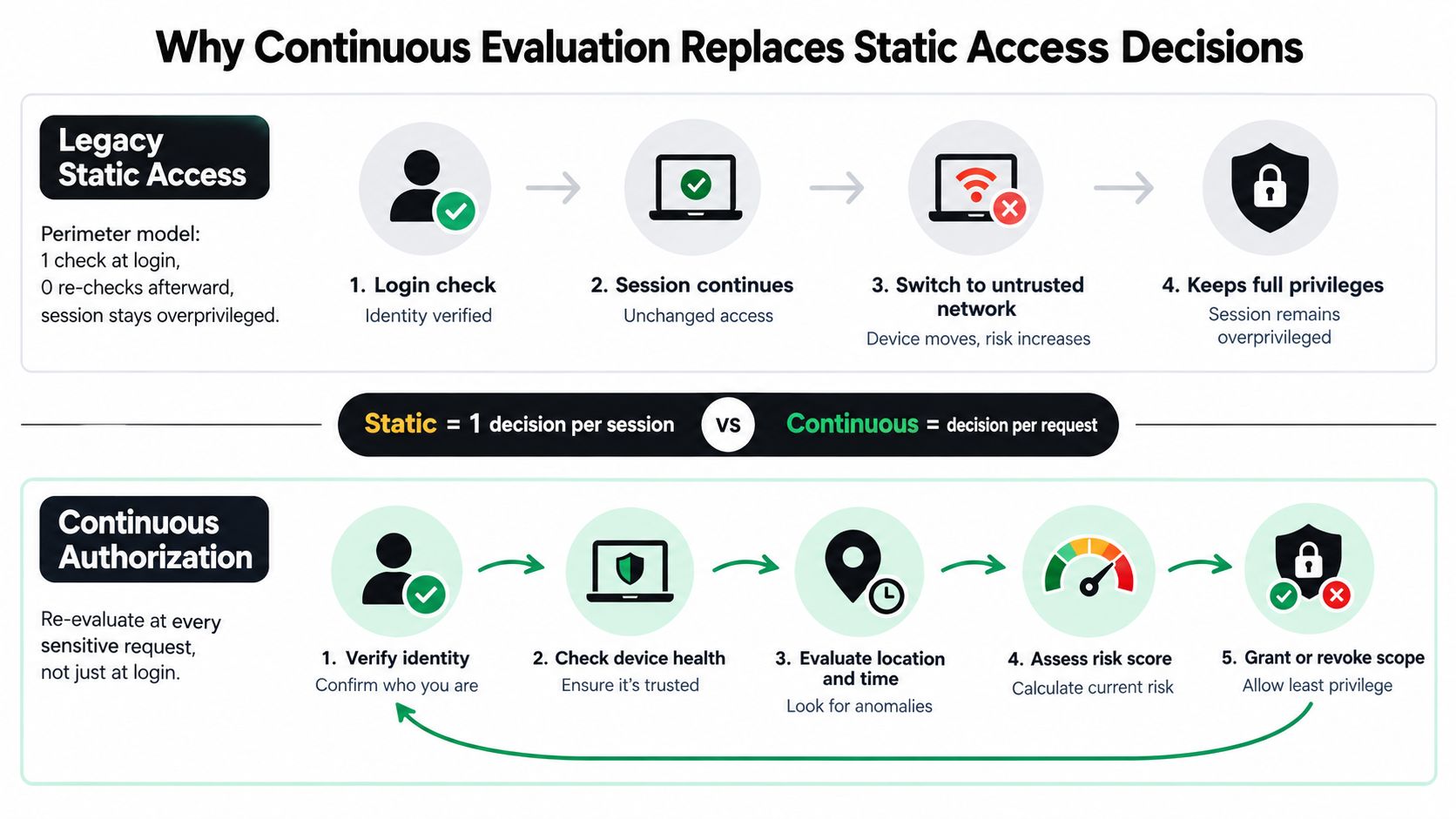
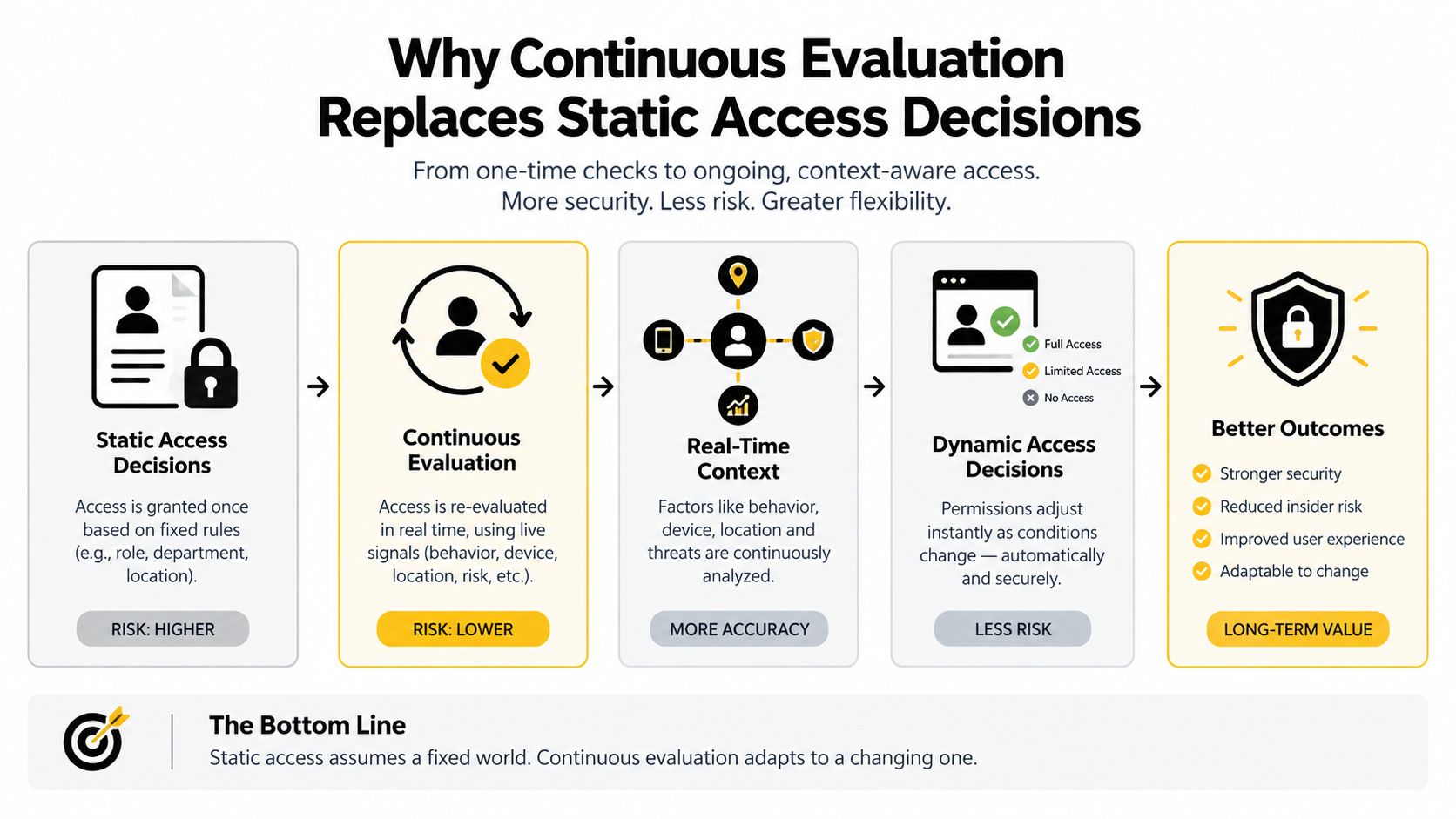
A static access decision assumes that the conditions at login remain trustworthy for the entire session. That assumption breaks when a device changes state, a membership is revoked, a resource becomes more sensitive, or a request pattern becomes unusual.
Continuous authorization treats permission as a current decision rather than a permanent consequence of an earlier login. The platform can reconsider access when a user opens a protected resource, changes a sensitive setting, requests a credential, or performs an administrative action. It can narrow the scope, ask for stronger verification, or terminate the session when the current evidence no longer supports the requested privilege.
NIST's 2025 zero-trust practice guide describes access decisions across on-premises environments, multiple clouds, remote workers, partners, devices, applications, and services. It calls for decisions based on static attributes such as identity and role together with dynamic context, including device health, location, resource sensitivity, anomalous behavior, and business-process logic. NIST's 2025 zero-trust practice guide also frames zero trust around explicit authentication and authorization for resource access or communication, without implicit trust based on network location.
A workable architecture usually combines several parts:
- Policy decision points evaluate requests at API gateways, service boundaries, or application services.
- Policy enforcement points block, permit, limit, or challenge the operation where the resource is accessed.
- Scoped session credentials limit what a session can do instead of treating a long-lived credential as unlimited proof of trust.
- Telemetry signals provide current information about device state, location, behavior, and resource sensitivity.
- Revocation paths update membership and permissions quickly when an owner, administrator, or policy engine changes the result.
This doesn't mean every low-risk page needs an expensive remote check. It means architects should identify which operations deserve fresh evaluation and avoid assuming that a session remains equally trusted after its context changes.
A session is a delivery mechanism for requests, not a permanent authorization certificate.
For shared accounts, this approach separates ordinary use from high-impact actions. A member might continue using an approved feature while the platform independently blocks password viewing, invitation creation, or billing changes because the current request lacks the required role or context. Zero trust is therefore less a product label than an operating philosophy that connects access-control governance with authorization decisions in real time.
Choosing the Right Model and Final Recommendations
Model selection should follow the shape of the permissions, not the popularity of an acronym. Stable roles favor a simpler policy structure. Context-heavy decisions need richer attributes. Products with relationships between users, teams, resources, and owners may need a hybrid design that combines role containers with relationship or attribute rules.
| Selection criterion | Choose RBAC | Choose ABAC | Choose Hybrid (ReBAC) |
|---|---|---|---|
| Permission structure | Job or membership roles explain most access | Multiple attributes determine the result | Roles establish a baseline and relationships or attributes refine it |
| Team pattern | Stable groups with predictable responsibilities | Roles change often or are too broad | Users belong to tenants, teams, projects, or resource ownership chains |
| Context sensitivity | Context rarely changes the decision | Device, location, time, sensitivity, or entitlement matters | Context matters, but a role-based baseline keeps policy manageable |
| Operational complexity | Prefer a smaller policy surface and easier administration | Can support detailed rules with more data and testing needs | Useful when resource relationships are central to the product model |
| Shared-service example | Owner, administrator, member, viewer | Member may use a feature only from an approved context | Member may access resources connected to a team, project, or owner |
For many small shared environments, RBAC provides the clearest starting point. Add attributes when a role grants too much or can't express a condition that genuinely matters. Use a hybrid when the resource relationship itself, such as ownership, team membership, or tenant hierarchy, determines the permitted scope.
A few operating recommendations deserve priority:
- Review permissions regularly. Look for unused roles, stale memberships, broad exceptions, and actions that lack a clear owner.
- Prefer limited session scope. Give sessions and tokens only the permissions needed for their purpose, with practical revocation paths.
- Centralize policy decisions where possible. A consistent policy service makes rules easier to test, audit, and update than scattered application-specific checks.
- Instrument denial events. A denied request can reveal a legitimate workflow problem, attempted privilege escalation, stale data, or a policy that no longer matches operations.
- Adopt continuous authorization deliberately. Begin with sensitive actions and changing context, then expand coverage as telemetry and policy quality improve.
Tools that compare identity and network access approaches, such as this WiFi authentication comparison tool, can help teams distinguish authentication mechanisms from the authorization and access-control policies that must follow them. That separation prevents a familiar technology label from hiding an incomplete permission design.
The distinction isn't academic. Calling the decision logic “access control” can obscure who owns the policy, where enforcement occurs, which context was evaluated, and how quickly a revoked permission takes effect. Authorization is the question, and access control is the system that answers repeatedly, contextually, and without assumption.
AccountShare lets people manage shared access to premium services with customizable permissions, member invitations, revocation controls, and password visibility settings. Use those controls to separate subscription membership from sensitive actions, then visit AccountShare to organize shared services around clearer, least-privilege access.