
Shared Music Streaming: Cost, Access, and Rules
The cheapest way to split a music subscription is rarely the cheapest way to keep listening. A shared password looks simple until two people press play at once, someone moves, or a playlist disappears. Shared music streaming works best when you judge it by total cost, access, and fairness, not by the monthly split alone.
Why Shared Music Streaming Is Not Just a Split Bill
One person pays for a music login, sends the password to a partner, a sibling, and a friend, and everyone calls it a bargain. Then the friend moves abroad, two people listen during the same commute, and someone leaves without paying for the final cycle. Suddenly the group isn't arguing about songs. They're arguing about lockouts, payment responsibility, and who can recover the account.
That's the common mistake. People treat shared music streaming as simple arithmetic, as if dividing a price by the number of listeners settles the matter. It doesn't, because the ways people share aren't interchangeable.
Three Different Arrangements Get One Label
An official family or multi-user plan is built for several listeners under service rules. Informal password sharing gives people the same login, often with one mixed history and one recovery email. Organized group purchasing sits between those options, with a platform managing seats and permissions instead of leaving the group to handle everything in a chat thread.
Each arrangement answers basic questions differently. Who's allowed to join? Can recommendations stay separate? What happens when a member lives in another country, travels for work, or leaves mid-cycle?
The lowest monthly split can become expensive once you add lost playlists, recovery hassle, taxes, and foreign-exchange fees.
This isn't a fringe habit. Global streaming revenue reached US$20.4 billion in 2024, representing 69.0% of total recorded-music revenue, while subscription-account users rose 10.6% to 752 million worldwide in the same report. Subscription-streaming revenue also grew 9.5%, showing that paid access is now the dominant way recorded music makes money.
Those subscription counts need careful reading. A multi-user plan can count as one paid account even when several people listen through it. The number of listeners can therefore be substantially larger than the number of paid plans, which matters when you're judging real demand for shared access.
There's also a fairness question hiding under the discount. If several people listen through one subscription, their plays don't automatically send each person's share of money to the artists they choose. A good setup should protect access and privacy for listeners without pretending the savings have no effect on creators.
How a Shared Music Streaming Plan Actually Works
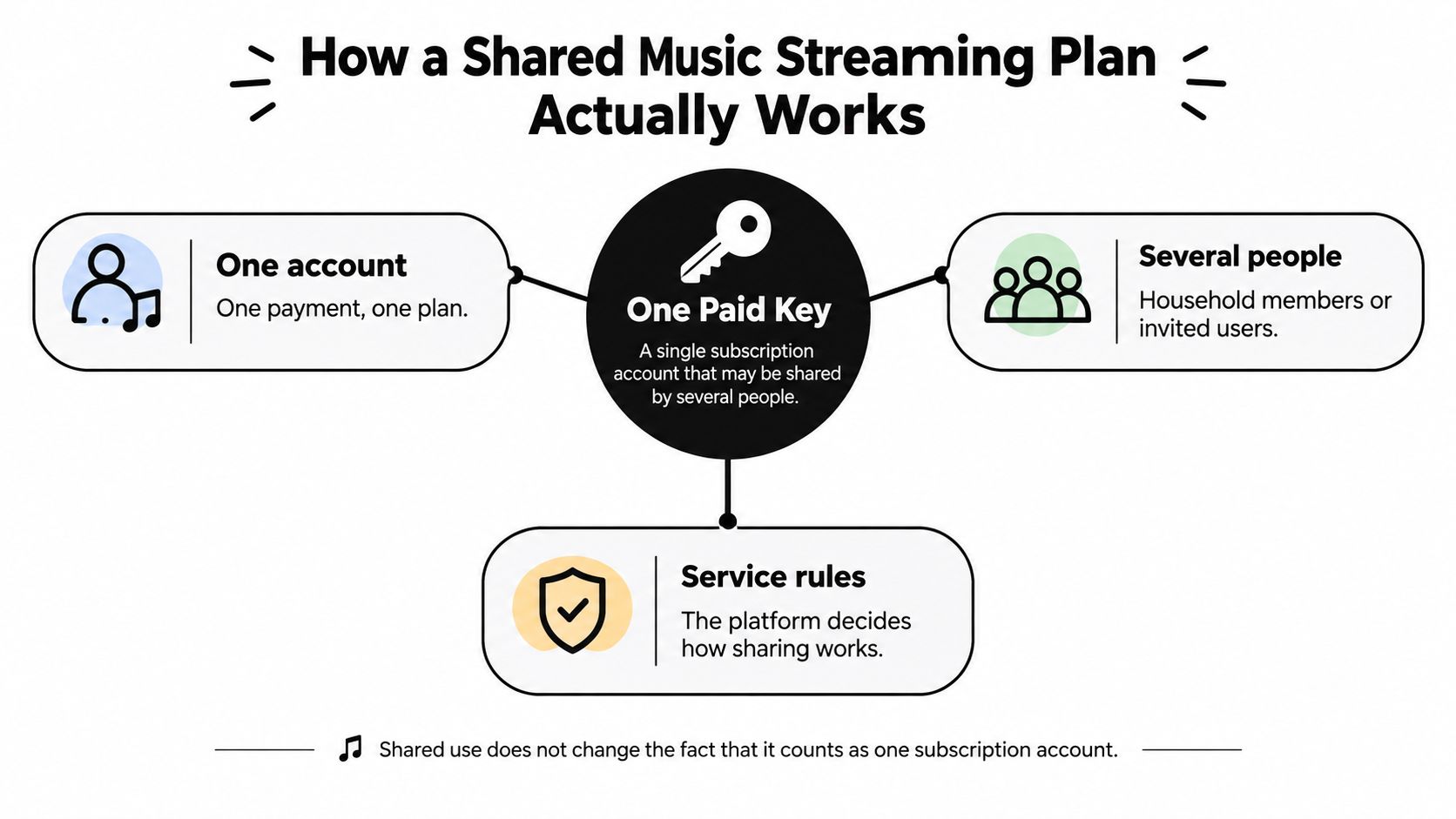
Think of a subscription as one paid key. The service may let several people use that key, but it still sees one subscription account, one plan, and usually one payment source. A household can have several key holders while the landlord still sees one lease.
That analogy explains why listener counts and subscription counts don't match. If parents and children listen through one family plan, the service has one paid plan and several real listeners. The plan is shared, but it doesn't become several independent subscriptions.
Four Terms People Often Confuse
- Paid plan: The subscription the service bills, even if several people use it.
- Profile: A listener's separate space for playlists, history, and recommendations.
- Device: A phone, tablet, computer, or other registered place where someone signs in.
- Simultaneous stream: Music playing at the same time as another stream on the plan.
A proper multi-user plan usually separates profiles so one person's workout tracks don't reshape another person's recommendations. It may also cap how many people can join, how many devices can be registered, and where members need to live. Those details vary by service, so you shouldn't assume one plan's rules apply to another.
A single shared login works differently. Everyone enters through the same door, mixes listening history, and depends on the same password and recovery details. If one person changes the password after a security alert, everyone else can lose access at once.
Why the United States Shows the Scale
The average number of paid music-streaming subscriptions in the United States reached 100.0 million in 2024, up 3.3% from 96.8 million in 2023, and paid-subscription revenue rose 5.3% to about US$10.69 billion in the same report. Total U.S. streaming revenue reached about US$14.88 billion, while streaming generated 84% of U.S. recorded-music revenue for the fifth consecutive year.
The Recording Industry Association of America counts a multi-user plan as one subscription. That means the 100.0 million figure measures paid plans, not every person listening through those plans. A cheap login therefore doesn't prove everyone has an independent seat. It may only prove several people are squeezed behind one paid key.
Family Plans, Password Sharing, and Group Access
You have three main paths, and they solve different problems. An official family plan gives structure but may require members to meet household or location rules. Password sharing feels flexible but leaves payment, privacy, and recovery tangled together. A managed group platform adds administration, which can help when a simple household plan doesn't fit.
Demand clearly extends beyond people at one address. A 2025 BearingPoint survey reported that 35% of YouTube Music subscribers shared passwords. That finding shows how common informal sharing is, but it doesn't prove a service permits it or that access will remain reliable.
Three Ways to Share a Music Subscription
| Option | Who it fits | Access control | Main cost risk |
|---|---|---|---|
| Official family or multi-user plan | People who meet the service's household or eligibility rules | Separate profiles managed by the plan holder | Region or address rules may exclude someone |
| Informal password sharing | People who prioritize a low split and accept weak controls | Everyone uses one login and recovery route | Lockouts, mixed history, and unclear payment duty |
| Managed group access | Groups that need seats and permissions handled centrally | Individual credentials or permissions with session controls | Fees, taxes, or currency costs may narrow savings |
Start with who can legitimately join. A family plan is the cleanest option when everyone qualifies, because profiles stay separate and the plan holder knows who's responsible for payment. It becomes awkward when a student lives away, a couple splits time between countries, or friends want in but don't meet the household definition.
Password sharing avoids that eligibility question by ignoring it, which is exactly the risk. One reset can strand the whole group, and a departing member may still know the login. If the account holder stops paying, the others may have playlists and listening history tied to an account they don't control.
Managed group access tries to formalize that messy middle. AccountShare is a group-purchasing platform for premium subscriptions, including music streaming, that pools buying power and manages shared access with individualized credentials or permissions, password-sharing options, session controls, and priority access rather than handing everyone one raw password. For a practical service-specific example, readers comparing Amazon's options can review how sharing Amazon Music works before deciding which path fits.
Don't judge any path by the headline split alone. Add taxes and foreign-exchange fees, then ask what a week without access would cost you in time and frustration. If someone leaves mid-cycle, decide in advance whether they get a refund, keep access until the paid period ends, or lose their seat immediately.
Practical rule: Choose the arrangement you'd still trust on the day a member leaves, not the one that looks cheapest on the day everyone joins.
Device Limits, Profiles, and Secure Access Controls
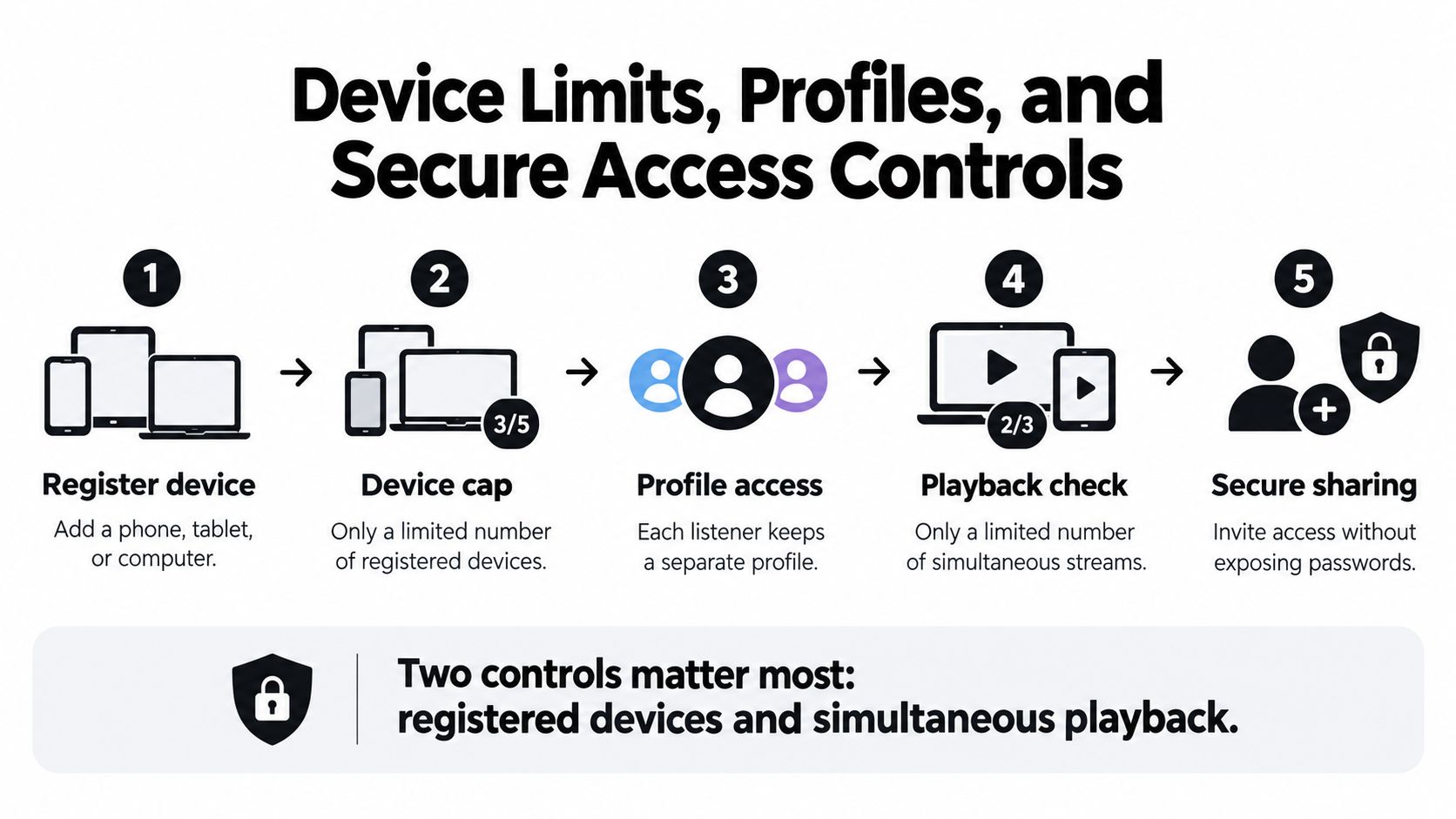
Two limits shape everyday sharing more than any marketing promise. A service can cap the number of registered devices, and it can cap how many streams play at the same time. You feel the first limit when a new phone won't register, and the second when your music stops because someone else pressed play.
Those controls are blunt. A door code proves someone knows the code, not that they live in the house. In the same way, a device or playback cap can't reliably tell a traveling family member from an outside user.
Why Profiles Beat One Shared Password
A machine-learning study of subscription sharing identified simultaneous-session limits and registered-device restrictions as common provider controls, while noting they cannot reliably distinguish legitimate household sharing from unauthorized external sharing. The study instead proposed per-account profiles built from geolocation and device-usage logs, with a sharing-risk score based on behavior patterns.
That approach is more humane than instant termination. A platform can flag rapid geographic changes, unfamiliar device clusters, or overlapping usage for review instead of cutting off a family member who's traveling. Multiple users on one account don't necessarily indicate abuse, since household sharing is common.
Before joining a group setup, check whether it offers these safeguards. If you're weighing Spotify specifically, the device limits for Spotify accounts show why device planning matters before a group grows.
- Individual credentials or tokens: Each participant signs in without receiving everyone's master password.
- Central device registration: An administrator can see which phones and computers belong to the group.
- Session expiry: Old logins don't stay active forever.
- Revocation: A departing member's access can end without disrupting everyone else.
- Audit trail: The group has a record when access or payment is disputed.
Rotating one shared password looks secure, but it breaks every listener at once and leaves no clean record of who did what. Separate permissions are more defensible because they connect enforcement to observable behavior. They also make a household easier to manage when a child gets a new tablet or a student replaces a phone.
The right control doesn't just block people. It keeps legitimate listeners playing while giving the group a fair, reviewable way to question unusual activity.
Who Gets Paid When Several People Share Music
Most listeners imagine their subscription money following their ears. You play a small artist all month, so that artist receives your share. Under the dominant system, that's usually not how it works.
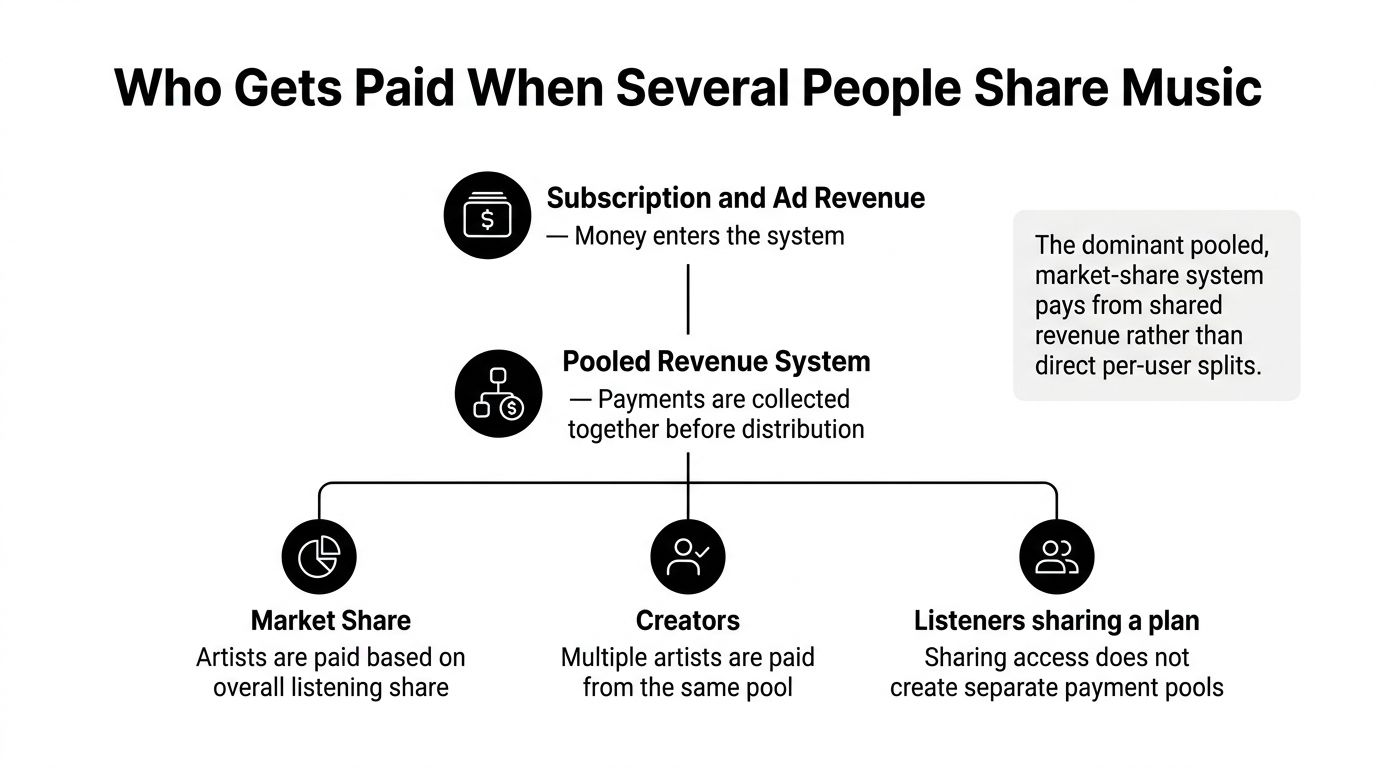
Major services commonly place subscription and advertising revenue into a pool. Artists are then paid according to their share of total streams across the platform, a model often called pro-rata or market-share allocation. Your plays matter, but they're measured against listening by everyone else, not isolated inside your personal subscription.
Pooled Pay Versus User-Centric Pay
A user-centric model would divide each subscriber's fee among the artists that subscriber played. A Management Science study contrasts pro-rata allocation with user-centric allocation and provides formal foundations for both revenue-sharing methods. In a shared plan, that difference becomes personal because several listeners may sit behind one subscription payment.
Suppose one member streams niche jazz for hours while another plays a few mainstream hits each week. Under pooled allocation, the heavy listener generates more streams in the platform-wide calculation, while the light listener's preferences carry less stream volume. The subscription money isn't neatly fenced off by person, so heavy and light listeners don't influence payouts in identical ways.
Scale makes the rules more consequential. Streaming platforms represented 52.22% of the global music-royalty market in 2025, and Spotify reported paid music streaming had more than 750 million monthly paying users globally by 2025 in the same analysis. Spotify's 2024 policy also requires a track to reach 1,000 annual streams before it generates recorded-music royalties.
That threshold is the uncomfortable part for smaller artists. More listening in a shared household doesn't automatically mean every niche release gets paid. A track below the threshold can be loved by a small group and still generate no recorded-music royalties under that policy.
Separate profiles and play histories help a group understand its habits, even if they don't change a platform's payout formula. A responsible shared setup should document its allocation assumptions instead of calling pooled savings neutral for creators. Cheaper access can be reasonable, but it shouldn't be marketed as if listener savings and artist income exist in separate worlds.
Shared Listening for Households, Students, and Travelers
Rules become clearer when real routines test them. A family at one address is the easiest case. Each person keeps a profile, so a child's repeat songs don't take over a parent's recommendations, and one adult owns the payment decision.
That household still needs a simple agreement. Decide who can add devices, what happens during simultaneous listening, and whether a teenager keeps playlists after moving out. With pooled royalties, the family should also know its combined plays enter a platform-wide system rather than separate artist pots.
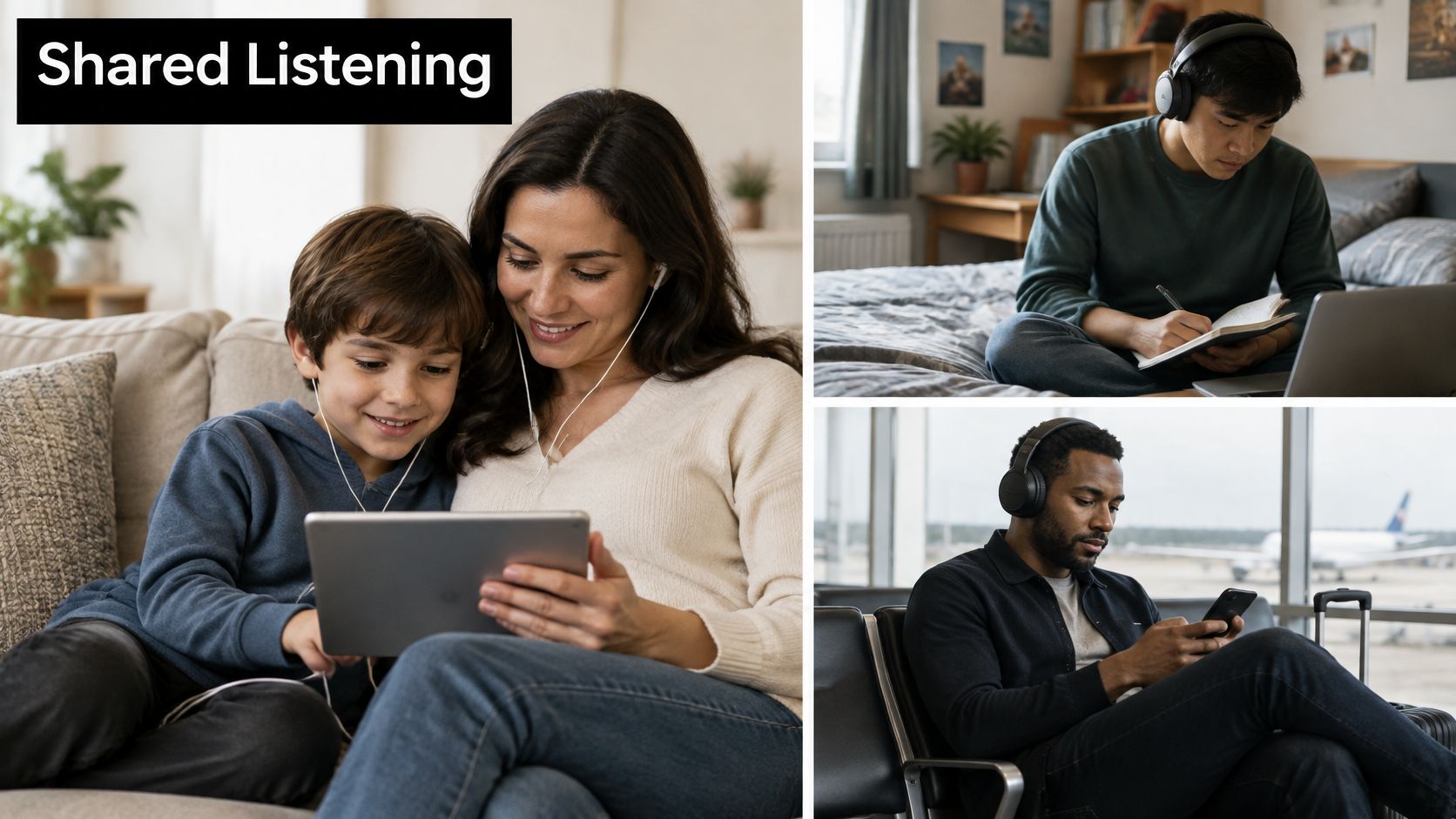
Students Spread Across Cities
Now picture students splitting one login from different campuses. Their playlists collide, one person's late-night listening interrupts another's study session, and a password reset locks everyone out before exams. When one student travels home or studies abroad, a region check can turn a normal trip into an access problem.
The payment risk is just as practical. If the account holder graduates and cancels, everyone else may lose history tied to that login. Students should agree who pays, when a seat ends, and how playlists will be copied or exported where the service allows it. Their artist impact follows actual streams, so a member who barely listens shouldn't assume their favorite niche band benefits because they helped pay.
Travelers and Cross-Border Households
A digital nomad creates a harder pattern. They may use a phone in one country, a laptop in another, and a partner's tablet at home within a short period. To a blunt security system, those geographic jumps and device clusters can look like outside sharing even when the listener is legitimate.
Cross-border families face a related problem. A plan designed around one household may not match parents, children, or partners who live in different countries for work or care. Currency conversion can also make the split less predictable than the group expected.
Don't ask only whether a setup works today. Ask what breaks first when someone travels, moves, replaces a phone, or stops paying.
For travelers, individual credentials and reviewable risk flags beat one password passed across borders. They won't override a service's region rules, but they make legitimate use easier to explain and departures easier to revoke. The household, student, and traveler scenarios all point to the same lesson. Your address pattern and exit plan matter as much as your taste in music.
Choose a Secure Shared Music Streaming Setup
Start with the setup your group can defend, not the one with the smallest advertised split. If everyone qualifies for an official family or multi-user plan and lives where that plan requires, begin there. It's the clearest route for separate profiles, payment responsibility, and service support.
Use this checklist before anyone pays.
- Confirm eligibility: Check household, region, and member rules for the exact service.
- Keep one profile per listener: Protect playlists, history, and recommendations from day one.
- Make playback limits visible: Everyone should know what happens when several people listen together.
- Name the payer: Agree who pays, when reimbursement is due, and what happens after a missed payment.
- Plan the exit: Decide how access ends and how a departing member handles playlists.
- Count the price: Add taxes and currency fees before calling the split a saving.
Add one creator check to the list. Know whether the service pools revenue, and don't assume your share travels directly to the artists you play. If supporting smaller artists matters to your group, discuss that openly instead of treating a discounted seat as economically neutral.
Pick One Path This Week
If your group fits an official plan, join that plan and set up profiles before sharing devices. If you don't fit neatly into one household, compare managed group access against buying separately, and look closely at credentials, session controls, revocation, and dispute records. Readers still choosing a platform can compare what makes the best streaming music service before locking a group into the wrong catalog or rules.
Reject any arrangement that depends on one raw password and one person's recovery email. That setup gives you the weakest privacy, the messiest exit, and the least evidence when something goes wrong. A secure shared plan should still feel worth it after fees, disruption risk, and artist-payout rules are placed beside the discount.
AccountShare helps groups access premium subscriptions, including music streaming, through group purchasing with managed seats, customizable permissions, and security controls instead of relying on one exposed password. If an official household plan doesn't fit your group, compare the total cost and access rules, then visit AccountShare to see whether a managed shared seat suits your listening setup.