

Prime Music vs Spotify A Head-to-Head Comparison
When you're trying to pick a side in the Prime Music vs. Spotify debate, it usually comes down to what you already use and what you care about most. If you live for discovering new artists and can't get enough of podcasts, Spotify is probably the better standalone service. But if you’re already an Amazon Prime member and crave higher audio quality, Amazon Music Unlimited offers a ton of value.
Comparing The Streaming Giants
Choosing where you get your music is a big deal; it's the soundtrack to your life. Both Spotify and Amazon Music give you access to tens of millions of songs, but they're built for different listeners. They each have unique strengths in how you find new music, how they connect with other devices, and how you pay for them.
It’s not just about who has more tracks. The real difference is in the experience. Spotify built its kingdom on a powerful algorithm that nails personalization, serving up playlists that feel like they were made just for you. Amazon plays a different game, using its massive Prime ecosystem to bundle a high-quality music service into a deal that’s hard to ignore.
Prime Music vs Spotify Key Feature Comparison
To get started, let’s lay out the core features side-by-side. This table gives you a quick snapshot of what you get with the premium versions of each service, making it easy to see where they shine.
| Feature | Amazon Music | Spotify (Premium) |
|---|---|---|
| Music Library Size | 100 million+ songs | 100 million+ songs |
| Maximum Audio Quality | Up to Ultra HD (24-bit/192 kHz) | Up to 320 kbps (Ogg Vorbis) |
| Podcasts | Yes, with a solid selection | Extensive, with many exclusives |
| Free Tier Available? | Yes, included with Prime (limited) | Yes, ad-supported with shuffle-play |
| Best For | Audiophiles & existing Prime members | Music discovery & podcast listeners |
As you can see, the core offerings are pretty close on paper. But for many people, the decision of Prime Music vs. Spotify boils down to a simple trade-off: do you want the best possible sound quality, or do you want the best discovery engine?
The real value often lies beyond the monthly fee. How you share access through group plans on platforms like AccountShare can make a premium service remarkably affordable, shifting the focus from price to features.
In this guide, we'll break down everything that matters—from sound quality and device support to the real cost of a subscription—so you can figure out which platform is the perfect fit for your ears and your wallet.
Sound Quality and Music Libraries: A Deeper Dive
When you stack Prime Music against Spotify, the first thing people usually mention is the library size. Both services throw around the 100 million song number, which honestly means you'll find pretty much any major artist on either platform. The real story isn't about how many songs they have, but the quality of those tracks and the depth of their catalogs.
Spotify has been the king of streaming for so long that its catalog feels woven into the fabric of pop culture. Its ecosystem is famously open, and understanding how artists get their music on Spotify shows why it’s bursting with indie darlings, obscure remixes, and underground hits right alongside the chart-toppers.
Amazon Music counters with its own massive, comprehensive library, often using its retail muscle to lock down exclusive content. But where it really tries to set itself apart is by making high-resolution audio a standard part of its premium subscription, which is a direct upgrade to your listening experience.
Sound Quality: The Audiophile’s Choice
This is where Amazon Music Unlimited lands a solid punch. It bundles High Definition (HD) and Ultra HD audio right into its standard plan, giving it a technical edge over Spotify for anyone who cares about pure sound fidelity.
So, what does that actually mean for your ears?
- Spotify: Delivers music at a maximum of 320 kbps (kilobits per second) in the Ogg Vorbis format. For years, this has been the gold standard for high-quality streaming—it sounds fantastic and is more than enough for most people listening through standard headphones or car stereos.
- Amazon Music HD: Uses the lossless FLAC format, streaming at CD quality (HD) or even better-than-CD quality (Ultra HD) up to 24-bit/192 kHz. This preserves every last detail from the original studio recording.
Now, let’s be realistic. If you’re just listening with regular earbuds during your commute, you might struggle to hear a major difference. Spotify’s compressed audio is expertly tuned for consumer gear and sounds great.
But if you’ve invested in a nice pair of headphones, a dedicated DAC (digital-to-analog converter), or a quality home sound system, the gap widens. Amazon’s Ultra HD tracks can feel more spacious and detailed, letting you hear the subtle textures of instruments and vocals with stunning clarity.
For anyone who considers themselves an audiophile, Amazon Music Unlimited is the obvious winner here, offering lossless audio at no extra charge. But for the vast majority of listeners, Spotify’s high-quality stream is perfectly sufficient and often indistinguishable in everyday situations.
Podcasts and Exclusive Content
While both services offer podcasts, this isn't even a fair fight. Spotify is the undisputed champion of the podcasting world. The company has poured billions into exclusive deals with top creators and has built an experience that flawlessly mixes podcasts into your music library. It's the one-stop shop for listeners who want both music and talk.
Amazon Music has podcasts, sure, but they feel like an afterthought. The discovery features aren't nearly as sophisticated, and you won't find the big-name exclusive shows that dominate the charts. If podcasts are a big reason you're subscribing to a service, Spotify has a massive lead.
Evaluating Music Discovery and User Experience
A great music app does more than just play songs; it should be your trusted guide to finding your next obsession. This is where the user experience and discovery algorithms come into play, and in the prime music vs spotify showdown, it’s a real point of separation. The best app should feel intuitive, personal, and exciting every time you open it.
Spotify has practically built its empire on a powerful, data-driven recommendation engine. It’s always learning from you—every song you play, skip, or save—to build a ridiculously detailed profile of your tastes. This is what powers its legendary personalized playlists.
- Discover Weekly: A Monday morning ritual for millions, this playlist serves up 30 songs from artists you’ve probably never heard of but are almost guaranteed to like.
- Release Radar: Your Friday update on all the new music from artists you follow or listen to often. You'll never miss a new drop.
- Daily Mixes: Multiple genre-based mixes that blend your go-to tracks with fresh, similar-sounding songs you haven't discovered yet.
These features make for a deeply engaging experience that just keeps you coming back for more. This relentless focus on personalization is a huge part of why they lead the market.
The Spotify App Experience
Spotify’s interface is clean, dark-themed, and practically begs you to explore. It’s built to make finding new music feel effortless, whether you're diving into curated playlists or letting Spotify Radio take the wheel. The social features are another big win; seeing what your friends are listening to and sharing tracks is seamless.
For a fun look at just how well Spotify knows you, third-party tools like the Spotify Pie Chart tool can visualize your listening habits, adding another cool layer of personalization to the experience.
Amazon Music’s Approach to Discovery
Amazon Music certainly has personalized recommendations, but the whole system feels a bit less dynamic. It will suggest stations and playlists based on what you’ve played, but it just doesn't have that almost psychic, predictive quality of Spotify's algorithms.
Amazon’s strategy often feels more focused on human curation than pure algorithmic personalization. The playlists are solid, but they can feel more like a well-programmed radio station than a mixtape made just for you.
The app itself is functional, but it can feel a little busy, especially if you aren't already living inside the Amazon ecosystem. That said, its Alexa integration is its killer feature. Simply asking Alexa to "play something I'll like" works like a charm and is a massive convenience for anyone with Echo devices.
This difference in philosophy shows in the numbers. Spotify pulled in about $14.5 billion in 2023, and with over 246 million premium subscribers, it has the scale to invest heavily in the AI-driven discovery and exclusive content that have become its signature.
Breaking Down Subscription Costs and Real Value
When you're trying to pick between Spotify and Amazon Music, the monthly price is often the first thing you look at. On the surface, they seem pretty similar, but the real value is hidden in the details of each plan and who it's actually for. This is where you move from just looking at a price to making a smart investment in your daily soundtrack.
First, let's clear up a common point of confusion: Prime Music is not the same as Amazon Music Unlimited. Prime Music is a nice little perk that comes with your Amazon Prime membership, but it's limited and mostly shuffle-play. If you want a real, head-to-head competitor to Spotify with on-demand streaming and high-res audio, you need to pay for Amazon Music Unlimited. Prime members do get a slight discount on it, but it’s a separate subscription.
Comparing Individual and Family Plans
For a single user, both Spotify and Amazon Music Unlimited are priced almost identically. You can expect to pay around $10.99 per month for an individual plan on either platform. That gets you everything you’d expect: unlimited, ad-free listening, offline downloads, and the ability to play any song you want.
Where things get interesting—and where you can find some serious savings—is with the multi-person plans. This is where the simple price comparison becomes a strategic decision.
- Family Plans: Both services offer a Family Plan for around $16.99 per month. This is a fantastic deal, giving up to six people their own separate premium accounts.
- Student Plans: If you're a student, you're in luck. Both platforms have plans for about $5.99 per month. Spotify often sweetens the deal by bundling it with services like Hulu or SHOWTIME.
Do the math on the family plan: for a group of six, the cost per person plummets to less than $3 a month. That's a huge drop from paying for six separate individual accounts.
Cost Analysis: Standard vs. Shared Plans
The family plan model is a game-changer for affordability. Instead of everyone paying the full individual price, you can pool together. This table breaks down just how much you can save.
| Plan Type | Spotify Standard Price | Amazon Music Unlimited Price | Potential Shared Cost per User |
|---|---|---|---|
| Individual | $10.99/mo | $10.99/mo ($9.99 for Prime) | N/A |
| Family (6 users) | $16.99/mo | $16.99/mo | ~$2.83/mo |
| Student | $5.99/mo | $5.99/mo | N/A |
As you can see, splitting a family plan completely changes the value proposition. It makes premium features accessible for the price of a coffee.
Maximizing Value with Shared Subscriptions
The cost-saving potential of family plans has paved the way for new solutions. Platforms like AccountShare are designed around this very idea, helping people form groups to share the cost of a family subscription safely. It makes the top-tier features of both Spotify and Amazon Music far more affordable for everyone.
When you join a shared plan, the conversation shifts from "Which one is cheaper?" to "Which one do I actually like more?" The cost becomes so low that you can finally choose based on the user experience, music discovery, and sound quality you prefer, not just your budget.
For example, a Spotify Family plan offers six completely independent premium accounts. Our guide on the Spotify Premium Family plan cost walks through exactly how this works and the savings involved. The same logic applies directly to the Amazon Music Family plan, turning a premium service into a low-cost utility. This approach fundamentally changes the Prime Music vs Spotify debate, letting you get the best possible experience for the lowest price.
Device Integration and Ecosystem Compatibility
A great music service should just work, blending into the background of your life and playing nicely with all your gadgets. When we look at Prime Music vs Spotify, this isn't really a question of which is "better," but which one slots more comfortably into the tech you already own. It usually boils down to one simple question: Are you all-in on Alexa, or do you have a mix of everything else?
Spotify’s ace in the hole is a feature called Spotify Connect. Honestly, it's a game-changer. It lets you use your phone as a universal remote for your music across a staggering number of devices. You can kick off a playlist on your laptop, stroll into the living room, and instantly hand off the stream to your smart TV, PlayStation, or Sonos speaker with a single tap. The whole experience feels incredibly fluid and doesn't care what brand your gear is.
The Power of an Ecosystem
Amazon Music, on the other hand, plays a different game. Its biggest strength is its deep, native integration within Amazon's own world. If your home is kitted out with Echo speakers, a Fire TV, and other Amazon gadgets, Prime Music is the path of least resistance. Voice commands via Alexa are snappy and precise, giving you a level of control that third-party integrations often struggle to match. For anyone who talks to Alexa all day, this synergy is a massive plus.
This "walled garden" approach is central to Amazon's strategy. For instance, when you want to share Amazon Music with family members, the process is a breeze for anyone already in the Amazon system. It’s built to be the default choice for Prime households.
Market Share and User Familiarity
How these platforms fit into a shared living situation also matters. In the U.S., Spotify, Apple Music, and Amazon Music basically own the market, commanding about 90.5% of all paid subscriptions. Spotify is the clear frontrunner with around 36% of paid listeners, but Amazon Music isn't far behind, holding a solid 23.8%. You can dig into more stats about the U.S. music streaming market on routenote.com.
What does this mean for you? Spotify's popularity means that in any group or family plan, there's a good chance most people already know how to use it. That built-in familiarity can make it much simpler to get everyone on board with a single shared account.
The bottom line on device compatibility is pretty straightforward. If you value flexibility and need your music to work seamlessly across a wide variety of gadgets from different manufacturers, Spotify Connect gives it a clear advantage. But if you're deeply invested in Amazon's world of Alexa-powered devices, Amazon Music will feel more like a native, effortless extension of your smart home.
Which Music Service Is Right for You?
So, after all that, which one should you pick? The truth is, there’s no single "best" service. The right choice really hinges on your habits, the gear you use, and what you prioritize in a listening experience. It’s less about which one is better on paper and more about which one slots into your life with the least amount of friction.
Often, the choice gets a lot simpler when you look at the technology you already own and use every day. This decision tree cuts right to the chase for most people.
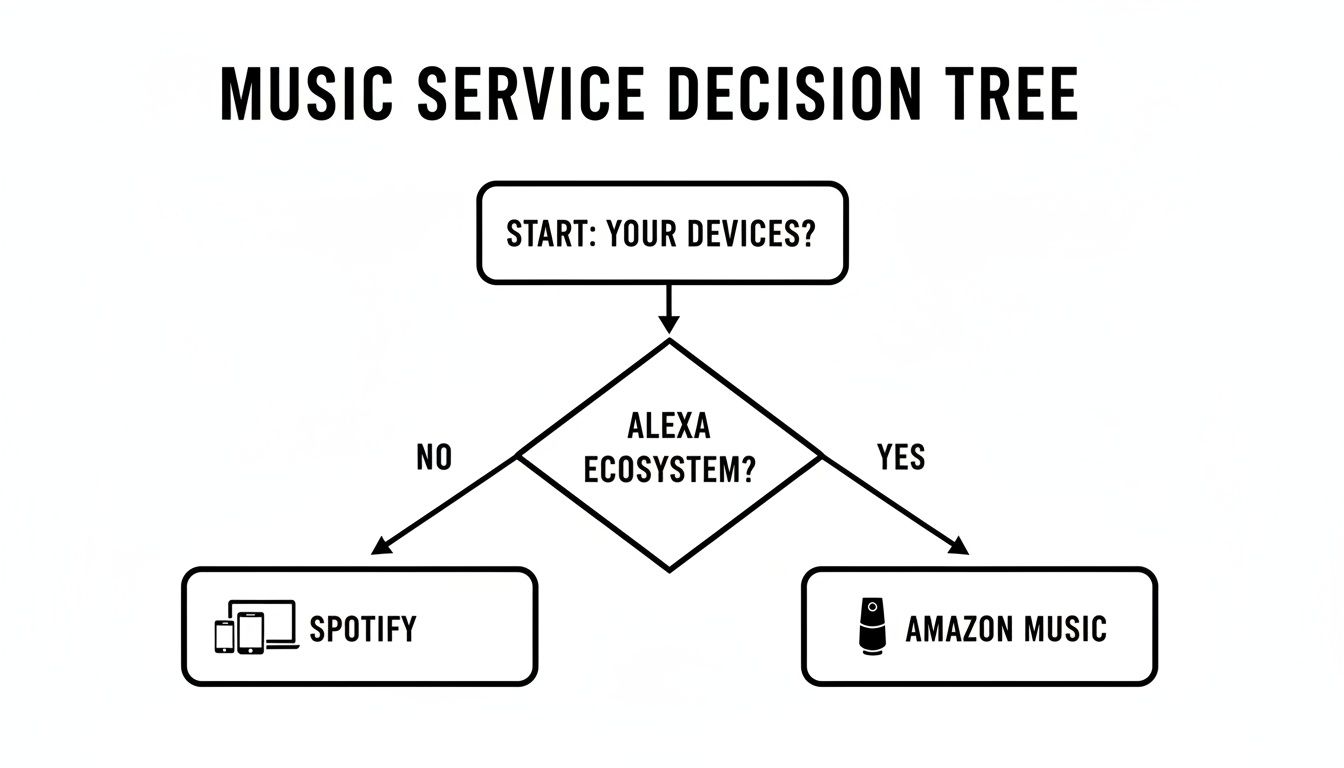
As you can see, if your home is already kitted out with Alexa devices, Amazon Music just works more seamlessly. For pretty much everyone else, Spotify’s massive device compatibility gives it the edge.
The Verdict for Different Listeners
Let's get even more specific and break down the recommendations for different types of people.
You should probably go with Amazon Music Unlimited if:
- You're an Audiophile: This one is a no-brainer. Getting HD and Ultra HD audio included in the standard price is a huge win for anyone who has invested in good headphones or speakers.
- You're a loyal Prime Member: The discount you get as a Prime subscriber makes Amazon Music an incredible value, and it fits perfectly within the ecosystem you're already paying for.
- Your home is powered by Alexa: The deep, native integration with Echo speakers is something Spotify just can't match. The voice commands are more reliable and the whole experience feels smoother.
You'll likely be happier with Spotify if:
- Music discovery is everything to you: Spotify’s algorithms are legendary for a reason. Playlists like Discover Weekly and Release Radar are uncanny in their ability to serve up new music you’ll actually love.
- You listen to a lot of podcasts: With a massive library of exclusive shows and a much more polished podcast interface, Spotify is the clear winner if you switch between music and spoken-word content.
- You value social sharing and device flexibility: From its collaborative playlists to the magic of Spotify Connect that lets you control playback on virtually any device, it’s built for a connected, shareable world.
When you take cost out of the equation, the decision between Prime Music and Spotify gets a lot easier. By using a service like AccountShare to split the cost of a family plan, the monthly price drops so much that you can simply choose the platform that delivers the features and user experience you genuinely prefer.
Got Questions? We've Got Answers
Even after breaking it all down, you probably still have a few things you're wondering about. Let's tackle some of the most common questions people ask when they're stuck between Prime Music and Spotify.
Is Amazon Music Actually Free with Prime?
It's a classic "yes, but" situation. Your standard Amazon Prime membership includes Prime Music, which gives you access to the entire music catalog. The catch? It works a lot like Spotify's free version—mostly shuffle play with limited skips.
If you want to pick any song you want, on-demand, and get that sweet HD audio, you have to upgrade to Amazon Music Unlimited. Think of it as a separate subscription, though Prime members usually get a nice discount.
Can I Transfer My Playlists from One to the Other?
You'd think they'd make this easy, but nope. Neither service offers a built-in tool to move your carefully crafted playlists.
Thankfully, you're not stuck starting from scratch. Third-party services like Soundiiz or TuneMyMusic are lifesavers here. They connect to both your accounts and do the heavy lifting, migrating your playlists, liked tracks, and entire library so you don't lose years of music curation.
Which One Is the Podcast King?
If you're a big podcast listener, this one's easy: Spotify. They've poured a ton of money into exclusive shows and have built a much better, more integrated experience for finding and listening to podcasts right alongside your music.
Amazon Music has podcasts, but the library isn't as deep, and the discovery tools feel like an afterthought. For serious podcast fans, Spotify is the clear winner.
The choice really comes down to this: ecosystem vs. specialization. Amazon is a fantastic deal if you're already plugged into the Prime and Alexa world. Spotify, on the other hand, is laser-focused on creating the best possible dedicated experience for music and podcasts.
How Many Devices Can I Listen On?
Both services are pretty generous, but they do have rules. With a Spotify Premium account, you can download music for offline listening on up to five different devices. If you want the full rundown, you can learn more about how many devices are allowed on Spotify in our guide.
Amazon Music is a bit more restrictive on its individual plans, typically limiting you to streaming on one device at a time. The family plan, of course, opens that up significantly.
Ready to make premium services more affordable? At AccountShare, we help you join group plans to get the best subscriptions for a fraction of the cost. Start saving today at https://accountshare.ai.