
Netflix vs Amazon Prime: Which Is Best for You? netflix vs amazon prime
So, what's the final verdict in the Netflix vs. Amazon Prime showdown? It really boils down to what you value most. If you're after a premium, dedicated streaming experience packed with critically-acclaimed original shows and an interface that just works, Netflix is the clear winner. But if you're looking for the absolute best bang for your buck and are already plugged into the Amazon ecosystem, Prime Video is an incredible value-add.

A High-Level Breakdown of Your Options
Trying to pick between the two titans of streaming can feel like a tough call. Both platforms offer a dizzying amount of content, but their core philosophies are worlds apart. Grasping this fundamental difference is the key to figuring out which one belongs in your living room.
Netflix is a pure-play, premium entertainment service. Its entire reason for being is to build and license a top-tier library of movies and exclusive series that keeps you subscribed. You can think of it like the HBO of the streaming world—you pay a specific price for a specific, high-quality product.
Amazon Prime Video, on the other hand, is one (very significant) piece of a much larger puzzle. It’s a major perk of an Amazon Prime membership, which bundles in things like free two-day shipping, music streaming, and photo storage. The video content is a massive draw to keep you in the Amazon fold. This strategic difference influences everything from their content budgets to their pricing structures.
Key Takeaway: You're not just choosing between two content libraries. You're choosing between a focused, specialist streaming giant (Netflix) and a versatile, value-stuffed benefit within a massive retail membership (Amazon Prime).
Netflix vs Amazon Prime Key Differences at a Glance
This table breaks down exactly what sets Netflix and Amazon Prime Video apart, giving you a quick snapshot of where each service shines and for whom.
| Attribute | Netflix | Amazon Prime Video |
|---|---|---|
| Primary Strength | Critically-acclaimed original series and a polished user interface. | Exceptional overall value bundled with a Prime membership. |
| Best For | Viewers prioritizing exclusive, high-budget original content. | Shoppers who want streaming as an added, high-value benefit. |
| Content Library | Deep catalog of originals, global content, and licensed series. | Mix of originals, licensed content, and an extensive pay-per-view store. |
| Pricing Model | Tiered standalone subscription (with or without ads). | Included with an annual or monthly Amazon Prime subscription. |
| User Experience | Widely considered the industry leader for its intuitive design and algorithm. | Functional and improving, but can feel cluttered with rental/purchase options. |
Ultimately, this comparison helps frame the decision: are you buying a streaming service, or are you buying a lifestyle membership that happens to include a great streaming service? Your answer to that question will point you in the right direction.
Comparing Subscription Costs and Overall Value
When you're trying to pick between Netflix and Amazon Prime, the price tag is usually the first thing that jumps out. But that monthly fee doesn't tell the whole story. The real decision comes down to what you actually get for your money and how that fits into your budget and daily life.

Netflix keeps things simple with a tiered model that’s all about video streaming. You pick a plan based on the quality and features you want. Amazon Prime Video, on the other hand, is built on a totally different philosophy.
Netflix Pricing: A Tiered Approach
Netflix's pricing is straightforward—you get what you pay for, with clear trade-offs at each level. Knowing the difference helps you avoid paying for features you'll never touch.
-
Standard with Ads: This is your entry-level, budget-friendly ticket. You get most of the content in Full HD (1080p), but you'll have to sit through some commercials. It's perfect for casual viewers who don't mind ads if it means saving a few bucks.
-
Standard: This is the ad-free version of the basic plan. You still get Full HD quality and the full content library, making it the sweet spot for most people who just want to watch without interruptions.
-
Premium: The top-of-the-line option. This plan unlocks Ultra HD (4K) resolution, HDR, and spatial audio for a true home cinema feel. It also gives you more simultaneous streams and downloads, making it the go-to for families or anyone with a 4K TV.
The decision with Netflix is clear-cut: you’re paying for a specific level of streaming quality and convenience. Your cost directly maps to the experience, from ad-supported HD to a premium, ad-free 4K powerhouse.
Amazon Prime: The Bundled Value Proposition
Amazon’s approach is completely different because Prime Video is just one piece of a much larger puzzle. When you sign up for Amazon Prime, you're not just buying a streaming service; you’re tapping into a whole ecosystem of perks.
This bundle includes:
- Prime Video: A huge library of movies, shows, and Amazon Originals.
- Free Shipping: That famous fast, free delivery on millions of items.
- Amazon Music Prime: Ad-free access to millions of songs.
- Prime Reading: A rotating library of free ebooks and magazines.
Because of this, figuring out the "real" cost of Prime Video is tricky. If you're already an avid Amazon shopper, the streaming service feels like an amazing, nearly-free bonus. But if you only want to watch videos, you're paying for a bunch of extras you might not use. This makes a standalone Netflix plan look much more direct. Looking at how others go about comparing subscription services can put this kind of bundled value into a broader context.
Final Cost Analysis
So, which one is the better deal? It really boils down to how you'll use it.
If you’re a serious movie buff or TV binger who wants a top-tier, ad-free 4K experience and rarely shops on Amazon, Netflix's Premium plan offers clean, direct value. You pay for a high-quality streaming product, and that's exactly what you get.
However, if you're a regular Amazon shopper, listen to music, or read ebooks, Amazon Prime offers unparalleled bundled value. The effective cost of the video service shrinks to almost nothing when you account for the shipping savings and other included media. For a deeper look at how these and other platforms stack up financially, our streaming services cost comparison breaks it down even further.
Analyzing the Content Library and Original Programming
When you pit Netflix against Amazon Prime Video, the real battle is fought over content. This is where their core philosophies diverge, and it’s not just about counting titles. Each service has a completely different strategy, which means one is a clear winner for binge-watching series while the other is a paradise for movie lovers.

Think of Netflix as a premium cable network like HBO, but on a global scale. Its entire game plan is to create exclusive, must-see original shows and movies that you literally can't watch anywhere else. This approach is all about driving subscriptions and keeping you hooked, justifying its standalone price tag.
Amazon Prime Video, on the other hand, feels more like a massive entertainment superstore. It mixes its own impressive slate of originals with a huge library of licensed content and—this is the key—an integrated pay-per-view store for new movies. It’s designed to be an all-in-one hub.
Netflix: The Undisputed King of Original Series
Netflix built its empire on the back of its original series. We're talking about global cultural events like Stranger Things, The Crown, and Bridgerton—shows that dominate social media and awards season. The company pours a staggering amount of money into a constant pipeline of high-quality, bingeable TV across every genre imaginable.
This isn't cheap. Netflix reportedly invests around $17 billion a year in content, a figure that bankrolls its reputation as the home of original programming. It’s a focused strategy that directly supports its premium pricing. In contrast, Prime Video is just one piece of the giant Amazon ecosystem, used to make the overall Prime membership stickier and more valuable.
The result is a library that feels curated and exclusive. If you're the kind of person who gets FOMO about the "next big show," Netflix is where you need to be. The trade-off? Its collection of older, licensed movies can sometimes feel a bit thin compared to the competition.
Amazon Prime: The Versatile Movie Powerhouse
While Amazon has its own heavy-hitters like The Boys and The Marvelous Mrs. Maisel, its real superpower is its film library and hybrid model. Prime Video often has a deeper, more diverse catalog of licensed movies—from recent hits to old classics—all included with your subscription.
But the real game-changer is the built-in rental and purchase store. If a brand-new movie you want to see isn't streaming for free, you can almost always rent or buy it right inside the Prime Video app. This makes for a seamless movie night, so you never have to bounce to another service.
Key Differentiator: Netflix wants to be your exclusive TV network, offering shows you can't get anywhere else. Amazon Prime Video wants to be your all-in-one video store, offering a mix of included content and new releases for rent or purchase.
For instance, you could watch an included action-comedy like Heads of State one evening and rent the latest theatrical blockbuster the next, all without leaving the app. For anyone who wants access to the widest possible selection of films, this flexibility is a massive plus.
Comparing Content Depth and Genre Variety
So, which one is right for you? Let's break down their strengths.
Original Series:
- Netflix: The clear leader. It cranks out a higher volume of exclusive, culture-defining series. Its global production network also gives it an unmatched variety of international shows.
- Amazon Prime: A smaller but potent slate of high-quality originals. It tends to focus on big-budget, genre-specific hits that develop a fiercely loyal fanbase.
Movie Library:
- Netflix: A solid, rotating collection of licensed films plus a growing number of its own original movies, like the upcoming The Old Guard 2. Still, the main focus is always on its original content pipeline.
- Amazon Prime: Generally offers a larger and more consistent library of licensed movies. The rental/purchase store makes it the hands-down winner for film buffs who need immediate access to new releases.
Content for Families:
- Netflix: Has a fantastic and well-organized library of kids' shows and family-friendly originals. The dedicated Kids profile is simple to use and works great.
- Amazon Prime: Also offers a strong selection, which can be expanded even further with the Amazon Kids+ add-on for more curated content.
Ultimately, it comes down to what you watch. If your main goal is to stay on top of the latest must-see TV series and explore international hits, Netflix is your best bet. But if you’re a movie lover who values a deep back catalog and the convenience of renting new releases, Amazon Prime Video has the clear edge. For more ideas, check out our guide to the top affordable streaming services to watch in 2025.
Evaluating Streaming Quality and User Experience
A great content library means nothing if the actual viewing experience is a letdown. How a streaming service performs day-to-day—from picture quality to finding something new to watch—is what really separates the good from the great. This is where the technical details and user interface of Netflix and Amazon Prime Video come into play.
Both services deliver a solid stream, but they approach their premium features from completely different angles. Netflix essentially puts its best quality behind a paywall, tying it to their most expensive plan. Amazon, on the other hand, bakes its high-end formats right into the standard Prime membership.
Video and Audio Quality: Who Delivers the Best Picture?
Netflix has a reputation for delivering a smooth, high-quality stream, but you have to pay for the privilege. To get 4K Ultra HD resolution and HDR (High Dynamic Range) formats like Dolby Vision, you absolutely must subscribe to their top-tier Premium plan. No exceptions.
Amazon Prime Video is far more democratic with its pixels. A huge chunk of its library, especially its original shows and movies, comes in stunning 4K UHD and HDR10+ at no extra cost. If you own a 4K TV, this makes Prime an incredible value proposition right out of the box.
Key Insight: Netflix treats 4K as a premium add-on. Amazon Prime Video treats 4K as a standard feature, making high-end visuals a core part of the deal.
Of course, none of this matters if your internet can't keep up. To get that crisp, buffer-free picture you're paying for, a stable connection is non-negotiable. It's often worth learning how to boost your home WiFi signal for faster streaming to make sure you’re getting the most out of either service, especially with data-hungry 4K content.
Navigating the Interface: Clean vs. Cluttered
This is one area where Netflix runs away with the crown. The Netflix interface is the gold standard for a reason. It's clean, snappy, and makes discovering new shows feel effortless. Its recommendation engine is legendary for its spooky ability to figure out what you'll love next.
Amazon Prime Video’s interface gets the job done, but it can feel like a bit of a maze. It’s trying to be two things at once: a streaming library and a digital storefront. This means the content included with your subscription is often sitting right next to movies and shows you have to rent or buy, which can be confusing. It’s functional, but it lacks the polished, premium feel of Netflix.
Practical Features for Everyday Watching
The little things—like how many people can watch at once or downloading shows for a flight—are what really matter for a busy household.
Here’s how they stack up on the essentials:
| Feature | Netflix | Amazon Prime Video |
|---|---|---|
| Simultaneous Streams | 1 (Ad plan), 2 (Standard), 4 (Premium) | 3 streams (but only 2 can watch the same title) |
| Offline Downloads | Devices tied to plan (1, 2, or 6) | Supported on mobile devices and PCs |
| Parental Controls | Excellent PIN-protected profiles and rating filters | Strong viewing restrictions and purchase PINs |
| User Profiles | Up to 5 profiles, with a separate Kids UI | Up to 6 profiles, including Kids profiles |
Netflix’s model forces larger families toward its most expensive plan just to avoid arguments over who gets to watch. Amazon is a bit more flexible, though the two-stream limit on a single title is an odd quirk to remember. You can get the full rundown on how many streams Amazon Prime allows to see how it works in practice. Both services offer great parental controls, but the dedicated, colorful interface for the Netflix Kids profile is a standout feature for parents with young children.
Choosing the Right Service for Your Viewing Habits
The whole Netflix vs. Amazon Prime debate isn't about which service is universally "better"—it's about which one is better for you. Your habits, your budget, and what you actually want to watch are what really matter. So instead of a one-size-fits-all answer, let's break down which service makes the most sense for different types of viewers.
This little flowchart can help you think through the decision, especially if your home entertainment setup is a big factor.
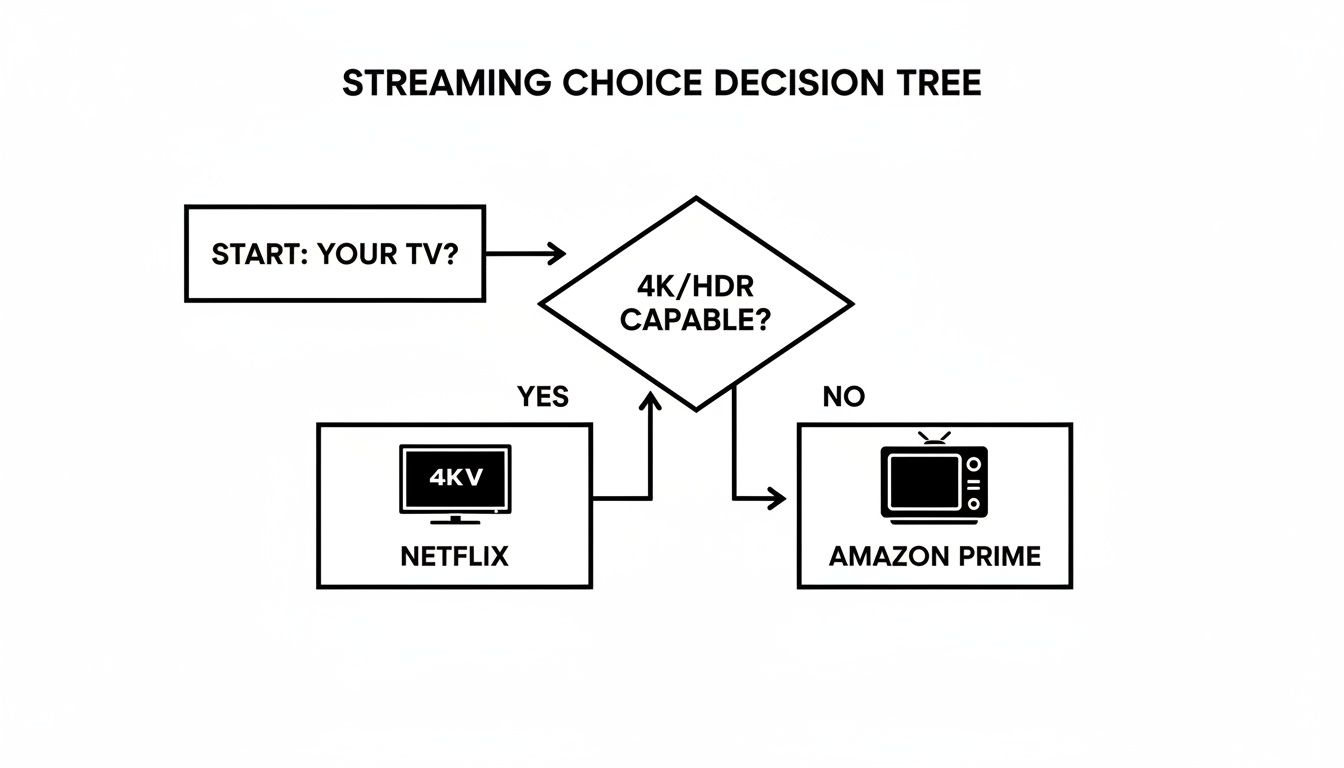
As you can see, the decision gets a lot clearer for tech-focused users. Netflix makes you pay up for its premium 4K plan, while Amazon Prime includes it as a standard feature.
For the Prestige TV Binger
Do your weekends revolve around catching up on the critically-acclaimed series everyone is talking about? If you live for complex stories, high production values, and being part of the cultural conversation, the choice is pretty clear.
Recommendation: Netflix
Let's be honest: Netflix built its empire on being the home of binge-worthy television. Shows like Stranger Things and The Crown aren't just popular; they're cultural events. The platform pumps a staggering amount of money into a constant stream of exclusive content, which means you'll almost never run out of something new and high-quality to watch.
This content-first approach is why they dominate. As of early 2025, Netflix had somewhere around 310 million paid subscribers worldwide, making it the undisputed global leader. And that's with an average monthly price of USD 15.49, which makes it the priciest major streaming service out there. It just goes to show that for many people, premium content is worth the premium cost. You can dig into more stats about the global streaming market over on Straits Research.
While Amazon has some great shows, Netflix's sheer volume of exclusive, must-see series gives it the edge for anyone who puts prestige TV first.
For the Value-Seeking Family
For families, the decision is about more than just what’s on TV. It's a real-world calculation of cost, features, and how much use everyone in the house will get out of it. You need something for everyone—from kids' shows to adult dramas—all without blowing the budget.
Recommendation: Amazon Prime Video
When it comes to bundled value, Amazon Prime is the hands-down winner, and that’s a huge deal for families. The subscription isn’t just about unlocking movies and shows; it’s a whole ecosystem of perks that a family can use every single day.
- Bundled Perks: Free two-day shipping on Amazon is a genuine money and time saver for busy parents.
- Included Content: Getting Amazon Music Prime and Prime Reading thrown in adds a ton of entertainment options at no extra cost.
- User Profiles: With up to six profiles, everyone gets their own personalized watchlist and recommendations. No more sorting through Paw Patrol to find your shows.
- Kids Content: It has a solid library of family-friendly entertainment, and you can add the Amazon Kids+ subscription for even more curated content if you need it.
Sure, Netflix has a great kids' interface, but it just can't compete with the sheer multi-faceted value of a Prime membership. For a family, Prime Video is often the most practical and cost-effective choice because its benefits reach far beyond the TV screen.
For the Casual Movie Watcher
If your perfect evening involves curling up with a good film—whether it’s a classic, an indie gem, or a recent blockbuster—your main priority is having a deep and flexible movie library.
Recommendation: Amazon Prime Video
This might seem counterintuitive, but for dedicated film lovers, Prime Video often has the upper hand. Its strength lies in a three-pronged movie strategy that Netflix’s all-or-nothing subscription model can't really touch.
First, its included library of licensed films is often larger and more eclectic than Netflix's rotating catalog. Second, Amazon Originals has produced some seriously acclaimed films that can stand toe-to-toe with the best of them.
But the real game-changer is its integrated rental store. If a new movie isn't streaming for "free" with your membership, you can almost always rent or buy it right inside the Prime Video app. This hybrid model turns the service into a one-stop shop for movies, offering a level of convenience and selection that’s tough to beat.
Got Questions? We’ve Got Answers.
When you're trying to pick between two streaming giants, a few key questions always pop up. Let's tackle the big ones to clear up any lingering doubts you might have.
Is Live Sports on the Table?
This is one of the clearest dividing lines between the two. If you're looking for live sports, your decision is pretty much made for you.
Netflix sticks to what it does best: on-demand shows and movies. While they've produced some incredible sports documentaries like Drive to Survive, you won't find any live games on the platform.
Amazon, on the other hand, has made live sports a core part of the Prime Video experience. A standard subscription gets you Thursday Night Football and a mix of other international sports, making it the default choice for fans who want live action without an extra subscription.
Who Wins on International Content?
If you love exploring shows and movies from around the globe, Netflix is in a league of its own. They've poured billions into creating original content in dozens of countries, building a library that’s unmatched in its global reach. Think Spanish thrillers, Korean dramas, and Scandi-noir mysteries all in one place.
Prime Video is definitely building its international collection, but it just can't compete with the sheer volume and cultural buzz of what Netflix offers. For true world cinema and TV buffs, Netflix is the clear winner here.
For anyone who sees streaming as a window to the world, Netflix’s strategy of producing authentic local content gives it an undeniable edge. Prime is making strides, but Netflix’s library is simply far more diverse and globally representative.
How Do Prime Video's Add-On Channels Actually Work?
This is a clever feature that turns Prime Video into more of an all-in-one entertainment hub. You can subscribe to other streaming services—what Amazon calls "Channels"—directly through the Prime Video app.
Think of services like Max, Paramount+, or STARZ. You can add them to your Prime account with a separate monthly fee. The real benefit? It's all managed in one place. One app, one bill. This makes Prime a fantastic foundation if you want to build a custom streaming package without juggling multiple accounts.
How Painless Is It to Cancel?
Thankfully, both services have done away with the old-school runaround. Canceling is refreshingly straightforward.
- Netflix: Just head to your account settings. It takes a couple of clicks, and you can keep watching until your current billing cycle ends. No fuss.
- Amazon Prime: It's just as simple to cancel through your main Amazon account settings. The only catch is that you're canceling your entire Prime membership, not just the video streaming part.
Ready to get smarter about your subscriptions? AccountShare lets you tap into premium services like these for a fraction of the price through secure, managed group buys. Start saving today at https://accountshare.ai.