
Joint Accounts for Couples: A Practical 2026 Guide
Maya and Jordan weren't fighting about money. They were fighting about a streaming password.
One of them paid for the bundle. The other reimbursed half. Then the password got changed during a routine security reset, the smart TV logged out, and both of them started sending screenshots, one-time codes, and annoyed texts just to watch a show they were already paying for.
That mess looks small until you notice it's the same problem couples keep tripping over everywhere else. Shared checking. Shared savings goals. Shared grocery memberships. Shared cloud storage. Shared gym apps. Shared cards saved inside someone else's Apple Pay.
The old advice about joint accounts for couples is too narrow. The question isn't just whether you should merge money. It's whether you have a clean system for shared access.
Why Couples Are Rethinking Shared Access in 2026
A lot of couples still treat “sharing” as one casual habit. Swap a password, add a card to autopay, split a bill later, move on. That worked when the stakes were lower and fewer services were tied to your identity, payment methods, and recovery devices.
It doesn't work well now. Banks ask for tighter verification. Streaming platforms check households more aggressively. Recovery emails, text codes, device approvals, and saved payment methods turn a simple split into a chain of dependencies. One person controls the login, and suddenly they also control access, billing history, and the reset path.
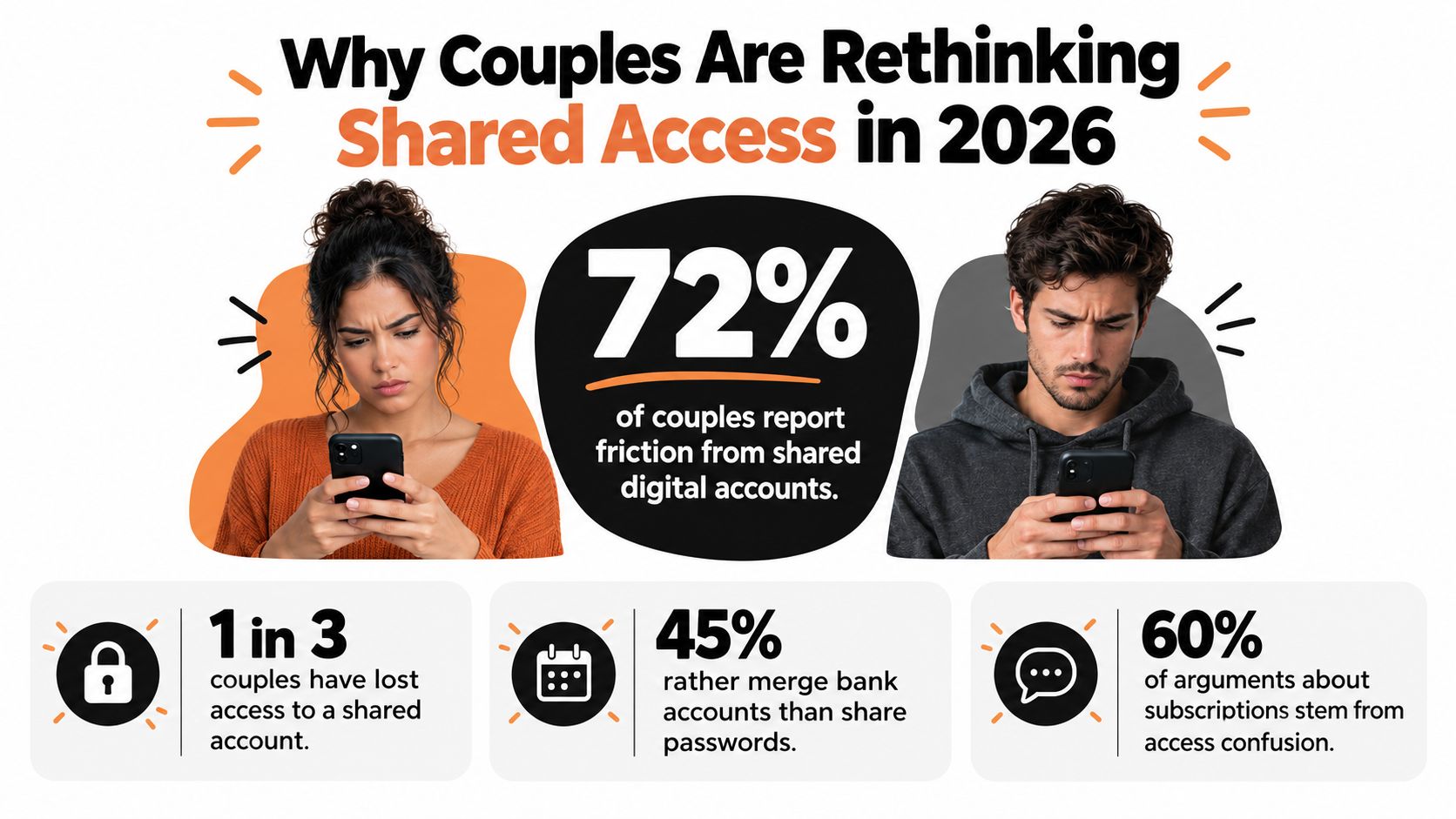
Two decisions, not one
Couples in 2026 are usually making two separate sharing decisions:
- Who shares a financial account
- Who shares a digital account
Those are not the same choice. A joint checking account creates legal ownership and liability. A shared streaming login usually doesn't. But both create friction when no one defines the rules up front.
That's why couples get stuck in weird arguments that sound petty but aren't. One partner thinks access means equal use. The other thinks paying means control. Both feel reasonable. Both can be wrong.
Practical rule: If two people use something regularly, they need a system for access, payment, and recovery before the first problem hits.
There's also a relationship layer most money guides ignore. If repeated access fights are turning into trust fights, a neutral third party can help. That's where couples counselling with Interactive Counselling can be useful, especially when the argument isn't really about Netflix or the bank login, but about control, privacy, and fairness.
What changes when you get this right
When couples separate the money question from the access question, decisions get simpler.
You can share bills without sharing every dollar. You can split subscriptions without texting raw passwords. You can build visibility without creating surveillance. That's the frame that helps.
What Joint Accounts for Couples Actually Mean
When you hear “joint account,” you might think of one thing. A bank account with two names on it. That's too narrow.
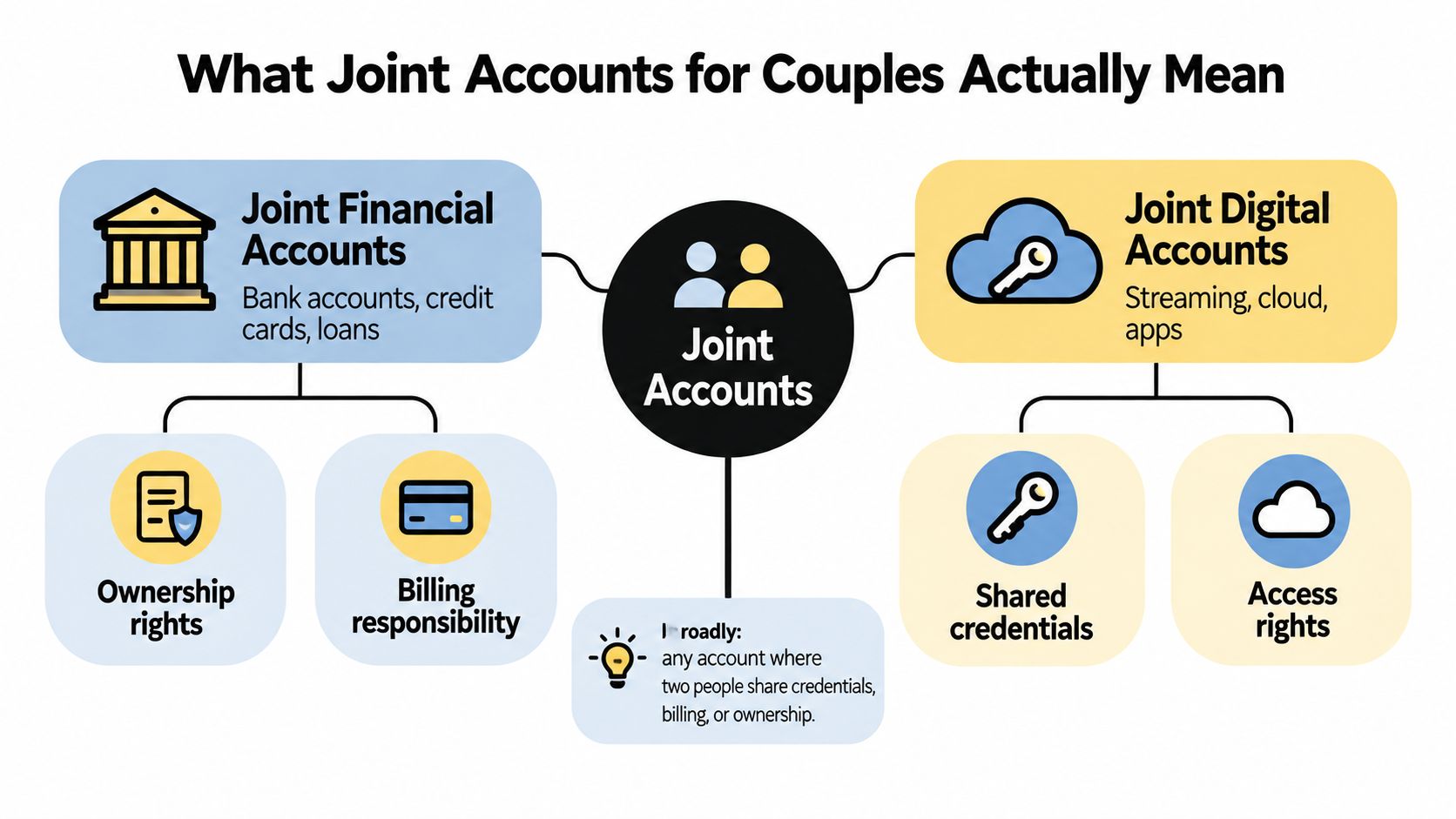
For practical purposes, joint accounts for couples include any account where two people share credentials, billing responsibility, or ownership rights. That broad definition matters because couples now share far more than checking accounts.
Joint financial accounts
A joint financial account is the serious version. Both names are on the account. Both people usually have equal access to deposits and withdrawals. In plain English, that means shared ownership of the balance and shared exposure if the account goes sideways.
Consumer guidance also warns that both partners can be equally responsible for overdrafts, fees, or unpaid debts tied to the account, and one partner's mismanagement can affect the other even when the transaction wasn't authorized, as explained in this guide to joint bank account pros and cons for couples.
That's what “joint” means in banking. Not symbolic togetherness. Legal and operational entanglement.
Joint digital accounts
A joint digital account works differently. The couple shares access to a streaming platform, family plan, cloud storage subscription, shopping membership, or app. But the contract often stays in one person's name.
The key difference is liability. Access may be shared, but ownership usually isn't. The platform expects one primary account holder. If the bill fails, terms change, or recovery codes go to one phone, the non-owner can lose access fast.
Shared credentials feel equal right up until there's a reset, dispute, breakup, or fraud alert.
The gray zone most couples miss
The messiest setup sits in the middle. One partner owns the subscription. The other partner's card pays for it, or both rely on the same saved payment method. That creates hidden exposure without clear ownership.
If you want a deeper definition of shared-access models beyond banking alone, this explainer on what a share account is is a useful way to think about it.
The fix is simple. Treat financial jointness and digital jointness as separate decisions. They overlap, but they are not interchangeable.
Three Ways Couples Structure Shared Money
Most households don't need a philosophical debate about money. They need plumbing that works. In practice, couples usually land in one of three setups.
In the United States, 77% of married couples with financial assets held at least one joint account in 2023, down from 85% in 1996. Over that same period, the share with all accounts jointly owned fell from 53% to 40%, while the share using both joint and separate accounts rose from 9% to 17%. The share with no joint accounts increased from 15% to 23%, according to the U.S. Census Bureau's look at married couples and separate finances.
The three real-world models
| Structure | How Money Flows | Typical Users | Main Strength |
|---|---|---|---|
| Fully combined | Income and bills run through one shared account system | Couples who want maximum visibility | Simplicity |
| Hybrid | Each person keeps an individual account and both fund a shared bills account | Couples who want teamwork without full merger | Balance |
| Split-bills-only | No joint account. Each person pays their share through transfers or assigned bills | Couples who value independence or are still testing cohabitation | Autonomy |
Fully combined
This is the old-school model. Paychecks land in one place. Bills, savings, groceries, and fun money all come out of the same pool.
It can work beautifully when both people have similar habits, similar trust levels, and no desire to maintain much financial privacy. It fails fast when one person spends loosely and the other tracks every coffee.
Hybrid
This is the model I recommend most often.
Each partner keeps personal accounts. Then they open one joint checking account for rent, utilities, groceries, insurance, and shared savings goals. It gives the household a single operating account without turning every purchase into a committee meeting.
If you want a cleaner way to track who owes what while keeping the core structure intact, a shared expense tracker app for couples can help.
The hybrid model solves the argument most couples actually have. Not “Do we love each other enough to merge?” but “How do we pay shared bills without policing each other?”
Split-bills-only
This model keeps everything separate. One person pays rent. The other covers utilities and groceries. Or both use transfers to settle up.
It's lean and flexible. It also demands the most communication. If one bill gets missed, there's no shared dashboard catching the error. Oddly enough, this same three-part logic maps cleanly onto subscriptions too. Fully shared, partly shared, or loosely reimbursed.
Benefits and Real Risks of Going Joint
Joint accounts get sold on convenience, and that part is fair. One account for household bills is easier than ten reimbursements and weekly Venmo archaeology.
But convenience has a price. Couples should look at the upside and the liability on the same page.
Where joint accounts help
A good joint account gives both people one place to see recurring bills, shared savings, and basic household cash flow. That lowers the friction around rent, utilities, groceries, and emergency expenses. It also reduces the “I thought you paid it” problem.
For couples building a household, that visibility matters. So does access during emergencies. If one person is traveling, sick, or dealing with a work crunch, the other can still keep the machine running.
| Dimension | Benefit | Risk |
|---|---|---|
| Bills | One payment hub for household expenses | One person can still create a mess from the same hub |
| Visibility | Both partners can see transactions | Constant visibility can feel like surveillance |
| Savings | Shared goals are easier to automate | Shared funds can become commingled in disputes |
| Access | Either partner can act quickly in emergencies | Either partner can also move money quickly without consent |
| Credit and debt | Some joint products feel simpler to manage together | Liability can land on both people |
Where couples get burned
The risk isn't abstract. With a true joint bank account, both people can be exposed to overdrafts, fees, debt problems, and account misuse. If one partner behaves badly or just carelessly, the other doesn't get to claim distance after the fact.
That's the part many couples underestimate. “I didn't make the charge” is emotionally relevant, but it may not protect you from the consequences.
There's also a legal spillover problem. Joint funds can become harder to untangle in breakups, creditor actions, and disputes over who contributed what. If you're making other long-term financial decisions together, review them with the same seriousness. Couples looking at broader planning questions often benefit from reading about joint life insurance for couples because the same issue keeps coming up: shared financial products create shared consequences.
The digital version of the same problem
Shared subscriptions carry a lighter version of joint risk. The liability usually sits with one primary owner, but the confusion spreads to both users. Password resets, surprise renewals, unauthorized device access, and stored cards can all create cleanup work.
That's why I tell couples to secure shared access like they secure money. This guide on shared access security is a useful starting point if your current method is “we both kind of know the login.”
Security and Permissions Checklist for Any Shared Account
Security advice usually fails because it's too vague. “Be careful” isn't a system. Here's a system.
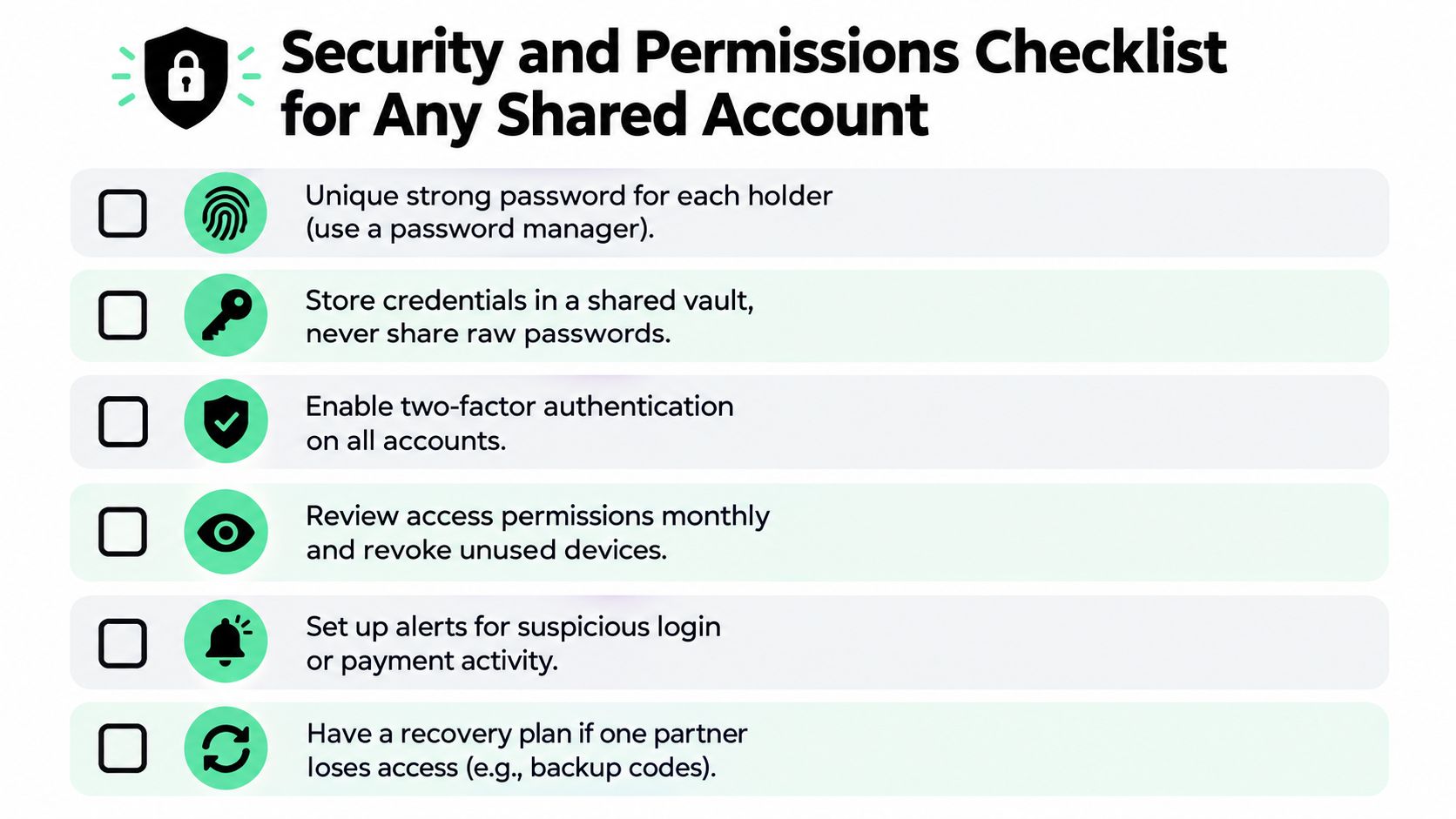
Apply this checklist to any shared account, whether it's a joint checking account, a family Spotify plan, or an Amazon household login.
Use cleaner identity hygiene
- Keep personal emails personal: Recovery should route to an email each partner individually controls, not a neglected shared inbox.
- Use a password manager: Don't store bank or subscription credentials in Notes, text threads, or browser autofill alone.
- Create unique passwords: Shared account or not, every important login needs its own password.
A raw password copied into a chat is not “organized.” It's unsecured.
Tighten access before there's a problem
- Turn on two-factor authentication: Banking, investing, email, and paid subscriptions all deserve it.
- Prefer permissions over ownership: If a service lets one person be the owner and the other be an authorized user, start there.
- Limit saved payment methods: Don't casually leave multiple cards attached to accounts both people use.
Security rule: Share access intentionally. Don't share recovery power by accident.
Build a maintenance routine
Most shared-account problems don't come from hackers. They come from neglect.
- Review devices quarterly: Remove old phones, tablets, browsers, and TVs you no longer use.
- Check alerts: Turn on transaction notifications and login alerts wherever possible.
- Write the agreement down: Decide who pays, who owns, who can cancel, and what happens if one person wants out.
- Store backup codes safely: If one partner loses a phone, you need a recovery path that doesn't involve panic.
Separate courtesy from control
One partner can be the more organized one. Fine. That person should not become the permanent gatekeeper.
If only one of you knows where the logins live, how bills are paid, or which card is attached, you don't have a shared system. You have dependency dressed up as teamwork.
Sharing Streaming and Subscription Accounts the Safe Way
Couples usually share subscriptions in one of three ways. One is lazy, one is decent, and one is built for adults who don't want recurring access drama.
The casual model
One person opens the account, saves the login in their browser, and texts the password when needed. This is the most common mess.
It's convenient until the password changes, the recovery code goes to one phone, or the paying partner forgets which card is attached. It also creates awkward tension during arguments because one person effectively controls the front door.
The native household-plan model
This is better. Use the platform's built-in family, duo, or household features when they exist. Each person gets their own email, their own profile, and clearer access rules.
| Model | Security | Cost | Convenience |
|---|---|---|---|
| Casual password sharing | Low | Can seem cheap at first | High until something breaks |
| Native household or family plan | Medium to high | Often cleaner to split | Strong if the platform supports it well |
| Managed sharing layer | High | Depends on tool and services | Strong for multi-service households |
Native plans usually reduce friction, but they come with catches. Some platforms tie use to household location or device checks. Others make transfers clumsy if the plan owner changes. And many couples still leave the billing and recovery power with one person, which means the access problem never fully goes away.
The managed-access model
This is the cleanest setup when you share multiple services. Instead of handing over raw credentials, you use a managed layer that organizes access, ownership, and updates more deliberately.
If you're sharing more than a couple of subscriptions, treat them like infrastructure, not trivia.
That matters most during life changes. Moves. New devices. Card replacements. Breakups. A good subscription setup should survive all four without turning into a scavenger hunt through old messages.
My opinion is simple. If a platform offers a proper household plan, use it. If it doesn't, don't improvise with sticky-note security and memory-based billing. Build something that one tired password reset can't destroy.
Where AccountShare Fits Into the Picture
The banking side and the subscription side need different tools. For subscriptions, a managed access layer can solve a problem that joint bank accounts never were meant to solve.
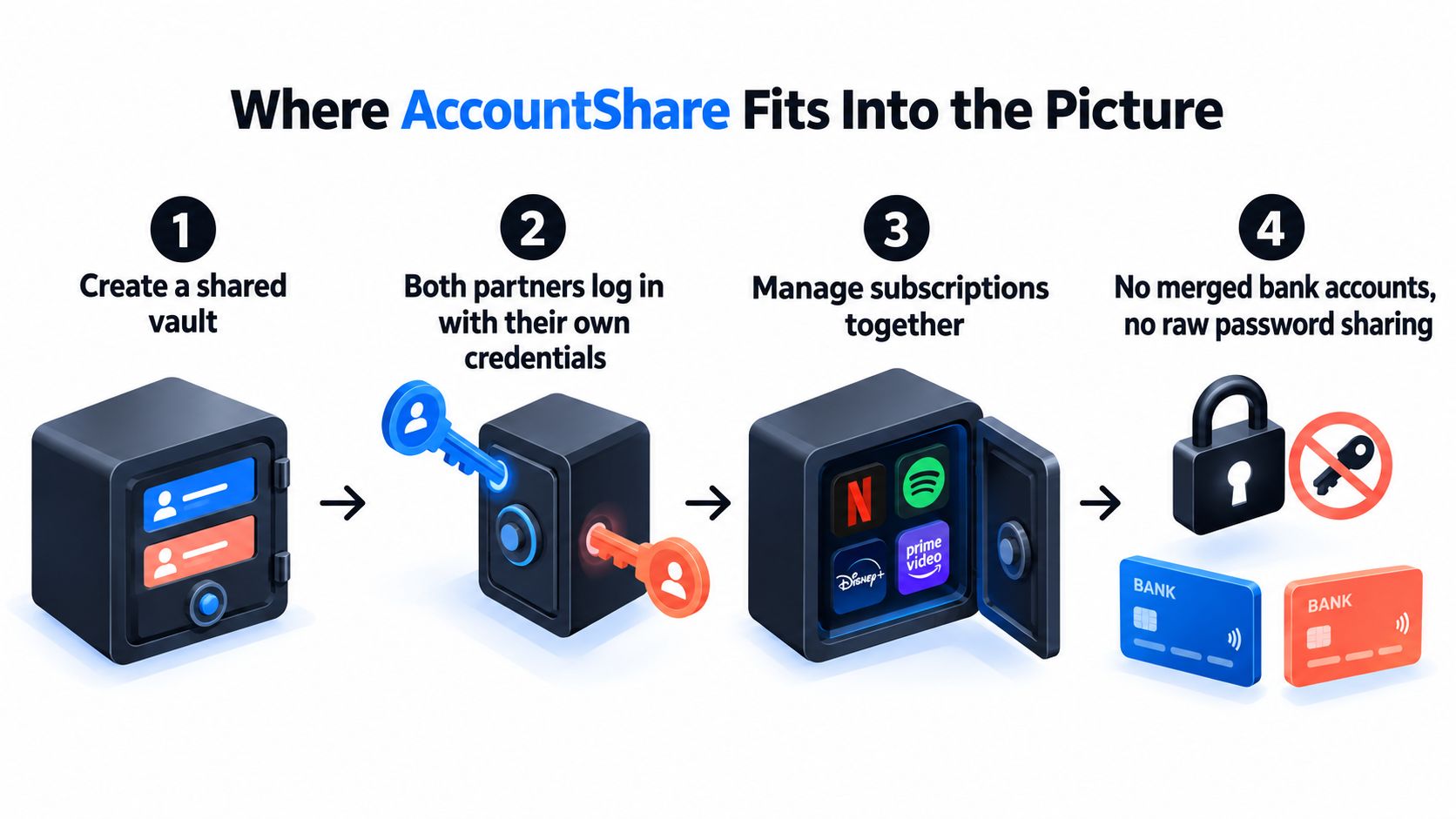
AccountShare sits on that digital side. It gives couples a shared vault for subscription credentials while each person keeps their own login to the vault itself. That means the household can manage access together without merging bank accounts or passing raw passwords back and forth.
When that setup makes sense
This kind of arrangement fits couples who share several recurring services and are tired of using text threads as their credential manager. It's also useful when one partner should remain the primary owner while the other needs reliable access.
That's a better fit than a bank merger for a lot of households. Shared entertainment, shared software, shared memberships. Separate finances where needed.
What problem it actually solves
The benefit isn't romance or even savings. It's operational clarity.
One person can own the subscription. Both people can still access it in a controlled way. If a password changes, the system changes with it. If the relationship changes, access can be adjusted without untangling a shared checking account.
That's the distinction many couples miss. Some things should be jointly owned. Others should be jointly usable.
Choosing the Right Setup for Your Relationship
Don't copy another couple's system. Copying the appearance of trust is how people build fragile setups.
Choose based on risk, habits, and how much coordination your daily life requires.
A simple decision framework
| Couple Type | Banking Setup | Subscription Setup | Watch Out For |
|---|---|---|---|
| Similar incomes, shared household bills, stable habits | Hybrid with one joint bills account and separate personal accounts | Native household plans or managed access for multi-service sharing | Letting the joint account expand into “everything” by accident |
| Uneven incomes | Separate personal accounts plus a shared system for proportional contributions | Keep billing clear and assign one owner per service | Resentment if fairness isn't defined in writing |
| Newly living together | Start separate, add limited shared billing only after routines are proven | Don't swap passwords casually | Mistaking convenience for readiness |
| One partner has debt or messy credit habits | Avoid joint credit and keep core banking separate | Share access cautiously and keep payment methods explicit | Dragging one partner into avoidable liability |
| High need for privacy or independence | Split-bills-only or a narrow hybrid | Use household plans, not informal credential sharing | Bills slipping through the cracks |
My direct recommendation
For most couples, the sweet spot is one joint checking account for shared expenses, separate personal accounts for everything else, and a deliberate system for subscription access.
That gives you teamwork where it matters and breathing room where it doesn't. It also keeps a bad subscription habit from bleeding into a bad banking decision.
If you're just moving in together, start narrower than you think you need. If one of you carries debt, avoid joint credit. If you share several subscriptions, stop using memory and screenshots as your infrastructure.
Good couples don't need maximum merging. They need clear rules, clean access, and fewer avoidable points of failure.
If your household is splitting streaming, software, or membership costs, AccountShare gives you a cleaner way to manage that access without tossing raw passwords into text threads or merging bank accounts you'd rather keep separate. It fits the part of modern couple budgeting that most joint-account guides ignore: who gets in, who pays, and how both people keep access when life changes.