

Company Purchasing Policy Guide
The most popular advice about a company purchasing policy is also the least reliable: make the rules stricter and security will improve. In practice, a policy that turns a modest software request into a long approval chain often drives the purchase into personal expense claims, unapproved accounts, and undocumented renewals. You haven't improved control. You've removed visibility.
Modern teams buy AI tools, specialist SaaS, design platforms, collaboration software, and shared subscriptions continuously. A useful policy must control financial, legal, and operational risk without forcing employees to choose between waiting weeks and bypassing procurement. The standard should be simple: low-risk purchases move quickly, high-risk commitments receive serious review, and every recurring subscription has a named owner and an exit plan.
Why Rigid Purchasing Rules Fail Modern Teams
Strict purchasing rules don't automatically create secure purchasing. They create secure purchasing only when employees can follow them without unreasonable effort. If the compliant route is slow, confusing, or unavailable for a legitimate business need, employees find another route.
That pattern is especially common with digital tools. A marketing specialist may need a niche SEO platform today, a product team may test an AI service, and a small business may need access to a shared design application without signing a large enterprise contract. Treating each request like a major physical-asset purchase makes the policy look thorough while leaving actual buying behavior outside the system.

Recent SME procurement research found that 78% of respondents considered automation and AI indispensable for efficiency, while almost half rated their current procurement systems inadequate for effective risk management, according to research on digitalization obstacles in SME procurement. That combination creates a direct policy challenge. Employees need faster access to digital tools, but many organizations don't yet have workflows that assess those tools efficiently.
The hidden cost of banning unapproved tools
A blanket ban sounds decisive. It can also create shadow purchasing.
An employee who can't obtain approval in time may use a personal card, submit an expense later, or create an account with a personal email address. Finance sees an invoice, if it sees anything at all. Security may not know what data entered the tool, who controls the administrator account, or when the subscription renews. The organization has exchanged a visible request for an invisible liability.
A rigid policy also encourages poor purchasing behavior in less obvious ways:
- Employees split requests: They divide a larger commitment into smaller transactions to stay below an approval limit.
- Teams duplicate tools: Each department buys its own solution because no one can see the existing subscriptions.
- Renewals happen by default: The original requester may have left, but the vendor continues billing.
- Shared credentials spread informally: People pass passwords through chat instead of using controlled access methods.
- Finance reviews after commitment: Accounts payable becomes the first control point, when cancellation or renegotiation may already be difficult.
Practical rule: If employees repeatedly bypass a control, examine the workflow before blaming the employees.
What a modern policy should optimize
The policy should optimize for traceability with proportional effort. That means recording the requester, business purpose, vendor, price structure, data exposure, owner, renewal date, and cancellation path. It doesn't mean asking every employee to complete a security questionnaire for a low-risk tool that never handles company data.
Start by looking for friction points in your current process. Measure where requests wait, which approvals add no useful review, which purchases arrive through expenses, and which subscriptions lack a business owner. Those findings should shape the policy more than inherited language from an old procurement manual.
The objective isn't unrestricted buying. It is controlled speed. Give teams a fast lane for pre-approved categories and a monitored exception route for urgent tools. Reserve legal, security, and executive review for purchases that create meaningful exposure through sensitive data, critical operations, material commitments, or difficult termination terms.
Core Elements of an Effective Purchasing Framework
A modern purchasing framework needs more than a list of approval limits. It should connect the request, supplier decision, contract, access rights, invoice, and renewal into one accountable chain. The framework must work for office supplies, professional services, cloud applications, and shared digital subscriptions without pretending that they carry identical risks.
The public sector illustrates the scale of procurement as a governance function. Across OECD countries, government procurement expenditure increased from 11.8% of GDP in 2007 to 12.9% in 2021, and stood at 12.7% of GDP in 2023, when procurement represented 29.9% of total government expenditure, according to the OECD overview of public procurement. Companies face different rules, but the operational lesson is relevant: purchasing decisions deserve defined ownership, consistent controls, and reliable records.
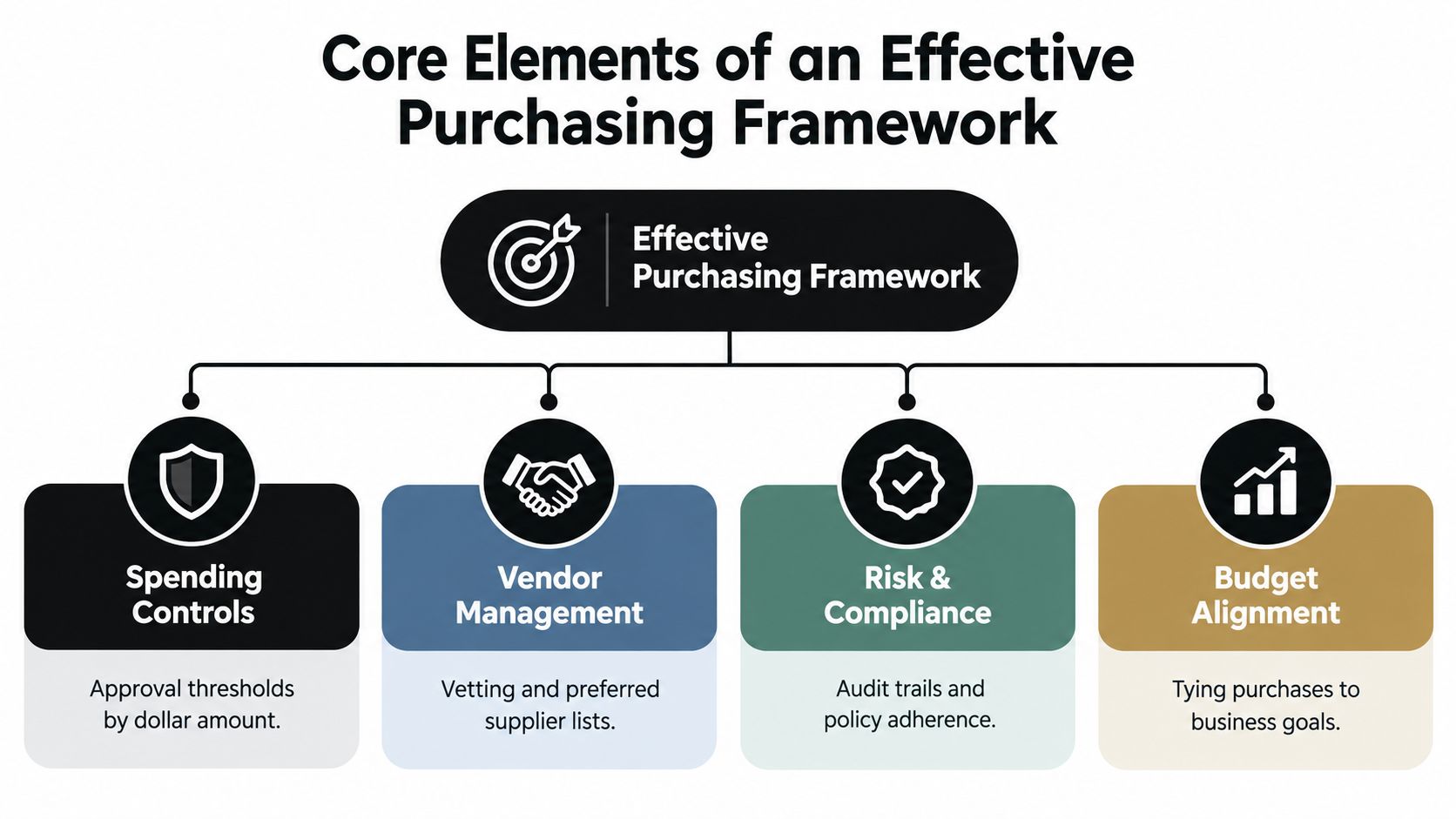
Four components belong in the policy
Spending controls define who can request, approve, commit, and pay. Use delegated authority, not informal knowledge. Employees should know whether they can purchase directly, which categories require a purchase order, and what evidence an approver must review.
Vendor management establishes how suppliers enter the organization. A preferred-supplier catalog can speed routine buying, but it shouldn't become a closed list that blocks useful specialists. Include competitive sourcing expectations, single-source exceptions, conflict-of-interest declarations, contract ownership, and supplier performance records.
Risk and compliance should cover data privacy, information security, regulatory obligations, business continuity, intellectual property, and ethical conduct. For digital tools, ask who owns the account, what data the vendor processes, how access is administered, and what happens when the contract ends.
Budget alignment links every purchase to a department, project, cost center, or approved business objective. A request without a business owner is difficult to renew, measure, or cancel. Finance should be able to distinguish an authorized recurring commitment from an isolated transaction.
Organizations building this structure can also use guidance on designing scalable financial controls to connect purchasing rules with broader financial governance.
Build the source-to-pay chain
A dependable process moves through a clear sequence:
- Establish spend visibility. Collect supplier, category, department, contract, invoice, and renewal information before redesigning approval rules.
- Segment categories. Separate routine supplies, professional services, software, sensitive-data tools, and operationally critical suppliers.
- Set category strategies. Identify preferred vendors, acceptable alternatives, competitive-bid requirements, and documented exceptions.
- Authorize before commitment. Issue a purchase order or approved digital request before an employee accepts terms or starts a subscription.
- Reconcile the transaction. Match the request or purchase order with the contract, receipt, invoice, price, quantity, tax, freight, and payment terms.
The framework should distinguish a one-time purchase from a recurring access commitment. A low monthly price can still create a renewal obligation, user-seat waste, data-retention issues, and account ownership problems. Add subscription-specific fields to the request rather than forcing employees to explain these details in free text.
Procurement's growing strategic role supports this broader design. A global CIPS survey reported that 64% of respondents said procurement's influence was growing, while 25% said the chief procurement officer had a permanent seat on the main board, according to the CIPS global procurement and supply report. The policy should reflect that reality by treating purchasing as part of risk and operating governance, not merely invoice processing.
Designing Smart Spending Limits and Approval Tiers
A single approval threshold is easy to administer and poor at managing risk. A modest purchase of a tool that handles customer information may deserve more scrutiny than a larger order of routine office equipment. A useful matrix considers financial value, category, data access, operational dependency, supplier terms, and commitment length.
Start with the spend baseline. Review what teams buy, not what the old policy says they buy. Group transactions by vendor and category, combine recurring charges, identify purchases made through expenses, and flag subscriptions that renew without an active owner. This exercise usually reveals why a flat threshold fails: the organization is managing individual transactions while the risk sits in the aggregate commitment.
A practical approval matrix
| Spend Threshold | Risk Tier | Required Approvals | Examples |
|---|---|---|---|
| Low value and routine | Low | Budget owner or delegated manager | Office supplies, standard catalog items, pre-approved productivity tools |
| Low or moderate value with recurring billing | Moderate | Budget owner, finance record, named subscription owner | Team software, collaborative services, recurring AI access |
| Any value involving sensitive data or important integrations | High | Budget owner, security or privacy review, legal where terms require it | Customer-data platforms, identity integrations, systems connected to core operations |
| Material or multi-department commitment | Strategic | Executive sponsor, finance, procurement, legal and security as applicable | Enterprise software, long-term services, major supplier commitments |
The table should guide judgment, not replace it. Define the tiers in plain language and publish examples. An employee shouldn't have to guess whether a shared design subscription is a routine purchase, a recurring commitment, or a high-risk account based on the data it stores.
Make recurring cost visible
Approvers need the total commitment, not only the payment interval. The request should show the billing frequency, renewal date, initial term, price-change language, cancellation notice, minimum seats, and owner. If the vendor offers annual and monthly options, record why the selected term fits the business need.
Assign different roles where practical. The requester explains the use case. The budget owner confirms funds. The license owner manages users and renewals. Finance validates the accounting treatment. Security or legal reviews the purchase when its risk profile warrants specialist input.
McKinsey benchmarking across more than 2,000 companies found that top-quartile procurement maturity correlates with EBITDA margins at least 5 percentage points higher than those of less mature peers, as reported in McKinsey's analysis of procurement's next phase. The figure doesn't justify adding approvals everywhere. It supports investing in a process that directs attention to the commitments most likely to affect the business.
Use fast lanes and monitored exceptions
Pre-approved catalogs should cover common low-risk purchases. Employees select the supplier, category, and standard terms, then route the request to the appropriate budget owner. This removes repetitive review while preserving the audit trail.
Urgent or unlisted tools need an exception path, not a policy vacuum. Require a short justification, named owner, approved data classification, access limit, end date, and follow-up review. A pilot should expire unless someone converts it into an approved purchase or documents cancellation.
Workflow tools can help embed this logic into daily operations. Teams evaluating ways to automate business processes with Wisely should focus on routing, evidence capture, reminders, and exception reporting rather than automation for its own sake. The best workflow is the one employees can complete correctly while the request is still relevant.
Governing Shared Subscriptions and Group Purchasing
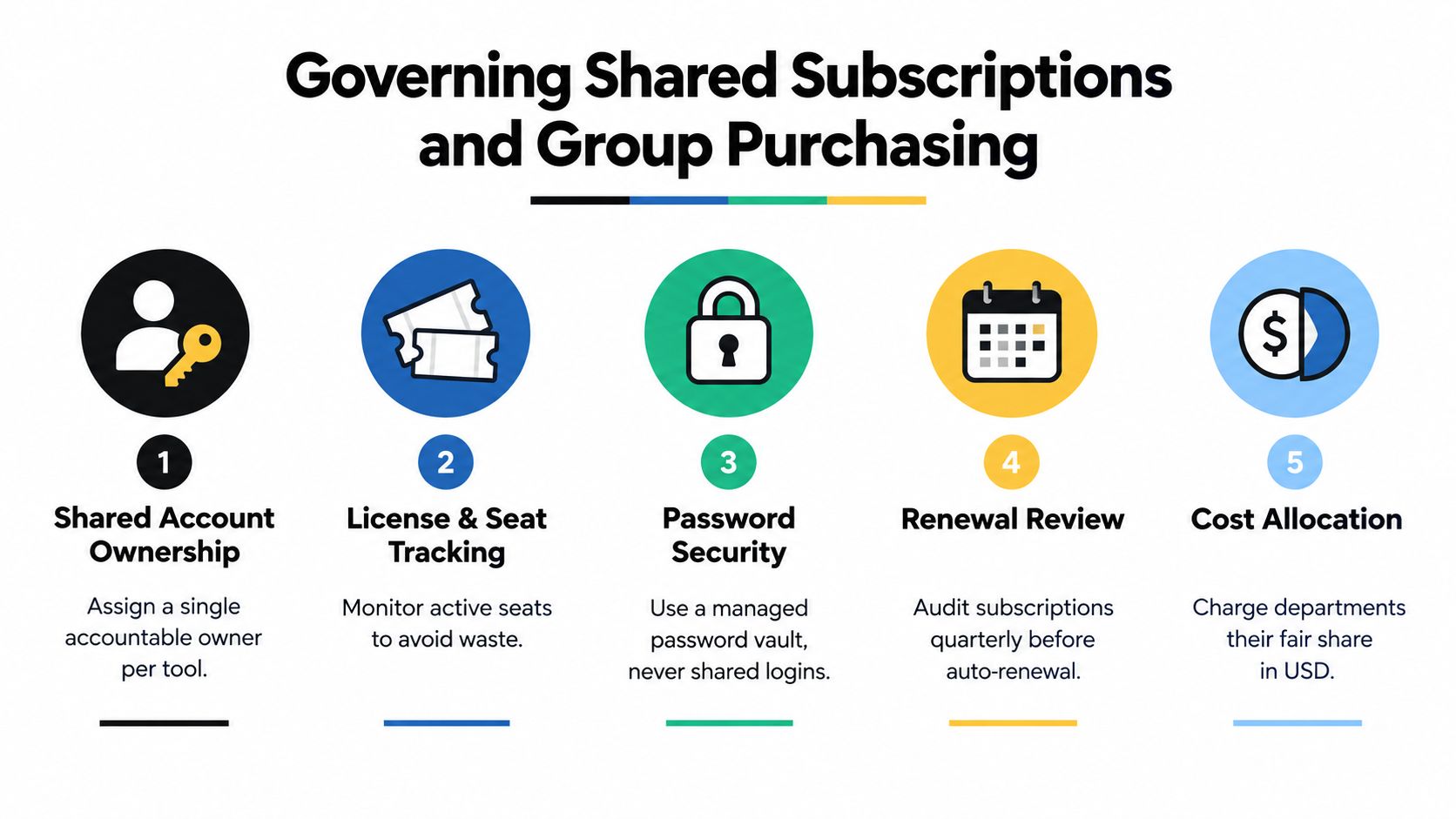
Shared subscriptions can reduce waste, but they also expose gaps that standard purchasing rules often miss. The decision is not limited to who paid. It must establish who owns the account, who controls permissions, where company data is stored, what the license permits, and how access ends when a participant leaves.
A group purchase can work when the vendor permits the arrangement, the data classification fits the service, and the company retains control. Risk rises quickly when employees share a master password, place confidential material in a personal workspace, or rely on an account with no formally assigned owner. Read what group purchasing means for the commercial model, then apply the company's licensing and security checks before approval.
Assign ownership before access
Every shared tool needs one accountable business owner. That person does not have to perform every administrative task, but must know the approved users, permission levels, renewal date, vendor terms, and cancellation route. Departments may divide the cost, yet responsibility still needs a clear decision-maker.
Record these details in the purchasing system:
- Business owner: The employee or team responsible for the continuing need.
- Account administrator: The person managing invitations, permissions, billing, and account recovery.
- User list: Current participants and the access each role requires.
- Data boundary: Information users may upload and material the service must not receive.
- Renewal record: Renewal date, notice period, price terms, and review owner.
- Exit evidence: Confirmation that users were removed, business data was exported or deleted where required, and billing was stopped if the service was no longer needed.
Control credentials and permissions
A shared login does not provide governance. Use individual seats when the vendor supports them. If a permitted shared account is unavoidable, store its credentials in a managed password vault, limit access to approved users, enable available multi-factor authentication, and prohibit forwarding passwords through email or chat.
Separate shared access from shared data. Several people may need the same service without needing access to every project, file, prompt, customer record, or billing setting. Configure the narrowest permissions that still support the work.
Document recurring authorization, name the person accountable for the license, set renewal reminders, reconcile paid seats with active users, and retain cancellation evidence. These controls address failures that occur after purchase, including forgotten renewals, unused seats, and accounts that remain active after the business need ends.
Make offboarding part of buying
Include an offboarding plan in the subscription request. When someone leaves the team, the owner removes access, transfers business content, updates recovery details where necessary, and records the action. At renewal, compare paid seats with active users and ask each participating department to confirm its continuing share of the need.
Group buying can lower cost without weakening confidentiality, licensing control, or continuity. The policy succeeds when it keeps administration light for legitimate shared use while assigning clear ownership for every account and renewal.
Proportional Vendor Vetting for Digital Tools
A small vendor doesn't automatically present a small risk, and a large vendor doesn't automatically present a safe one. The right question is what the supplier can access, how essential the service is, how much the company depends on it, and how difficult it would be to recover if the relationship failed.
Applying a full enterprise assessment to every freelancer or specialist plugin creates delay without necessarily improving judgment. Skipping all checks creates the opposite problem. A proportional model gives employees a fast route for low-risk tools while reserving deeper review for vendors that handle sensitive information, support critical operations, or create significant concentration and continuity concerns.
Start with a risk profile
For each digital vendor, record the service purpose, data handled, access permissions, integration scope, commitment structure, and business dependency. Then assign a review path.
A low-risk purchase may need basic identity verification, a review of privacy terms, confirmation of acceptable data use, service and support details, payment information, and a named owner. A higher-risk supplier may require security documentation, data-processing terms, business-continuity evidence, incident-notification commitments, access-control details, insurance information, and contract review.
The process should also ask whether the vendor's license permits the proposed access model. Group purchasing isn't a substitute for checking subscription terms. A tool may permit multiple named users but prohibit credential sharing, commercial resale, or use outside a defined account structure.
Give small suppliers a workable route
Small suppliers often offer specialized capability that larger providers don't. Excessive onboarding can exclude them before the business evaluates their actual suitability. Recent research found that 96% of enterprise leaders would source more from small businesses if finding, vetting, and onboarding them were easier, while 41% reported a failed small-supplier partnership because of poor vetting, according to the Babson CPO survey report.
A workable policy separates mandatory controls from evidence formats. A small vendor may not have a formal security certification, but it can still answer focused questions, sign appropriate contractual terms, explain its incident process, and identify who provides support. The absence of a polished compliance package should trigger a reasoned assessment, not an automatic rejection or automatic approval.
Proportionality matters: Reduce paperwork for low-risk suppliers, not accountability.
For teams refining their software procurement best practices, a short intake form can collect the facts needed for triage. Keep the form specific: data type, administrator rights, integration permissions, renewal terms, service dependency, and exit method.
Escalate only when exposure warrants it
A tool that stores no company data and supports a noncritical task can follow a lightweight route. A platform connected to customer records, identity systems, financial workflows, or proprietary content needs a more serious review even if the purchase price is modest.
Guidance on mitigating vendor risk in 2026 can help operations and security teams update their due-diligence questions as supplier models change. The policy should state who can approve residual risk, how exceptions are documented, and when a vendor must be reassessed after a material change in data use, ownership, integration, or service scope.
Rolling Out the Policy and Preventing Value Leakage
A purchasing policy creates value only when people can find it, understand it, and follow it without leaving their normal tools. Start with the buying problems that cause the most frustration. Show employees how the process handles routine requests quickly, defines urgent exceptions, and stops recurring charges from outliving their owners or users.
Launch with practical ownership
Assign a policy owner, finance contact, procurement contact, security reviewer, and subscription administrator. Publish a short decision guide with examples, so employees do not have to interpret a long document for every software request.
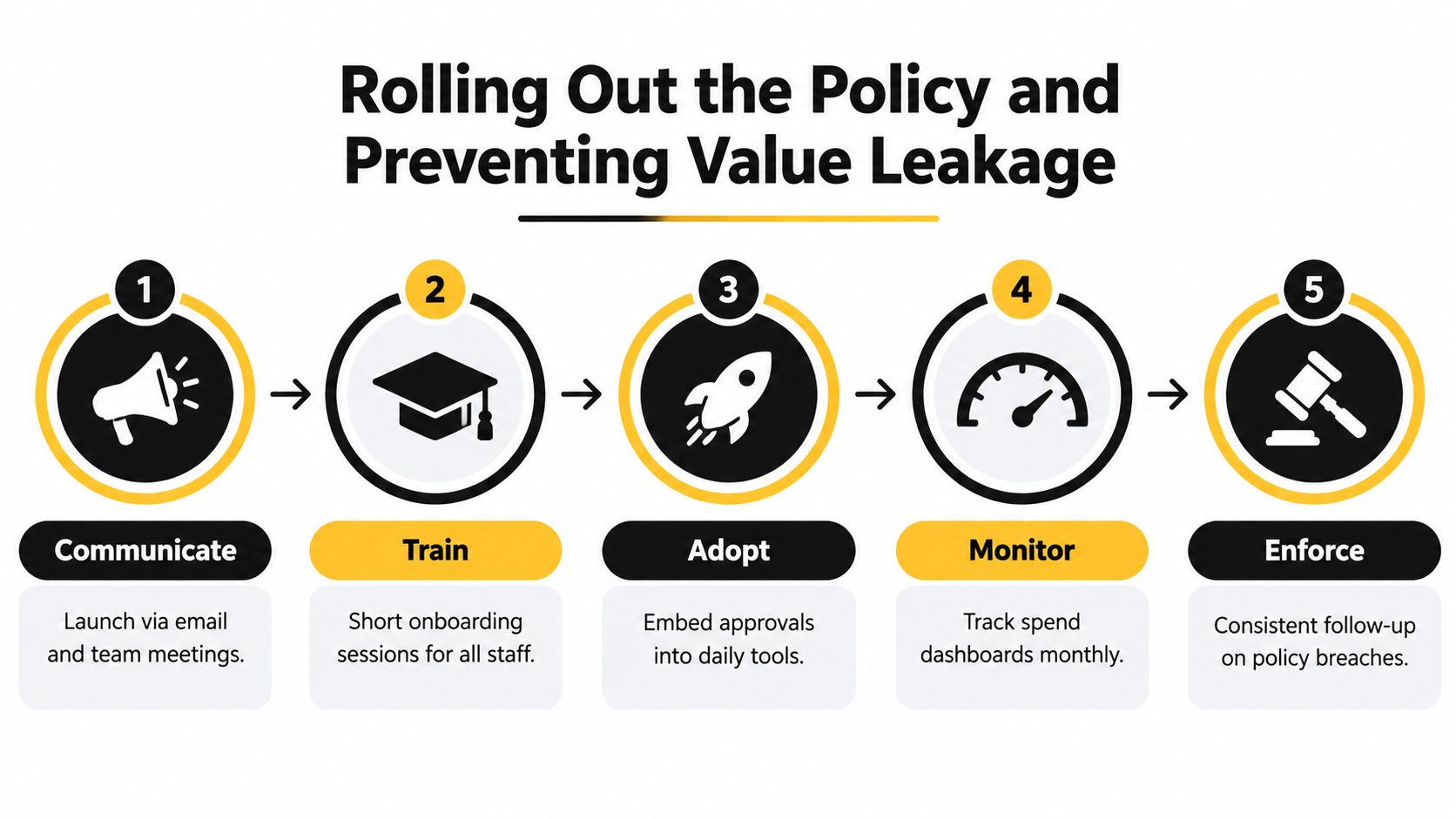
Use a focused rollout sequence:
- Communicate: Explain the policy's purpose, the fast lane, the exception process, and the consequences of recurring spend without an owner.
- Train: Run short sessions for requesters, approvers, finance staff, and department administrators. Demonstrate a software request from intake through renewal.
- Adopt: Place the request form, preferred catalog, approval route, and renewal calendar in the tools teams already use.
- Monitor: Review purchasing dashboards, expense claims, exceptions, supplier records, and subscription ownership.
- Enforce: Correct workflows that create avoidable friction, follow up consistently, and address deliberate bypasses through the appropriate management process.
Test for leakage after approval
A negotiated saving is realized only when the organization pays the agreed price for the agreed quantity under the agreed terms. Compare the expected commercial result with what appears in orders, invoices, and payments. Planning errors, missed contract terms, unused seats, and off-contract buying can all reduce the result without appearing as a single obvious failure.
Run a quarterly review across purchase orders, contracts, receipts, invoices, and payment records. Check for duplicate invoices, off-contract purchases, price variance, incorrect quantities, unexpected freight or tax, nonpreferred suppliers, and recurring charges for inactive users. Keep a benefits register showing the baseline, expected result, realized result, owner, and explanation for each variance.
Track measures that lead to action:
- Compliant-spend rate: Purchases completed through the approved route.
- Invoice exception rate: Transactions requiring manual investigation.
- Realized savings: Benefits confirmed against the prior benchmark.
- Renewal savings: Value created by canceling, renegotiating, or right-sizing subscriptions.
- Approval cycle time: Time from a complete request to a decision.
- Owned-subscription rate: Recurring tools with an active business owner.
Subscription reviews should cover seats, departments, permissions, renewal terms, and cancellation evidence, rather than invoice totals alone. Teams reviewing subscription optimization can apply the same checks to find duplicate tools and unused access before renewal.
A strong company purchasing policy keeps judgment in the process while making it visible. It assigns responsibility and gives employees a compliant route that suits decentralized digital work.
AccountShare helps users join group purchases for digital subscriptions, with centralized billing and account management for participating members. Teams can review whether its model fits their policy for shared access, permissions, renewals, ownership, and cost allocation at AccountShare.