
The Real Deal on Semrush Group Buy Services
A Semrush group buy is a pretty straightforward concept: a bunch of people pool their money to share one premium Semrush subscription. The whole point is to get access to a powerful, and expensive, SEO tool for a tiny fraction of what it would cost to buy it directly.
This "gray market" approach has become a go-to for freelancers, small agency owners, and SEOs, especially in places where shelling out for a full-priced subscription just isn't realistic. It’s a solution that promises massive value, but it's not without its own set of headaches and risks.
Why Do People Flock to Semrush Group Buys?
It all boils down to simple economics. Take one look at the official Semrush pricing page, and you’ll instantly see why so many people look for a workaround.
As you can see, the cheapest "Pro" plan will set you back more than $100 a month. The "Guru" and "Business" plans? Even more. That’s a serious chunk of change for a solo consultant or a startup trying to get off the ground. Group buys dangle the promise of those same premium features for a much more palatable $10-$20 per month.
Who's Actually Using These Services?
The folks signing up for shared accounts aren't big corporations with deep pockets. They're usually scrappy, ambitious individuals and small teams trying to punch above their weight on a shoestring budget.
You'll typically find:
- Freelance SEOs and Content Writers: They need top-tier data to deliver for clients but can't stomach the full subscription cost for just a handful of projects.
- Small Marketing Agencies: These teams are juggling a dozen different software bills and can't afford a dedicated license for everyone on staff.
- Entrepreneurs and Bloggers: People building their own brands from scratch who need real analytics without the enterprise price tag.
- Marketers in Developing Countries: In many parts of the world, the official price is simply out of reach when compared to local wages.
The rise of this gray market is a direct result of Semrush's own success. The platform boasted 117,000 paying customers by late 2024, with each customer spending an average of $3,225 a year. That high price point, while totally justified for the value Semrush provides, inevitably creates a huge demand for cheaper access—a demand that group buys are more than happy to meet.
Let's break down the key differences in a quick comparison.
Semrush Group Buy At a Glance
| Aspect | Direct Semrush Subscription | Semrush Group Buy Service |
|---|---|---|
| Cost | Starts at $129.95/month | Typically $10 - $20/month |
| Account Access | Private, secure login | Shared login, often via a browser extension |
| User Limits | Defined by your plan | Shared with unknown number of users |
| Data Security | Your data is private | No privacy guarantees; data is exposed |
| Terms of Service | Fully compliant | Direct violation of Semrush's ToS |
| Support | Official Semrush support | Community or seller support only |
| Reliability | 99.9% uptime | Unpredictable; access can be revoked anytime |
While the cost savings are obvious, the trade-offs in security, reliability, and compliance are significant.
The Bottom Line: A Semrush group buy is more than just a cheap-out. For many, it's a calculated decision to get the professional tools they need to compete when they're priced out of the official market. It’s a bridge between ambition and budget.
Of course, this whole model operates in a legal and ethical gray area, playing fast and loose with Semrush's terms of service and putting your data at risk. While you get the tools, it's crucial to weigh the trade-offs. For those looking for a safer, more reliable way to get shared access, you can learn more about how AccountShare provides Semrush access safely. Ultimately, it comes down to how much risk you're willing to take for affordable data.
How to Vet and Choose a Group Buy Provider
Jumping into the world of Semrush group buys can feel like a bit of a gamble. With so many anonymous providers popping up on forums and social media, the first and most important step is figuring out who's legit and who's just running a scam.
A great provider gives you stable, reliable access for a fair price. A bad one? They'll just take your money and disappear, leaving you high and dry.
Your search should start where real people share their unfiltered experiences. Forget the polished testimonials on a provider's homepage—you need to get into the digital marketing trenches.
- Forums like BlackHatWorld: These old-school communities have long-running threads dedicated to group buy SEO tools. Look for providers with a solid history of positive mentions and active, helpful participation.
- Reddit Communities: Subreddits like r/SEO or r/juststart are absolute goldmines for honest, and often brutal, reviews. Just use the search bar to see what people are saying about the specific providers you're considering.
At its core, the process for a Semrush group buy is pretty simple, as you can see here.
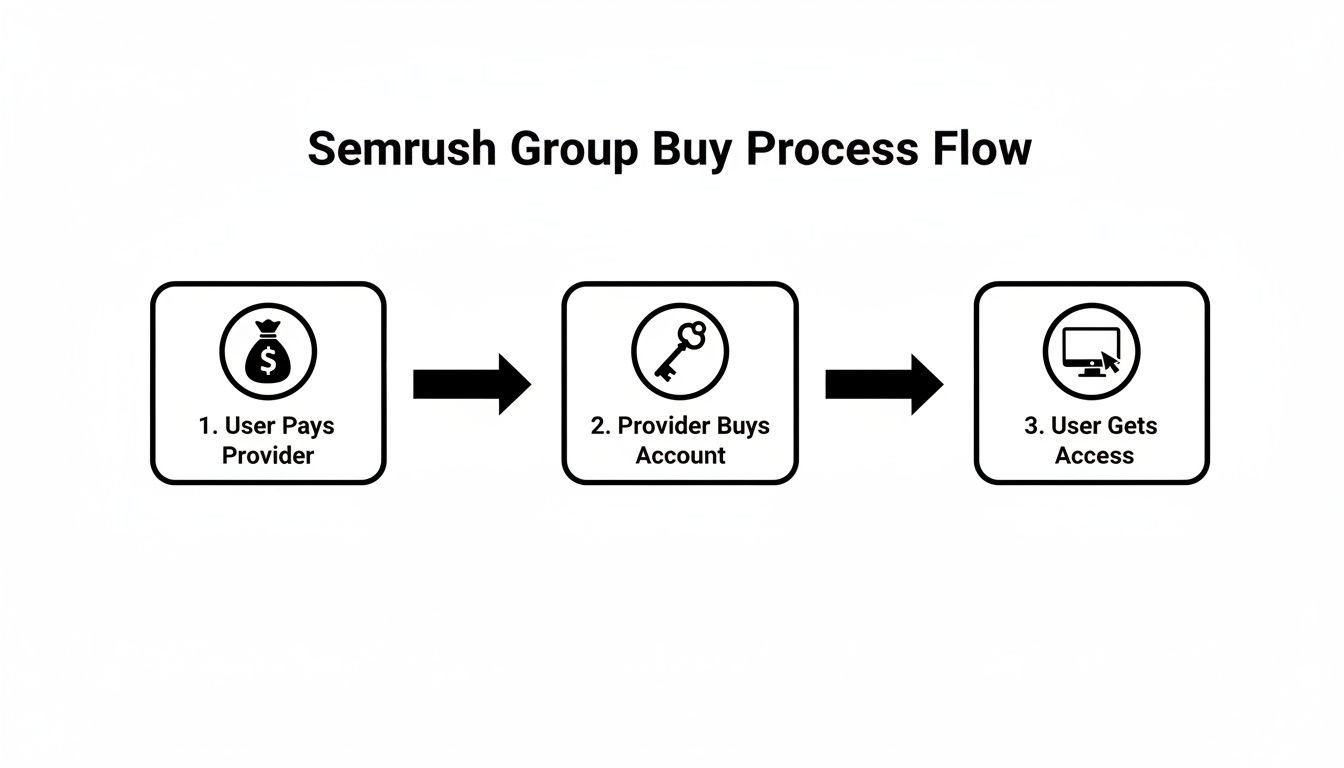
This flowchart really breaks it down: you pay the provider, they handle the official subscription with Semrush, and you get shared access credentials. The simplicity is what makes it so appealing, but it also shows just how much trust you're putting into the person or company running the show.
Spotting the Red Flags Immediately
As you dig through forums and reviews, you'll quickly start to notice patterns that separate the reliable operators from the risky ones. Some red flags are subtle, but others are massive, glaring warnings to run the other way.
For instance, a provider that only accepts irreversible payment methods like cryptocurrency should be an immediate deal-breaker. If something goes wrong—and it can—you have absolutely zero recourse to get your money back.
Another huge warning sign is unrealistic promises. If a provider is guaranteeing 100% uptime or lifetime access for a small one-time fee, they're probably not being straight with you. The very nature of shared accounts means occasional hiccups or login issues are part of the deal. The good providers are upfront and honest about this.
Finally, do a quick check on their digital footprint. Does this provider have any kind of public history, or are they a brand-new entity that just popped up last week? A provider with zero reviews, no community presence, and a freshly registered domain is a serious risk. For more on what to look for, check out this guide on evaluating a group buy website.
Your Pre-Payment Vetting Checklist
Before you even think about handing over your payment details, run through this final checklist. Think of it as your due diligence—a few minutes now can save you a world of headaches later.
A five-minute support chat before you buy tells you more about a provider's reliability than a week of reading their sales page. Test their responsiveness when the stakes are low.
Use this quick list to make your final call:
- Test Their Support: Ping them with a pre-sales question on their live chat or email. How quickly do they respond? Is the answer actually helpful and written by a human? Slow or useless support now means you'll be completely on your own when a real problem crops up.
- Clarify the Semrush Plan: Ask them directly which Semrush plan they're offering (Pro, Guru, or Business). This is critical, as it dictates your limits on projects, keyword tracking, and data exports. Make sure the plan you're buying into actually matches what you need.
- Understand the Access Method: How will you log in? Many providers use a central portal or a browser extension. Get clear on the method and make sure you're comfortable with it. Some can be clunky or feel less secure than others.
- Review the Refund Policy: A reputable provider will have a clear and fair refund policy. If their terms essentially say "no refunds, no matter what," you should be very, very cautious. It shows they have little confidence in their own service stability.
The Hidden Dangers and Legal Gray Areas
The idea of getting a full-featured Semrush group buy for a fraction of the price sounds fantastic, I get it. But it's crucial to pull back the curtain and see what you're actually signing up for. This isn't just about saving a few bucks; it’s a high-stakes gamble with your data security, professional reputation, and the very stability of the tools you need to do your job.
The most immediate problem is that you’re knowingly violating Semrush's Terms of Service. Every subscription is based on a clear agreement: the account is for one person or a set number of users within a single company. Sharing your login details outside of that framework is a direct breach of contract.
This isn't a minor infraction. Providers explicitly forbid account sharing, making a 'group buy' a clear case of understanding breach of contract with the software vendor. If Semrush spots suspicious activity—like simultaneous logins from different continents or a crazy number of queries—they can, and often do, terminate the account without warning.

Your Data Is Not Your Own
Beyond getting the account shut down, the security issues are genuinely alarming. When you join a group buy, you’re handing over your most sensitive business intelligence to the provider and every other stranger sharing that account.
Let that sink in for a moment. Every keyword you research, every competitor you analyze, and every client website you audit is logged and visible to others. The provider, who holds the master key, sees it all.
- Client Confidentiality: Auditing a major new client's site? Everyone with access can see that domain and all the data you pull.
- Strategy Exposure: Building a killer content strategy around untapped keywords? Your entire research process is an open book.
- Data Theft: What's stopping an unethical provider from selling your keyword lists or competitive analysis to your direct competitors? Nothing.
There are zero privacy guarantees. You're working inside a system built on blind trust in a completely unregulated market. These same risks apply to virtually any shared tool, as you can see in this breakdown of the issues with a group buy for Ahrefs.
The moment you log into a shared account, you must operate under the assumption that none of your work is private. The money you save comes at the direct cost of your data's confidentiality.
The Frustration of Performance and Usability Issues
Even if you can stomach the legal and security risks, the day-to-day experience is often a nightmare of frustration. The group buy business model is all about cramming as many users as possible onto a single account to maximize profit, which inevitably tanks performance.
Picture this: you're rushing to finish a client report on a tight deadline. You log in, only to be booted out because someone in another time zone just logged in. This constant game of getting kicked off is one of the most common complaints.
Worse yet, premium Semrush plans have daily limits on reports, keyword tracking, and other features. In a shared account, it’s a free-for-all to use those resources before another anonymous user beats you to it.
Common Performance Headaches:
- Exceeded Daily Limits: You try to run a vital domain report, but a pop-up says the daily limit has been hit. Someone else already used up the shared allowance for the day.
- Project Slot Scarcity: Semrush accounts have a finite number of "Projects" for site audits and rank tracking. If they're all claimed by other users, you're simply out of luck.
- Sluggish Performance: During peak hours, with dozens of users hitting the tool at once, the whole platform can grind to a halt.
These aren't just small annoyances. They are massive roadblocks that can derail your workflow, make you miss deadlines, and ultimately damage your credibility. That cheap price tag starts to look a lot more expensive when you factor in all the lost time and productivity.
Navigating a Shared Semrush Account: The Unwritten Rules
If you've weighed the risks and decided a Semrush group buy is the way to go, you need to learn how to operate inside a shared space. Think of it like a digital co-working office. Success means being a good neighbor, keeping your own work private, and following the house rules so nobody gets kicked out.
Your number one job is to protect your sensitive data. It’s crucial to remember that the provider—and every other person using the account—could potentially see what you're doing. From the domains you're auditing to the keywords you're tracking for a new client, nothing is truly private unless you make it so.
That's why you have to get into the habit of anonymizing your data from the very beginning. Never, ever use a client's actual domain or brand name in your projects. Instead, come up with a simple coded system that only you can decipher. This one small step creates a vital privacy buffer in what is otherwise a very transparent environment.
Keep Your Work Under Wraps
A privacy-first mindset isn't just a suggestion; it's a requirement. This is how you stop your strategic research from accidentally falling into the hands of a competitor or just a nosy user who happens to be sharing the account with you.
-
Project Naming: Instead of a project named
DrSmithsDental.com SEO Audit, use something generic and untraceable likeProject-Bravo-HealthorClient007-Q2. -
Keyword Lists: Give your lists nondescript names.
Local Biz KW - Mayis a much smarter choice thanMiami Roofer Lead Gen Keywords. - Export and Delete: Don't let your data sit around in the account. As soon as you run a report or finish gathering your keywords, export everything to a CSV or PDF. Save it on your own computer, then immediately delete the project or report from the Semrush interface.
Treat the shared account like a library computer—a tool for temporary access, not a permanent home for your files. Get in, get what you need, and get out.
Don't Be That Person
Living peacefully in a shared account means being conscious of the resources you're using. Every Semrush plan has daily and monthly caps on things like reports, keyword lookups, and data exports. If you go on a data-pulling frenzy, you’ll burn through the shared limits and frustrate everyone else.
Being a considerate user isn't just about good manners—it's a survival tactic. The account's stability depends on everyone playing fair. If one person abuses the limits, the whole account can get flagged and shut down, and then everyone loses access.
Before you kick off a major research session, try to gauge the remaining limits for the day. This can be tricky since most group buy setups don't give you a clear dashboard for this. You often only find out you've hit a limit when the tool stops you cold. The best approach is to be mindful and spread your heavy-duty tasks out over a few days instead of trying to cram them all into one afternoon.
The Golden Rule: Don't Touch Anything
This is the most important rule of all: never, ever change the account login, password, or any other core settings. It sounds like common sense, but you’d be surprised how often someone thinks it’s a good idea. The moment one user changes the password, it locks out everyone else—including the person who owns the account.
This is a one-way ticket to getting kicked out. The provider will immediately revoke your access, keep your money, and ban you from their service for life. It causes a massive headache for them and frustrating downtime for every other paying user.
To be crystal clear, here’s what you should never, ever touch:
- Account email or password
- Billing information
- User management or permissions
- API unit settings
Your goal is to fly under the radar. Get your work done, be efficient, and maintain your access. By keeping your data anonymous, respecting the shared limits, and leaving the settings alone, you can make a risky situation a lot more manageable.
Smarter Alternatives to Risky Group Buys
Before you jump into a sketchy Semrush group buy, it's smart to look at the safer, more stable ways to get your hands on premium SEO data. That super-low price tag is tempting, I get it. But the very real possibility of losing access overnight or having your project data exposed is a massive headache you don't need.
The good news? There are several legitimate alternatives that deliver fantastic results without the drama.

Honestly, a lot of people sleep on Semrush’s own free account. It's obviously limited, but it’s surprisingly useful for quick spot-checks, a little competitor snooping, or some initial keyword brainstorming. Think of it as the perfect way to test the waters without spending a dime.
Getting The Most Out of a Free Semrush Account
Treat the free account like a handy little spyglass. You won't be managing huge campaigns with it, but you can definitely pull critical bits of data to guide your bigger strategy. It’s a great way to handle essential, one-off tasks without the risks of sharing an account.
Here's how I'd put it to work:
- Daily Keyword Spot-Checks: You get a handful of keyword lookups each day. Use them strategically to check the search volume and difficulty for your most important terms.
- Quick Domain Overviews: Pop your site (or a competitor's) into the tool for a high-level snapshot of their organic traffic, top-ranking keywords, and backlink profile. It's a great starting point.
- Mini Site Audits: The free plan lets you crawl a small number of pages. This is perfect for finding any glaring technical SEO problems on your key pages, like your homepage or top service pages.
No, it won’t ever replace a full subscription. But for those quick, surgical tasks, it's an excellent—and completely safe—tool to have in your back pocket.
Exploring Budget-Friendly SEO Tool Suites
If the free account feels too restrictive, you're not out of options. Several other SEO platforms offer incredible value for a fraction of what Semrush costs. These aren't just "Semrush-lite" knock-offs; they are powerful, well-respected tools with their own unique strengths.
Many of these are especially good in certain niches. For instance, if you primarily serve a local market, you might find that some of the best local SEO tools are a much better fit than a sprawling, expensive international suite.
Here are a couple of top contenders worth checking out:
- SE Ranking: A true all-in-one platform that’s often praised for its bang-for-your-buck value. It delivers accurate rank tracking, in-depth site audits, and solid competitor analysis at a price point that's hard to beat. Its interface is also very approachable for newcomers.
- Mangools: This isn't one tool, but five that work together: KWFinder, SERPChecker, SERPWatcher, LinkMiner, and SiteProfiler. People absolutely love Mangools for KWFinder, which makes finding low-competition keywords almost effortless. Its design is clean and intuitive.
With these platforms, you get a legitimate subscription, real customer support, and total privacy for your data. All the big risks of a group buy simply vanish.
A legitimate subscription to a budget-friendly tool provides peace of mind. You own your data, your access is guaranteed, and you have a dedicated support team ready to help—privileges you give up in a group buy.
The Middle Ground: Managed Shared Access
For those who feel they really need the specific data and power of Semrush, a managed shared access platform like AccountShare offers a compelling compromise. This isn't your typical group buy. The entire model is built differently, with a focus on security, stability, and structure.
These services purchase official, high-tier enterprise licenses directly from the tool provider. Then, they securely partition access for individual users. The key here is that you get your own private, sandboxed workspace within the tool, meaning your projects and data stay completely confidential.
Let’s be real, a big reason people even consider a Semrush group buy is to tap into its absolutely massive dataset. We're talking 27.3 billion keywords and 43 trillion backlinks, with some data going all the way back to 2012. This kind of historical information is gold for analyzing long-term trends, but it’s locked behind expensive plans.
Managed access platforms make this data affordable without forcing you to roll the dice on a shady deal.
Semrush Group Buy vs. Safer Alternatives
To make sense of it all, let's break down the options. This table gives you a clear comparison of the risks and benefits you’re looking at with each path.
| Option | Average Cost | Risk Level | Key Benefit |
|---|---|---|---|
| Traditional Group Buy | $10 - $20/month | High | Lowest possible cost |
| Free Semrush Account | $0/month | None | Risk-free basic data |
| Budget-Friendly Suite | $40 - $80/month | None | Ownership and security |
| Managed Shared Access | $25 - $50/month | Low | Secure premium tool access |
Ultimately, what you choose comes down to your budget and how much risk you're willing to stomach. A traditional group buy is the cheapest, but the potential for data leaks and getting locked out is a serious drawback. For just a bit more, options like a budget-friendly suite or a managed platform give you a professional, secure, and stable foundation to actually grow your business.
Got Questions About Semrush Group Buys? Let's Clear Things Up.
So, you've weighed the pros and cons, but a few questions are probably still bouncing around in your head. It's smart to be skeptical. Let's tackle the most common questions I hear about how Semrush group buys actually play out in the real world.
Think of this as the final gut check, where we get into the practical, day-to-day realities of sharing a high-powered SEO tool.
Is Using a Semrush Group Buy Actually Legal?
This is the big one, and the answer isn't a simple yes or no. You're not going to jail for using a group buy; it's not illegal in a criminal sense.
However, it's a crystal-clear violation of Semrush's Terms of Service. By using their platform, you're agreeing to their rules, and sharing an account like this breaks them. The consequence isn't a legal battle; it's getting kicked off the platform. Semrush can, and often does, terminate shared accounts without warning. When that happens, your access vanishes, your money is gone, and any project data you had saved is lost forever.
So, the risk isn't legal trouble, it's getting permanently banned from the tool.
Can Other People See or Steal My Data?
Yes, and you should assume they can. This is a huge, non-negotiable risk that comes with the territory. When you log into a shared account, privacy goes out the window.
Here's a quick rundown of who might be looking over your shoulder:
- The Provider: This person or company holds the master login. They can see everything—every keyword you research, every site you audit, every report you pull.
- Other Users: It's a shared space. If you'm not careful to use generic, anonymous names for your projects (like "Project 123" instead of "ClientXYZ.com Audit"), other users could easily see what you're working on.
This complete lack of confidentiality makes group buys a terrible idea for any serious agency or freelancer handling sensitive client information.
The bottom line is simple: you trade data security and privacy for a lower price. In a traditional group buy, there are absolutely no guarantees your work will remain confidential.
Will I Get All the Same Features as a Regular Subscription?
For the most part, yes, but with a major catch. You'll typically have access to the core features of whatever plan the provider bought—Pro, Guru, or Business. That means you can still do your keyword research, competitor analysis, and site audits.
The real problem is the shared usage limits. Every Semrush plan has daily caps on things like reports, keyword tracking, and data exports. Now, imagine sharing that cap with 10, 20, or even 50 other people. Those limits get hit fast. It's incredibly common to log in midday only to find the tool is useless because someone else has already maxed out the daily reports.
So, you get the features on paper, but you don't get guaranteed access to use them when you need them.
What Happens if the Account Gets Banned?
It's not a matter of if, but when. And when Semrush brings the hammer down, everyone on the account is locked out instantly.
What happens next is a roll of the dice and depends entirely on the provider you chose. A more established provider might have a backup account ready and move you over with minimal downtime. A shady operator, on the other hand, could just vanish into thin air, taking your money with them. If you paid with something irreversible like crypto, you have zero recourse.
And to be clear, you will not get a refund from Semrush. From their perspective, the account was terminated for a valid reason: breaking their rules.
For those who see the appeal of cost-sharing but can't stomach the risks of a traditional Semrush group buy, a managed platform like AccountShare is a much safer middle ground. We offer private, partitioned access to legitimate enterprise accounts, giving you the best of both worlds: affordability and security. See how we've built a better way to share at https://accountshare.ai.