

Code of Destiny: Meanings, Origins and How to Identify It
If a calculator can reproduce your code of destiny perfectly, does that mean it can predict your life? Not necessarily. Before judging the answer, you need to know what the calculator calculates, because the same phrase can describe a birth-date matrix, a name-based number, a symbolic reading, or a published work.
A consistent calculation and an accurate prediction are different achievements. You can understand the rules of a destiny system without accepting its claims, and you can enjoy a symbolic reading without letting it make important decisions for you.
Which Meaning of Code of Destiny You Mean
Code of destiny isn't one standardized item. Start by matching what you saw to the kind of input or result involved.
| Meaning | What it is | How to recognise it |
|---|---|---|
| Birth-date numerology code | Matrix of numerical energies built from a date of birth | Asks for a birth date and shows values such as Sky and Earth |
| Name-based destiny number | Number produced by summing the letters of a full name | Asks for a full name rather than a date |
| Tarot-style destiny code | Reading built on card spreads and symbols | Shows cards, spreads and card meanings |
| Bazi chart interpretation | Chinese four-pillar birth chart read in destiny terms | Asks for birth date, hour and place |
| Game, book or media title | Named work that uses the phrase in its title | Has identifying details such as a publisher, author, release year and store or library page |
The birth-date version converts a date into positions in a numerical matrix. Its explanations attach symbolic meanings to those positions, so a diagram with connecting lines is a useful identifying clue.
A name-based destiny number begins with letters instead. Different schools use different letter-to-number mappings, which is one reason a familiar label doesn't guarantee a familiar calculation, a distinction discussed in Elunara Sanctuary's explanation of numerology.
Symbols, charts and titles
Tarot-style codes use cards and their interpreted meanings. Don't assume that a number beside a card was calculated from your birthday; ask whether the reader drew the card, selected it, or derived it through arithmetic.
Bazi readings belong to a different chart tradition. Their birth-chart inputs and interpretive framework shouldn't be treated as interchangeable with a date-only numerology calculator. If you want to discuss an astrological interpretation, you can chat with an astrologer through Kismo, while asking which tradition and inputs the reader uses.
A game, book or media title is a naming problem rather than a personal calculation. If your search concerns rewards in the Destiny game rather than a personal reading, the guide to Destiny redeem codes addresses that separate meaning.
There's no established single origin for the umbrella phrase in these accounts. It appears across numerology, tarot and Bazi-related interpretations, as well as product titles; that doesn't establish that they share a founder or method.
Start with the input: Did you see a date, a name, a card, a chart or a product title?
How to Find the Exact Item You Mean
If you were looking for a game, book or other named work, don't begin by reading numerology interpretations. Begin with the context in which you encountered the phrase.
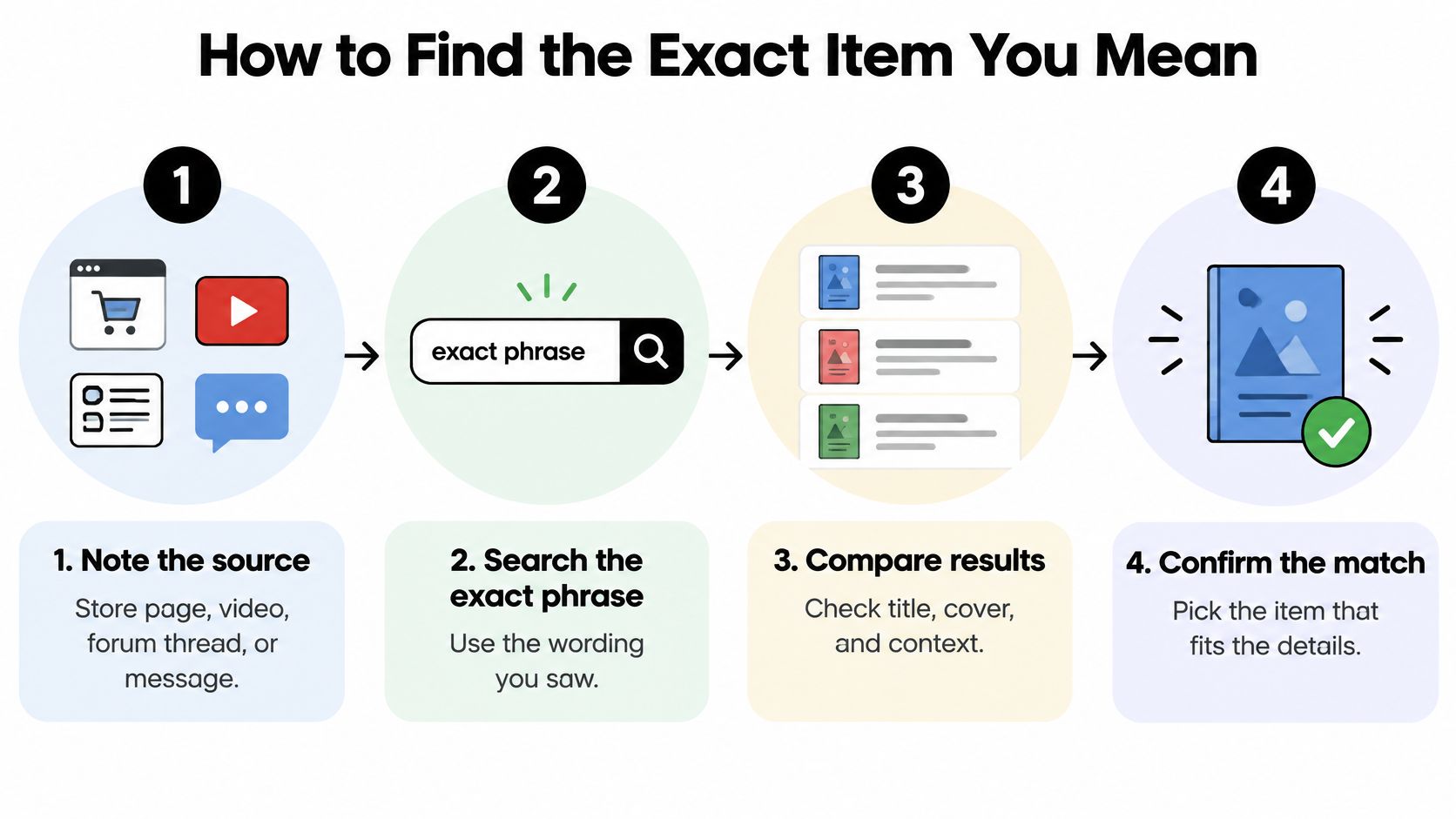
Follow the identifying clues
- Note where you saw it. Save the store page, video title, forum thread or message. A phrase in a gaming discussion calls for a different search than the same wording beneath a birth-chart diagram.
- Search the exact phrase in quotation marks, then add a clue such as game, book or calculator. Preserve the wording you saw rather than substituting a related phrase that may lead to another item.
- Check the creator and release information. On a product page, look for the author, developer or publisher and the listed release year. Titles can be reused, so the title alone isn't enough to establish a match.
- Compare the cover, genre and platform with your saved screenshot or description. A mobile role-playing game and a spiritual workbook can have similar names while having nothing else in common.
- Confirm the listing against an official page. Look for the creator's site or publisher catalogue, then check that the store or library entry names the same work. Don't treat a reposted cover or an unofficial download page as confirmation.
- If you find a calculator rather than a published work, inspect the input form. A birth-date field suggests a date-based method; a full-name field suggests name numerology, though a combined tool may request both.
- Record the match in a reusable note. Save the title, creator, listed year and the page you used to confirm it. This gives you an identifiable item to return to instead of another broad search.
Know when a result isn't a match
A matching phrase in a search snippet is only a lead. Open the page and check whether its description fits the thing you remember, especially if the snippet combines words from unrelated parts of the page.
For example, a page mentioning destiny, code and reading might discuss a calculator without naming any product Code of Destiny. Conversely, a book with that title may explain a system rather than provide an interactive tool.
If you can't identify a creator, cover, platform or catalogue entry, stop forcing a product match. You may be looking for a personal reading method that several sites describe under the same loose name.
How the Birth-Date Code of Destiny Works
What does the birth-date method calculate, and where do its instructions stop? In the documented method in English Code of Destiny, the day of birth is represented using one of 22 possible values. Days from 1 to 22 stay unchanged. For days from 23 to 31, add the digits.

A worked example with a clear stopping point
For someone born on 27 March 1985, apply the day rule:
Day reduction: 2 + 7 = 9
The documented calculation gives a day value of 9. It does not, by itself, show how to calculate other matrix positions. A worksheet for this example can record the supported result without filling in positions whose rules are not specified:
| Position | Calculation for the example |
|---|---|
| Reduced day | 2 + 7 = 9 |
The stopping point matters. Adding the month or year's digits might produce a sum, but without a stated rule, that sum cannot be treated as a result of this method. The same distinction applies to other date-based systems. For a separate approach, see an honest guide to life path numbers.
A repeatable calculation follows a stated rule from input to result. It does not, on its own, show that the result predicts anything about a person or their future. Use the day rule where it applies, and leave other values uncalculated unless their instructions are clear.
Why Two Code of Destiny Results Can Disagree
Give different tools the same personal details and you haven't necessarily given them the same mathematical problem. One may use your birthday, another your name, and another a set of cards.
Consider a hypothetical person named Maya Patel, born on 27 March 1985. Keep those details fixed while comparing what each system consumes.
| System | Input | Rule or mapping | Output |
|---|---|---|---|
| Birth-date numerology | Day, month and year of birth | Retains eligible day values and sums the digits of days above its stated limit | Matrix of values and paired sums |
| Name numerology | Full name letters | Letters mapped to numbers using the school's mapping | Single destiny number |
| Tarot destiny code | Chosen or drawn cards | Card meanings from the deck tradition the reader learned | Card-based interpretation |
| Bazi chart | Birth date, birth hour and birth place | Heavenly stems and earthly branches for four pillars | Four-pillar chart |
Locate the point of divergence
For the birthday example, the matrix's day rule produces 9. To illustrate a different operation, suppose another calculator explicitly instructed users to add the digits of the whole date. Its arithmetic would instead be:
2 + 7 + 0 + 3 + 1 + 9 + 8 + 5 = 35
If that hypothetical calculator then instructed another digit sum:
3 + 5 = 8
These aren't competing answers to the same defined calculation. One is a day-position value; the other is an illustrative whole-date result. The disagreement begins with the rule, before anyone interprets either number.
For Maya's name, a valid comparison requires each tool's letter mapping. Without those tables, assigning contrasting destiny numbers would be guessing. Check how each tool handles repeated letters, spaces, spelling and the version of the name entered before comparing its totals.
Tarot introduces another distinction: the same name and birthday don't specify which cards were drawn. Bazi also requires information that this example hasn't supplied, including birth hour and place, so a complete chart can't be inferred from the date alone.
Comparison check: Match inputs, mappings and output labels before judging whether answers agree.
That's why code of destiny isn't a standardized diagnostic category. A useful calculator should tell you what it calculated, not merely display a confident-sounding personal description.
What a Destiny Reading Can and Cannot Show
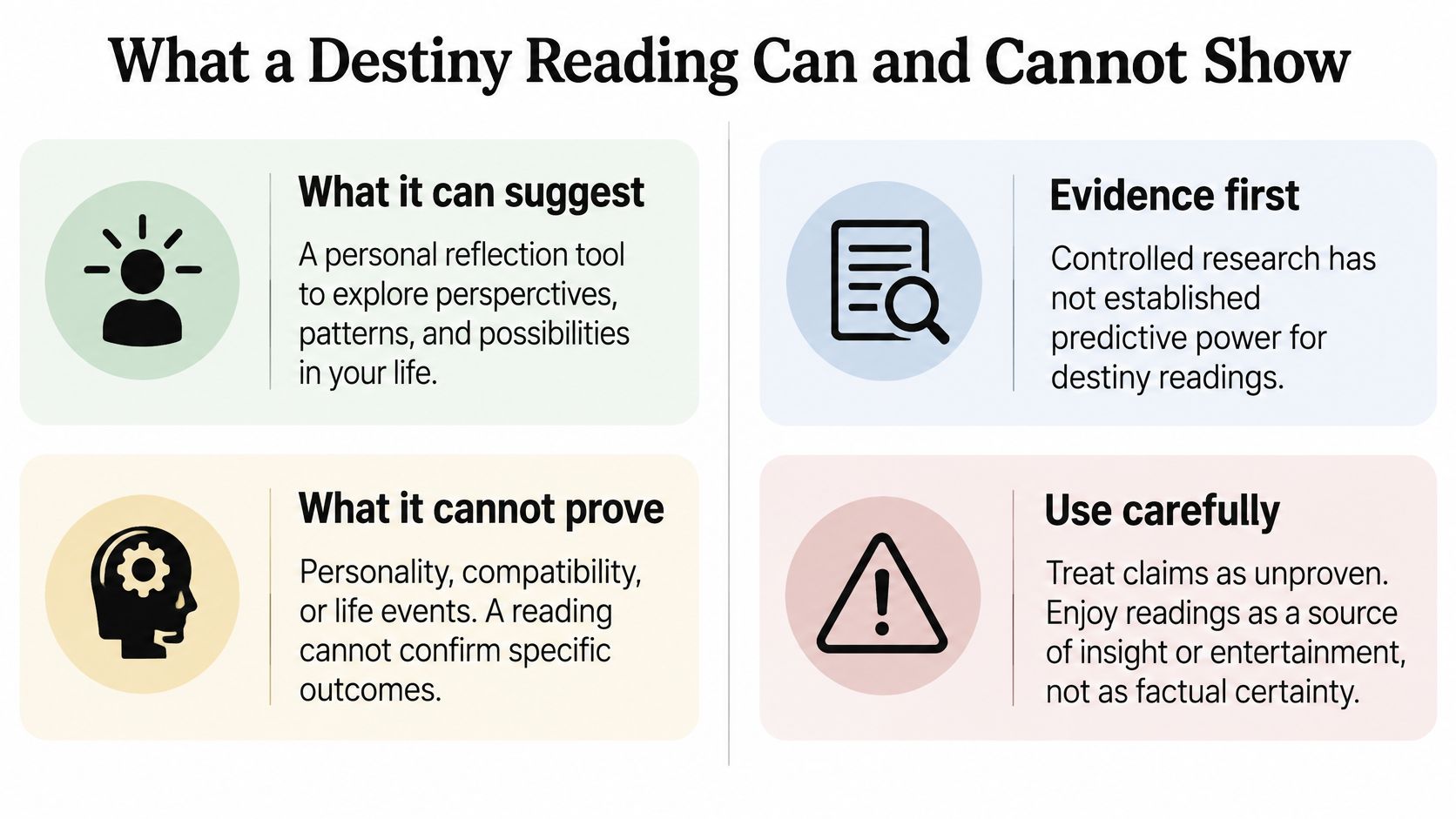
Predictive accuracy hasn't been established. JKit's overview of numerology and scientific evidence reports that controlled research hasn't established that numerological numbers predict personality, compatibility or life events, and that experiments haven't supported claims connecting birth numbers with exceptional achievement or destiny.
That leaves room for personal reflection, but not for treating a reading as a validated assessment. A statement can feel relevant without having been derived from information that distinguishes you from other people.
Test the feeling of accuracy
Try rating this invented statement before deciding how personal it sounds: You sometimes doubt yourself, but you have strengths that other people don't always notice.
It may fit your experience. Yet it contains no birth-date information, names no specific behaviour and could describe people in very different circumstances.
The Forer or Barnum effect describes the tendency to experience broad descriptions as uniquely personal. It offers a plausible explanation for why a reading can feel accurate without demonstrating predictive power.
| What a reading can offer | What it cannot establish |
|---|---|
| A prompt for journaling | A validated personality profile |
| A structured story to examine | A reliable compatibility assessment |
| A conversation about goals | A forecast of achievement |
| Language for discussing worries | Knowledge of future life events |
Turn a description into a useful question
Instead of accepting an instruction such as you're destined to lead, ask what leadership means in your actual circumstances. Do you enjoy organising work, resolving disagreements or accepting responsibility? Specific examples from your life are more informative than agreement with a flattering label.
For another discussion of how to assess such claims, consider the numerology analysis from Life Purpose App. Keep the evaluation focused on what would count as a wrong prediction, not just which phrases resonate.
You don't have to dismiss a meaningful cultural or spiritual practice to maintain that distinction. Subjective usefulness is an experience; empirical accuracy requires evidence that the method reliably gets things right. Enjoying the former doesn't establish the latter.
Choose How Much a Destiny Code Should Count
Treat a destiny code as entertainment or a reflection prompt, not as the basis for medical, financial, relationship, education or employment decisions. Keep important choices grounded in relevant facts, your circumstances and appropriately qualified advice.
The framework described in The Destiny Code Matrix maps birth dates into recurring numerical patterns. People sharing a birth date necessarily share the same date-only inputs, so an individualised narrative isn't the same thing as an individual measurement.
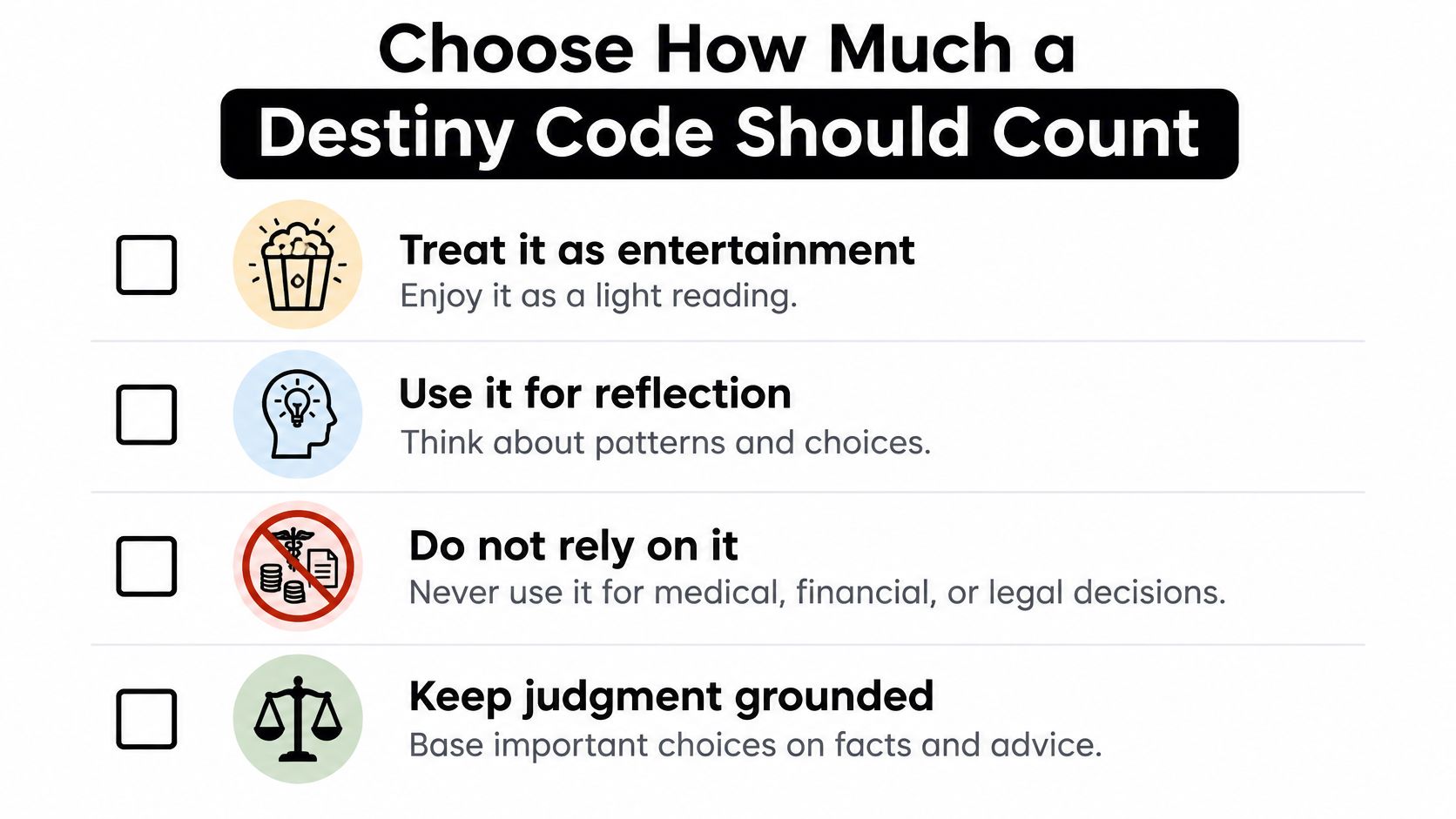
Check before entering personal information
- Read the purpose statement. Look for clear entertainment or reflective-guidance wording rather than promises of certainty.
- Question each requested field. A date-based calculation needs its stated date inputs. Don't supply a full name, location or contact details merely because extra fields appear.
- Inspect the privacy policy. Check whether the service stores your birth date, shares it or explains how to request deletion.
- Watch the payment language. Pause if a reading presents danger, bad luck or a hidden problem as something only a paid upgrade can resolve.
- Test transparency. Compare tools using the same input and ask whether their documented rules explain the results. Agreement alone isn't validation.
- Keep credentials separate. A symbolic reading has no reason to require your account password, verification codes or backup codes.
Share the least personal information needed for the activity you've chosen. If a service won't explain why it needs a field, you can leave without completing the form.
Keep a reading if it helps you ask thoughtful questions. Drop it if it demands belief, pressures you to pay or presents your future as fixed.
AccountShare offers group purchasing for access to premium subscriptions, including streaming, AI tools and software applications. If you're reviewing your digital spending alongside reading apps and other optional services, visit AccountShare to explore shared-access options that fit your needs.